
Anvil’s new SDK turns the crypto you already hold into fully secured credit
Exclusive · October 6, 2026
Anvil’s new SDK turns the crypto you already hold into fully secured credit
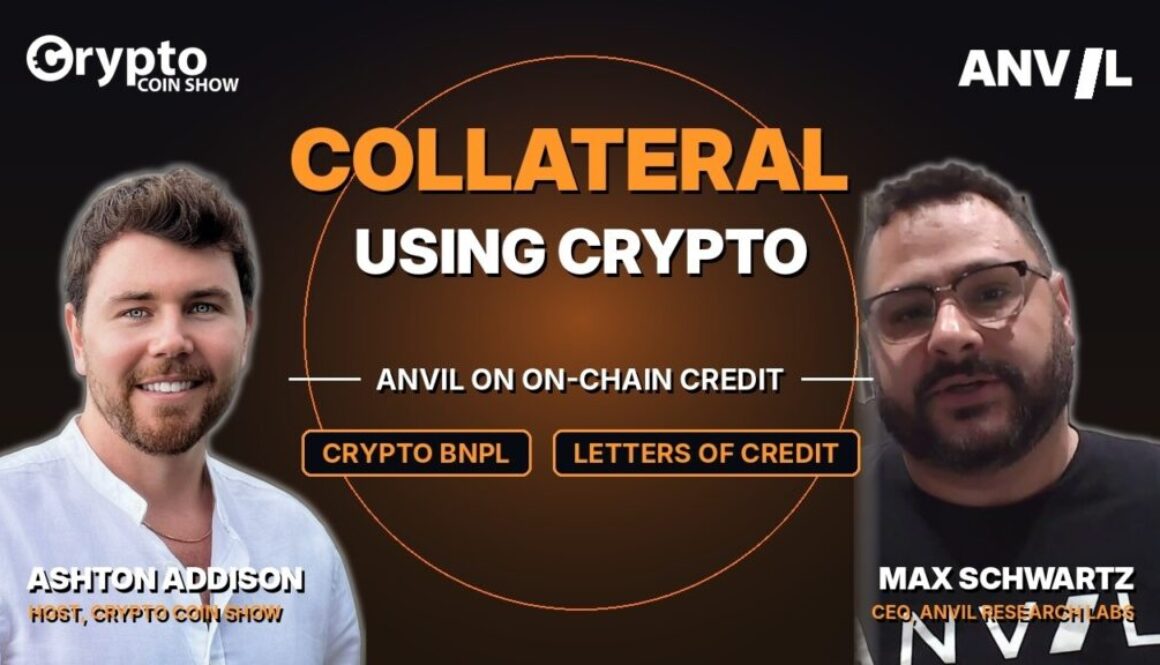
On the day Anvil Research Labs shipped its new SDK and disclosed a $5 million institutional purchase of its governance token, CEO Max Schwartz sat down with Crypto Coin Show to explain why digital assets make better collateral than a house, and how any business can now accept a crypto-backed promise to pay.
Watch: Ashton Addison with Max Schwartz, CEO of Anvil Research Labs · Full episode page
Most credit runs on trust. Banks, buy now pay later apps and suppliers all price in the chance that a customer won’t pay, and everyone else covers the cost through higher rates and fees. Anvil is built to remove that trust step. The Ethereum protocol lets a holder lock up crypto they already own as a guarantee behind a financial promise, without selling it and without handing it to the other side.
Schwartz describes Anvil as a “universal collateral layer.” At the protocol level it does one simple thing: it places an enforceable hold on digital assets so they back a promise to a counterparty. The assets stay associated with the owner’s account, but the owner cannot move them or pledge them twice while the promise is live. The counterparty, whether an individual, a lender or a mortgage company, can claim the pledged value at any point up to expiry and never has to care how the promise was collateralized.
The ThesisWhy crypto beats a house as collateral
Schwartz splits traditional collateral into two buckets, and argues both are flawed. Illiquid collateral like a home or a car is slow, costly and uncertain to repossess: the lender rarely knows the asset’s day to day value or condition, the resale market is not always open, and recovering anything means legal process and staff. Liquid collateral like cash or stock is easy to price but hard to lock down, since nothing stops an account holder from spending or re-pledging it short of an escrow agent and the fees that come with one.
Digital assets, he argues, solve both problems at once. Their price is always known, the market never closes, and a liquidation can settle in a single block. Smart contracts supply the missing piece, a hold that genuinely cannot be broken. The result is credit that is fully secured and instantly liquid, which Schwartz says is the reason default risk, and the premium everyone pays to cover it, can fall to roughly zero.
He has felt the gap personally. Schwartz told CCS that when he and his wife looked at buying a new home, the bank had no idea what to do with his digital asset wealth.
The bank looks at me like I’m a drug dealer.
Max Schwartz, CEO, Anvil Research Labs
The LaunchAn SDK that removes the excuses
Anvil’s flagship product is a digital letter of credit, a peer to peer version of the trade finance staple that settles instantly. The new SDK, developed by Anvil Research Labs as part of its enterprise tooling suite, wraps everything the protocol can do into a package aimed at companies that are curious about crypto but short on developers.
Schwartz said every company he has worked with, in Web2 and Web3, gives the same reasons for not integrating new rails: no developers, no time, a full roadmap. The SDK is built to answer each one. It ships with fallback wallet connectivity for apps that don’t have their own, built-in pricing data, transaction building and signing, plus a React component library that lets a business drop a complete flow into its product: a user connects a wallet, sees what they can pledge and issues a promise to the company. Advanced teams can run it headless and own the experience, and the documentation is written so AI coding agents can read it and implement it too. At the basic level, Schwartz said, setup can be a same day job.
Alongside the SDK, Anvil’s enterprise tooling lets a company receive letters of credit into its own smart contract with role based access control, so staff, bots and multiple keys can work from one pool of promises with fine grained permissions and predefined redemption routes, mirroring how a regulated custody account like Coinbase Institutional handles deposits.
The Use CaseAnyone can be the BNPL bank
Schwartz has been vocal about buy now pay later, a market he called a bubble during his talk at the Blockchain Futurist Conference. With Anvil, a merchant can offer “buy now, pay later with crypto” as a checkout option next to the usual providers. A shopper pledges, say, $5,000 of crypto behind a six month promise; if they pay, their collateral is released, and if they don’t, the merchant claims it. With default risk gone, he argues, a business could undercut competitors’ rates because the margin no longer has to absorb bad debt.
The same building blocks reach well beyond retail. Schwartz pointed to global trade, consumer lending and online gaming, where players currently have to pre-fund every platform they use. His team is now building industry specific “helper contracts” on top of the core protocol. One example he gave: a loan contract that receives repayments directly and blocks the lender from claiming the borrower’s collateral once payments are made, so the borrower never has to trust the lender to release it.
The SignalInstitutions buy the vote, not the company
Anvil also disclosed a $5 million purchase of its ANVL governance token by major institutional investors. Schwartz stressed that this was not equity in Anvil Research Labs or the foundation behind the protocol. Anvil’s governance is fully decentralized, built on the Compound style framework standardized by long time partner OpenZeppelin, and every change, from supported tokens to contract upgrades, goes through an on-chain vote. Buying the token, he said, is buying a say in what he expects to become the rules of the road for on-chain collateral, which made the purchase more meaningful to him than a stake in the company.
The other institutional proof point is Bullish. The exchange operator announced at Consensus 2026 in Miami that it plans to use Anvil across its organization, including internal operations, which would make it the first public company to run DeFi inside its own operations. Schwartz framed the appeal as plain operational efficiency: no more chasing invoices past net 30 or net 90, because a secured promise is already sitting there to claim. He sees the same logic pulling in tokenized real world assets, which need somewhere to be used as collateral once they arrive on-chain.
The CCS ReadThe suits are the point
Asked about the crypto Twitter mood that institutional money is killing the industry’s counterculture, Schwartz pushed back. Having been around since the late 2010s, he said this is the outcome early builders wanted: banks and institutions are the ones who will carry crypto beyond enthusiasts and modernize finance for everyone. Anvil’s bet is that the bridge they cross will be built from collateral people already hold. The SDK lowers the cost of trying that bet to close to an afternoon of integration work. The real test now is how many lenders, merchants and platforms actually ship it.
Anvil EcosystemWhere to go deeper
Builders and businesses can explore the universal collateral layer in Anvil’s documentation or contact the Anvil Research Labs team about an integration.
Anvil is a DeFi protocol on Ethereum that unlocks efficient collateral management and fully secured credit, governed by the ANVL token. Initially designed by the Acronym Foundation, it is now developed and expanded by Anvil Research Labs. Learn more at anvil.xyz.