
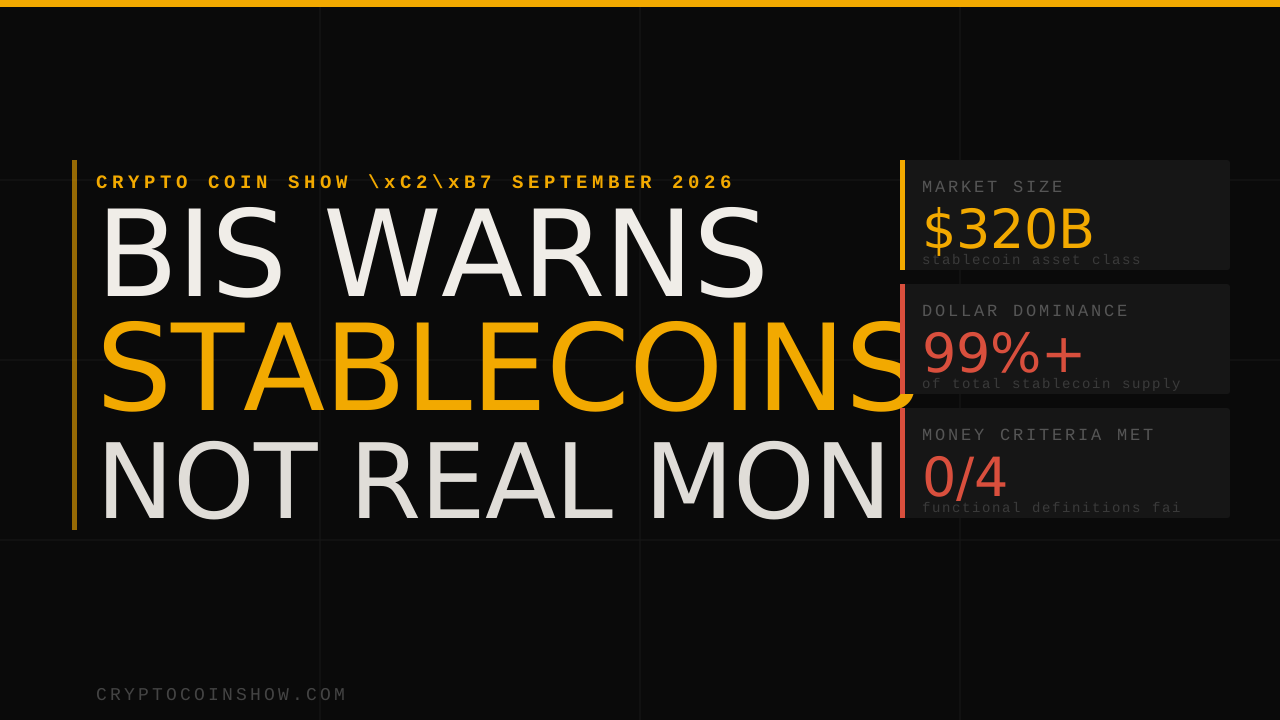
BIS says that dollar-backed stablecoins fall short of money, warns markets about FX risk
The Bank for International Settlements has determined that dollar-backed stablecoins fail to meet the functional definition of money and are accelerating capital flight from emerging markets at speeds traditional banking controls cannot contain. For institutional investors, this signals regulatory pressure ahead and structural fragility in a $320 billion asset class that may face restrictions on cross-border flows.
- Over 99% of the $320 billion stablecoin market is dollar-denominated, concentrated in USDT and USDC, creating structural vulnerability in emerging economies.
- BIS assessment finds stablecoins fail all four criteria for money: singleness, elasticity, interoperability, and integrity, behaving more like ETF shares than cash.
- Model shows stablecoin growth to $1-3 trillion would produce net negative economic effects as deposits migrate from traditional banks to stablecoin issuers.
- 99%+ Dollar concentration in stablecoin market versus 98% in prior May 2025 assessment
- $320B Total stablecoin market size as of end of May 2026, dominated by two issuers
- $1-3T Projected growth range BIS modeled for economic impact analysis and systemic risk
The Bank for International Settlements released its 2026 Annual Economic Report with a formal assessment that challenges the foundational assumption underlying stablecoin adoption: that dollar-pegged tokens function as money.
The Basel-based institution, which serves as the central bank for central banks, evaluated stablecoins against four criteria essential to monetary function and concluded they failed each one.
The finding carries material weight for institutional investors because it signals the BIS, a body with direct influence over banking regulation in 63 member countries, views stablecoins not as currencies but as financial instruments analogous to exchange-traded funds, a classification that invites tighter regulatory oversight and may constrain their utility across borders.
BIS Rates Stablecoins as Non-Money on Four Separate Functional Tests
The BIS assessment applied a structured framework examining singleness, elasticity, interoperability, and integrity. Singleness, the principle that one unit of money always equals one unit of the underlying asset regardless of issuer, fails because stablecoin prices drift from their dollar peg on secondary markets.
While slippage is often small, the occurrence itself violates the strictest definition of what makes a medium of exchange interchangeable across counterparties. Elasticity requires that money supply contract and expand with economic demand, allowing central banks or monetary authorities to manage cyclical pressures.
Stablecoins operate on an inverse model: issuers mint new tokens only after receiving equivalent fiat deposits, preventing the flexible supply adjustment that characterizes true monetary policy.
The interoperability and integrity criteria address network effects and confidence. Stablecoins lack true interoperability because they remain siloed across blockchain platforms and trading venues; a USDC token on Ethereum cannot be directly spent or settled on Solana or elsewhere without a bridging service that introduces counterparty risk.
Integrity, assurance that the issuer will honor redemption claims, depends on public faith in reserve adequacy and auditing standards, neither of which carries the explicit backstop of a central bank or deposit insurance scheme.
The BIS drew an explicit parallel to exchange-traded funds, a comparison that reframes the institutional debate: stablecoins are equity-like instruments backed by a portfolio of assets rather than liabilities of a monetary authority, a distinction with profound implications for how they should be regulated and reserved.
This functional classification matters because it disqualifies stablecoins from the regulatory treatment afforded to money or deposits under Basel III and related frameworks. If stablecoins are equity instruments, not cash equivalents, the capital and liquidity rules that apply to banks holding them change materially.
For institutional investors, this means the risk profile of holding stablecoins as a settlement layer is fundamentally different from holding bank deposits, there is no implicit central bank backstop, no deposit insurance, and no lender-of-last-resort facility when confidence wanes.
Dollar Dominance in Stablecoins Accelerates Capital Flight Pattern BIS Links to Historical Banking Crises
The concentration of stablecoin value in US dollar-denominated tokens, 99% of the market, or roughly $318 billion of a $320 billion total, is not incidental but structural. A separate BIS research paper from May 5, 2026, estimated dollar dominance at approximately 98%, indicating the market has become even more concentrated in the intervening weeks.
Tether’s USDT and Circle’s USDC account for the vast majority of that figure, creating a two-issuer oligopoly that the BIS explicitly identifies as a problem for financial stability in emerging and developing economies.
The BIS uses the term “stablecoin dollarization” to describe this pattern and warns it mimics a historical precedent with dangerous implications. In traditional banking crises, emerging market residents move savings into foreign bank deposits, a process called deposit dollarization, as a flight to perceived safety.
Cryptocurrency accelerates this dynamic because stablecoins operate outside traditional banking infrastructure, require no account with a regulated bank, and can be held in self-custody across borders without declaration or friction.
Countries including Turkey, Argentina, and Nigeria have experienced rapid stablecoin adoption precisely because residents use them to circumvent currency controls and store value outside domestic banking systems. The BIS notes this happens faster and at greater scale than historical deposit dollarization because the barriers to entry and movement are lower.
Several emerging economies have already imposed restrictions on cross-border stablecoin use. However, the BIS expresses explicit skepticism about the effectiveness of these controls. Capital controls that function against traditional bank deposits rely on intermediary banks enforcing compliance; they have institutional chokepoints.
Stablecoins held in self-custody on public blockchains have no such enforcement point. A resident in any jurisdiction can receive stablecoins peer-to-peer, hold them in a private wallet, and move them without detection.
This architectural reality constrains the policy tools available to central banks in emerging markets and suggests that stablecoin adoption may accelerate regardless of regulatory intent.
BIS Model Projects Negative Economic Output Effect as Stablecoin Deposits Disintermediate Traditional Banking
The BIS conducted a modeling exercise projecting the macroeconomic impact of stablecoin market growth to between $1 trillion and $3 trillion, a tenfold to tenfold-plus increase from current levels. The model examined the flow of deposits migrating from traditional banks to stablecoin issuers and the consequences for credit availability and economic output.
The central conclusion was stark: even under this large growth scenario, the net effect on economic output would still be “modestly negative.” This finding has profound implications for how institutional investors should think about stablecoin adoption trajectories, particularly in regulated jurisdictions.
The mechanism is straightforward but consequential. As deposits move from traditional banks to stablecoin issuers, banks lose funding for lending operations. Stablecoin issuers park their reserves in US Treasuries and money market instruments, which reduces credit availability in the real economy.
Banks that lose deposits shrink their loan books or raise funding costs, both of which reduce investment and consumption.
The BIS model does not assume stablecoin growth stops credit creation entirely, stablecoin reserves invested in money market instruments do generate returns, but the net effect of disintermediation produces lower economic output than a baseline scenario where deposits remain in traditional banking channels.
This finding directly contradicts the pitch that stablecoins offer an efficiency gain to financial systems. If the BIS model is accurate, the institutional case for stablecoin adoption as a systemic good weakens materially.
Regulators in developed economies may use this research to justify restrictions on stablecoin issuance or reserve management practices, potentially limiting the utility of stablecoins as settlement layers in institutional finance.
Emerging Markets Face Regulatory Squeeze Between Capital Controls and Crypto Architecture
The policy dilemma the BIS identifies is acute for central banks in emerging markets. They face simultaneous pressure to prevent capital flight through stablecoins while possessing no practical enforcement mechanism. Traditional capital controls rely on bank intermediation; central banks can instruct domestic banks to refuse transfers above certain thresholds or to foreign entities. Stablecoins bypass this mechanism entirely. A Turkish citizen or Nigerian business operator