Inside transfer wipes out $1M executive debt as crypto firm offloads payments business without independent valuation
RocketFuel Blockchain has transferred its entire payments business to RPay in a related-party deal that eliminated $1 million in executive compensation obligations without obtaining an independent valuation or stockholder vote. The transaction, which closed in mid-August and was disclosed through regulatory filings, highlights structural governance gaps in how certain crypto firms handle asset dispositions involving conflicts of interest.
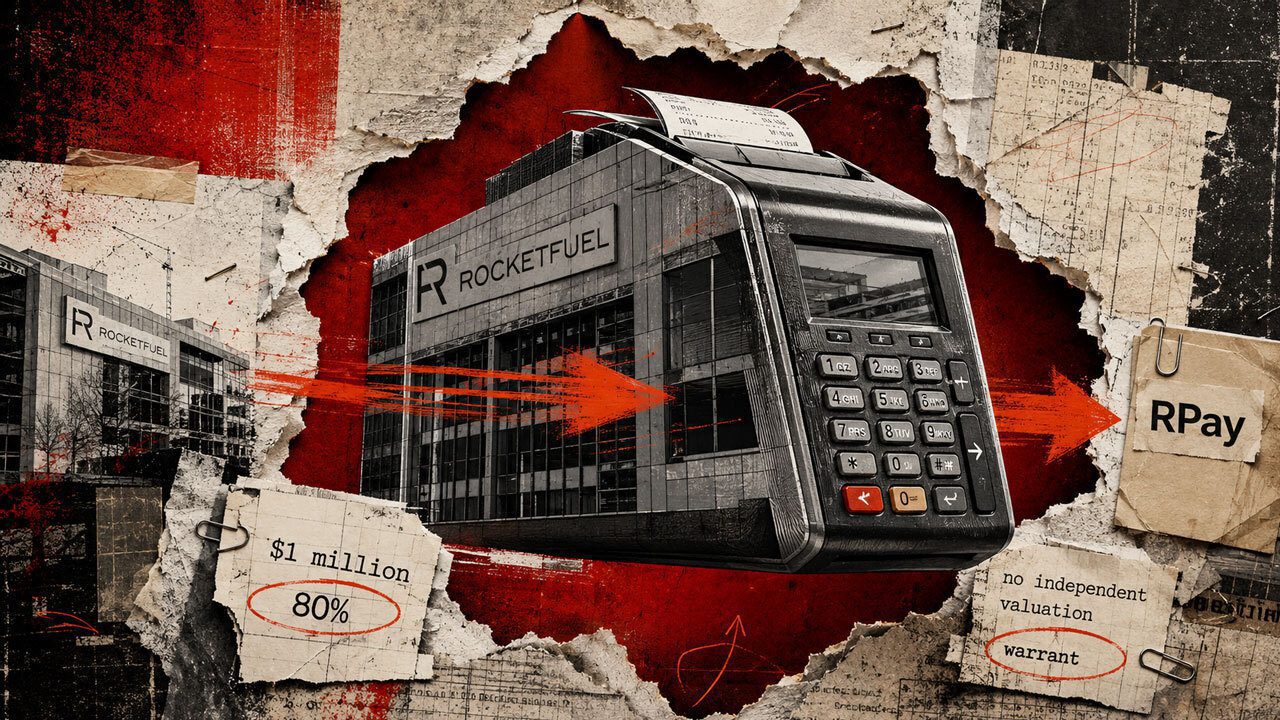
- RPay assumed $800,000 in deferred compensation owed to CEO Peter Jensen and $200,000 owed to former director Bennett Yankowitz, releasing RocketFuel from both obligations.
- RocketFuel’s board approved the sale using only a fairness memorandum, declining to obtain an independent valuation or seek stockholder ratification despite disclosed conflicts of interest.
- RocketFuel received a warrant to purchase 160,000 RPay shares subject to a $1 million repurchase right, meaning no cash or equity value was crystallized at closing.
- $1M Total executive debt eliminated through asset transfer and warrant capped value.
- Aug. 13 Transaction closing date, disclosed eight days later on Aug. 21 regulatory filing.
- 160,000 Warrant shares RocketFuel received, subject to $1M buyback right held by RPay.
RocketFuel Blockchain transferred substantially all assets of its payments business to RPay on August 13, with formal disclosure arriving in a regulatory filing eight days later.
The deal centered on debt assumption rather than cash consideration: RPay agreed to absorb $800,000 in deferred compensation owed to Peter M. Jensen, who serves as both RPay’s sole director and CEO and as a RocketFuel director and executive officer, plus an additional $200,000 obligation to Bennett J. Yankowitz, a former RocketFuel executive who remains on the company’s advisory board.
In exchange, RocketFuel transferred intellectual property, contracts, merchant relationships, cash, and accounts receivable tied to the payments line of business. The transaction structure raises material questions about asset valuation and governance oversight in a sector where executive conflicts and informal deal-making remain common practice.
RocketFuel board bypasses independent valuation despite acknowledged conflicts of interest
RocketFuel’s board explicitly acknowledged that Jensen’s interests differed from those of the company’s stockholders, citing both the assumption of his compensation claim and the warrant structure as sources of conflict.
Despite this disclosure, the company said its board determined that a stockholder vote was not required under Nevada Revised Statute 78.565 and instead approved the transaction using only a fairness memorandum.
This approach allowed the board to proceed without obtaining an independent valuation of the assets being transferred or seeking ratification from shareholders who bore the residual risk of the deal’s terms.
The warrant arrangement added opacity to the transaction’s true economic value. RocketFuel received the right to purchase 160,000 RPay common shares, but that warrant is subject to a $1 million repurchase right exercisable by RPay at any time.
This structure meant RocketFuel did not receive either the underlying shares or any cash payment at closing, leaving the fair value of consideration received entirely dependent on RPay’s future performance and the board’s ability to negotiate a favorable exercise price if the repurchase right is ever triggered.
Yankowitz’s obligation added a second layer of complexity. The $200,000 owed to him is payable at only $0.25 for each $1 paid to Jensen, at the sole discretion of RPay’s board.
This subordination creates an incentive structure that favors Jensen over Yankowitz and concentrates decision-making authority in RPay’s hands rather than establishing an automatic payment schedule tied to objective milestones.
Transaction deviates sharply from preliminary March framework covering dual buyers and earn-outs
The final RPay deal differs materially from a non-binding term sheet circulated in March, which contemplated a two-buyer package: RPay would acquire the payments business while a separate entity called RPoints would acquire RocketFuel’s loyalty and rewards business.
That preliminary structure included approximately $1.5 million in total deferred-compensation assumptions, a payments-revenue earn-out mechanism, and warrants representing 20% fully diluted stakes in both companies. The March framework thus contained performance-based revenue triggers and higher equity participation than the final RPay-only transaction.
The RPoints side of the dual-buyer proposal appears to have stalled or been restructured separately. A separate RPoints filing was not visible in RocketFuel’s SEC submissions dated August 22, making it impossible to compare the preliminary two-buyer package directly with the RPay-only asset transfer as if they covered equivalent business scopes.
This gap in disclosure complicates any assessment of whether RocketFuel negotiated away earn-out protections or equity upside in the final transaction, or whether the RPoints sale proceeded on different terms entirely.
Missing pro forma financials leave full economic impact unresolved in SEC filing
RocketFuel classified the RPay sale as a significant disposition under SEC asset and income tests, a determination that ordinarily requires inclusion of unaudited pro forma financial statements showing the company’s post-transaction financial position. However, the August 21 regulatory filing did not include those required pro forma financials.
RocketFuel stated it would provide them in a later Form 8-K/A amendment, deferring full disclosure of the transaction’s impact on the company’s consolidated balance sheet, revenue line, and liquidity position.
This timing gap creates a window in which the market and investors lack the quantitative context needed to assess whether the payments business represented a material portion of RocketFuel’s revenue, assets, or profitability.
The absence of pro forma data also prevents independent verification of whether the warrant valuation and debt relief adequately compensated RocketFuel for the transferred business or whether the fairness memorandum relied on outdated financial information.
The delayed amendment filing is commonplace in practice, but the combination of related-party dealing, conflict of interest, lack of independent valuation, and deferred financial disclosure creates a sequence that institutional investors increasingly scrutinize in the cryptocurrency and blockchain sectors, where governance standards remain uneven and disclosure practices vary widely across reporting entities.
RocketFuel’s promised Form 8-K/A amendment will supply the unaudited pro forma financials required by regulation, finally quantifying what percentage of the company’s pre-transaction business and assets were transferred to RPay. Investors should monitor that filing for disclosure of the payments business’s historical revenue contribution and any material changes to RocketFuel’s going-concern analysis. The amendment will also establish a formal record of the transaction’s valuation inputs that RocketFuel’s board relied upon, a critical data point given the board’s express reliance on a fairness memorandum rather than an independent valuation process.
Original reporting: cryptoslate.com