Firelight insurance protocol launches coverage for Sentora’s $2.8 billion vault portfolio
Firelight, a DeFi insurance protocol, has gone live with coverage on Sentora’s institutional vaults, introducing independent claims validation and segregated capital to a market where protection has lagged behind vault growth. For institutional crypto investors, this addresses a gap in institutional-grade risk management that has constrained deposit flows into onchain yield products despite assets under management in curated vaults growing 39% year-over-year.
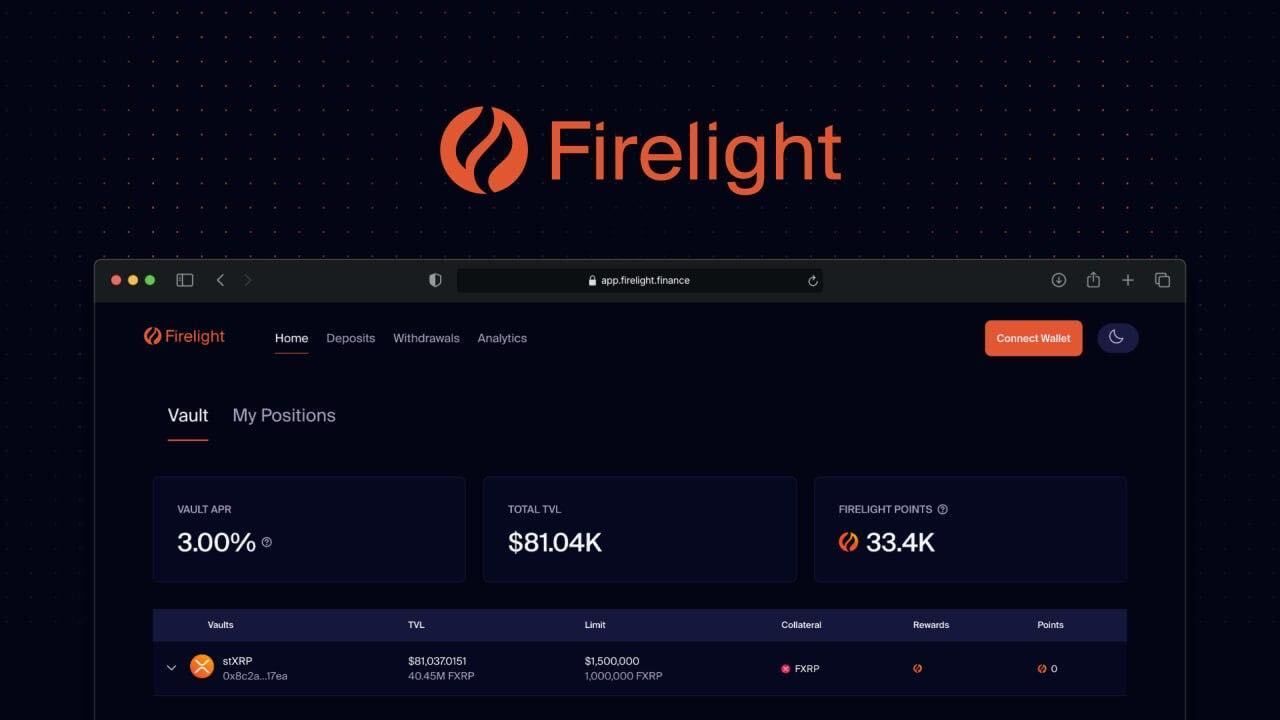
- Firelight launched live coverage on Sentora’s USD Protected Vault and Protected RWA Vaults with five independent validators reviewing every claim.
- Sentora manages $2.8 billion across more than 300 strategies, making it DeFi’s largest vault curator by aggregate TVL.
- Onchain cover capital represents just 0.14% of the $88.3 billion locked in DeFi, despite oracle attacks nearly tripling this year.
- $2.8B Sentora vault TVL across 300+ strategies, largest DeFi curator
- 0.14% Onchain cover capital as share of total DeFi-locked assets
- 39% Year-over-year growth in curated vault assets over past year
Firelight, built on the Flare Network and incubated by Sentora, registers coverage terms onchain and separates the party validating claims from the party paying them, a structural change that addresses a critical gap in DeFi infrastructure. According to Firelight’s protocol documentation, the system holds capital backing cover outside the protocols that are covered, preventing a scenario where the collateral securing protection falls in the same event that triggers a claim. The protocol went live after raising $8 million led by Gumi Cryptos Capital with participation from Tribe Capital and Maven 11.
Independent consortium validates claims against published criteria, eliminating internal adjudication
Five independent firms, Hypernative, Native, Credora, GFX Labs and Cyfrin, form the Firelight Risk Consortium, which reviews every cover event against pre-specified criteria. When an incident occurs, ZeroShadow, Firelight’s designated security partner, publishes an exploit report; the consortium then validates the occurrence and confirms loss before payouts follow.
This structure removes the conflict of interest that has plagued earlier vault-level cover designs, where the entity deciding a claim was the same entity that had to pay it.
Coverage includes defined technical and economic failure modes: smart contract exploits, oracle failures, governance exploits, bad debt and depegs from mechanism failure, and redemption failures. The terms, scope, price, capacity, are registered onchain in advance, making what is protected visible before an incident rather than disputed after.
Capital backing cover sits in segregated, non-custodial vaults funded by protocol stakers
Firelight operates as a two-sided market: vault operators and protocols purchase protection; stakers allocate capital to non-custodial vaults backing a diversified portfolio of cover markets and earn a proportionate share of protocol emissions and operator fees. The protocol is audited by OpenZeppelin and runs a public bug bounty through Immunefi.
Capital comes from participants staking to the protocol; XRP, brought onchain via Flare Network’s FAssets infrastructure, serves as collateral backing cover.
This model differs fundamentally from traditional insurance or earlier DeFi cover schemes, where capital and claims authority resided with a single entity. By distributing capital across independent stakers and validation across a named consortium, Firelight creates a market-like pricing mechanism tied directly to measured risk rather than opaque underwriting.
Sentora’s $2.8B vault suite becomes first-to-market deployment, with infrastructure providers Veda and Upshift integrating at protocol layer
Firelight’s live deployment covers Sentora’s USD Protected Vault and Protected RWA Vaults. Sentora, formed in 2025 from the merger of IntoTheBlock and Trident Digital, curates vaults for leading protocols and institutions, applying more than 1,000 risk models across 300 monitored strategies. The integration signals institutional adoption: vault infrastructure providers Veda and Upshift integrate Firelight at their infrastructure layer, allowing operators building on them to elect protection enablement for their own vaults, with depositors inheriting coverage automatically.
Lucas Outumuro, VP of Institutional DeFi at Sentora, framed the shift: “Yield alone is no longer enough. Users deserve an extra layer of protection.”
This deployment matters because curated vault assets have grown 39% over the past year, and major institutions are moving significant capital onchain. Apollo, which manages close to $940 billion, agreed to acquire up to 9% of Morpho’s governance token supply; Morpho alone has seen more than $10 billion in deposits over two years, around $1 billion through exchanges and fintechs. Yet the infrastructure for pricing and managing counterparty risk in these vaults has lagged deployment. Oracle attacks on lending protocols have nearly tripled this year, underscoring the gap between asset growth and protection availability.
One open question: whether fees charged by Firelight to vault operators will compress yields enough to offset the protection premium for retail depositors, or whether the added credibility unlocks a new tier of institutional capital that justifies the cost.
The CCS read. We see Firelight as addressing a structural credibility problem rather than a novel pricing mechanism. Independent validation and segregated capital are table stakes for institutional risk appetite; the real test is whether stakers earn sustainable yield relative to the risks they’re taking across a diversified portfolio of vaults. The protocol’s $8 million raise and infrastructure integrations suggest conviction, but the protocol’s fee structure and staker economics remain opaque to external observers.
Watch for Firelight’s first material claim payout and how the Risk Consortium adjudicates it. That validation will set precedent for how independent claims review actually works under stress. Also track whether rival vault operators beyond Sentora and its infrastructure partners adopt Firelight coverage within the next two quarters; broad adoption across competing curators would signal the market has accepted this model as standard, while isolated adoption would suggest Sentora captured a niche advantage.
Original reporting: beincrypto.com