How risk software opens the door to Kalshi’s new crypto perps
The CFTC has approved the first regulated Bitcoin perpetual futures contract available to US institutional investors, with Kalshi launching BTCPERP on June 3 and integrating risk management software to clear a major adoption barrier. This development could unlock billions in institutional capital currently locked out of a $90 trillion global derivatives market, provided compliance and risk infrastructure can bridge the gap between retail crypto trading and institutional asset management standards.
- Kalshi launched BTCPERP on June 3, becoming first US platform to offer CFTC-approved Bitcoin perpetual futures to American customers.
- Offshore perpetual futures markets recorded over $90 trillion in trading volume last year, vastly exceeding regulated US crypto derivatives capacity.
- Haruko’s risk management integration allows institutions to track perpetual positions alongside traditional assets and spot crypto holdings on a single dashboard.
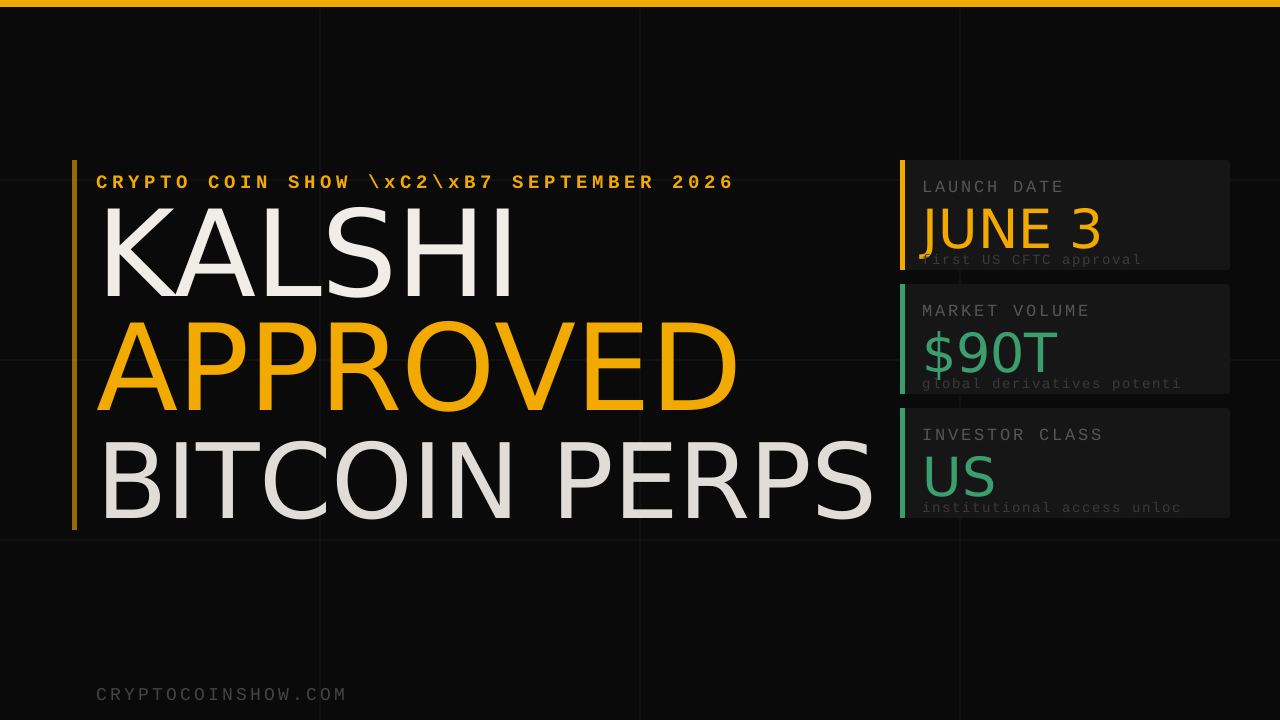
- $90 trillion Annual volume in offshore Bitcoin perpetual futures markets, showing scale of unregulated derivatives demand
- June 3 Launch date for Kalshi’s BTCPERP, first regulated US Bitcoin perpetual futures product
- 1 Number of US platforms currently offering CFTC-approved perpetual futures to retail and institutional traders
The Commodity Futures Trading Commission has cleared the way for regulated Bitcoin perpetual futures in the United States, a category of derivative that has long dominated offshore crypto trading. Kalshi, a platform best known for event contracts, launched BTCPERP on June 3 and became the first company to offer these products to American customers under CFTC approval.
Perpetual futures are cash-settled contracts tied to Bitcoin’s spot price that never expire, instead using a funding-rate mechanism to keep contract prices anchored to the underlying market.
The gap between offshore and onshore capacity is dramatic: unregulated platforms processed more than $90 trillion in perpetual futures volume last year, while regulated US alternatives have remained limited to options, standard futures with fixed expiration dates, and spot trading.
Kalshi Launches First CFTC-Approved Bitcoin Perpetual Futures in US Market
Kalshi’s entry into perpetual futures marks a strategic pivot for a platform that built its reputation on political and event betting. The company moved from prediction markets into a derivatives category that institutional traders have long accessed through offshore venues like Binance and Bybit, where perpetual contracts have become the dominant trading instrument.
BTCPERP uses the same cash-settlement and funding-rate model familiar to global traders, but now within a US regulatory framework designed to protect customer assets and enforce position limits.
The timing of the CFTC approval reflects broader regulatory evolution. US authorities have gradually expanded the scope of cryptocurrency derivatives available to institutional investors, moving from spot futures with fixed expiration dates toward more flexible products that better serve active traders.
Perpetual futures fill a structural gap: they allow traders to maintain leveraged exposure to Bitcoin without rolling positions every month or quarter, and they settle in USD rather than requiring physical Bitcoin delivery or custody arrangements.
For Kalshi, the launch signals confidence that the regulatory environment is maturing enough to support complex crypto derivatives infrastructure at scale.
Haruko’s Risk Integration Solves Institutional Adoption Barrier Beyond Regulatory Approval
Regulatory approval alone does not drive institutional adoption. Major asset managers, hedge funds, and family offices operate under strict compliance frameworks that require real-time visibility into portfolio risk across all positions.
A trader at Galaxy Digital or another crypto-focused institution may hold traditional equities, bonds, and commodities; spot Bitcoin and Ethereum; and positions in decentralized finance protocols simultaneously.
Adding a new derivatives product requires that all these positions be tracked, marked-to-market, and risk-adjusted through a single system, or else portfolio managers lose the ability to understand their true net exposure.
This is where Haruko enters the equation. The digital markets risk and portfolio management platform already serves institutional investors across traditional and alternative asset classes.
By integrating directly with Kalshi’s perpetual futures infrastructure, Haruko allows customers to monitor BTCPERP positions on the same dashboard where they track equity holdings, bond exposure, spot cryptocurrency, and DeFi investments.
The integration eliminates the need for separate risk systems, manual position reconciliation, or ad-hoc spreadsheet workflows that introduce operational risk and compliance friction.
The CFTC’s approval marks a big moment for institutions trading crypto derivatives in the US. Perpetual futures have been hugely popular in crypto markets around the world for a long time, but until now, there was no way for US based institutions to access them through a regulated channel.
Shamyl Malik, CEO of Haruko
The technical integration addresses a critical pain point that has slowed institutional crypto adoption despite years of regulatory progress. A large asset manager can now launch a perpetual trading desk without building custom middleware, hiring specialized engineers, or creating isolated silos within its risk management infrastructure.
Compliance teams can apply the same audit trails, position-limit rules, and counterparty monitoring to perpetual futures as they do to traditional derivatives, because the risk data flows through familiar systems using standardized protocols.
Offshore Perpetual Volumes Signal Massive Unmet Demand in Regulated US Market
The $90 trillion in annual volume processed by offshore perpetual futures platforms reveals the scale of the opportunity Kalshi is targeting. That figure dwarfs the entire volume of US-regulated Bitcoin and Ethereum futures, which are typically measured in single- or low-double-digit trillions annually.
Most of that offshore volume comes from retail and institutional traders outside the US who have no access to regulated alternatives, or from US-based institutions that accept the counterparty and regulatory risks of offshore exchanges to gain access to perpetual products.
Kalshi’s CFTC approval and Haruko’s integration create the first compliant pathway for US institutions to trade this market structure domestically. The question now is whether the combination of regulatory status and risk management infrastructure will be sufficient to pull meaningful volume away from established offshore venues.
Bybit, Binance, Deribit, and other global platforms have spent years building network effects, liquidity pools, and trader communities that cannot be replicated overnight. However, institutions managing billions in AUM have increasingly strict requirements around regulatory status and counterparty risk, and those requirements favor onshore products backed by US regulators.
If Kalshi can achieve sufficient liquidity in BTCPERP, the platform could become a default venue for US-based institutional perpetual trading within 12 to 18 months.
Infrastructure Readiness and Liquidity Will Determine Whether Adoption Takes Hold
The Haruko integration solves the risk management piece, but several other factors will determine whether this product launch translates into meaningful institutional trading volume. Liquidity is paramount: institutional traders require tight bid-ask spreads, deep order books, and the ability to enter and exit large positions without moving the market.
A brand-new perpetual futures venue typically suffers from thin liquidity until it reaches critical mass, creating a chicken-and-egg problem where traders avoid the platform because it lacks liquidity, which prevents liquidity from building.
Kalshi will likely address this through market-making incentives, rebates, or partnerships with liquidity providers who can help bootstrap trading activity. The company also benefits from starting with BTCPERP rather than a broader set of altcoin contracts, since Bitcoin perpetual futures attract the most volume and the deepest institutional interest.
If Kalshi can establish BTCPERP as a reliable, liquid venue within the first six months of operation, it creates a foundation for adding Ethereum perpetuals and potentially other major cryptocurrencies.
The next milestone to watch is whether Kalshi discloses trading volumes and open interest metrics within the next quarter, which will indicate whether the Haruko integration and regulatory status are actually attracting institutional capital or whether offshore platforms continue to dominate. Additionally, traders should monitor whether other US-regulated platforms apply for CFTC approval to launch competing perpetual products, as competitive entry would signal genuine institutional demand rather than a one-time regulatory curiosity.