
Circle acquires Tazapay for $400M to connect stablecoin settlements to real-world payouts
Circle’s $400 million acquisition of Tazapay targets the infrastructure gap that has limited stablecoin adoption: while USDC can settle in seconds onchain, recipients still need access to local banking rails, currency conversion, and fiat delivery to turn digital money into usable local currency. For institutional investors, the deal signals that blockchain settlement alone is insufficient, the scarce asset is now regulated payout capacity across global markets.
- Circle agreed to acquire Singapore-based cross-border payments operator Tazapay for $400 million in stock to gain access to payout rails spanning more than 100 markets and 60+ banking and fintech partners.
- Tazapay processed more than $25 billion in annualized payment volume as of July 31, 2026, with approximately 60% involving stablecoins, according to Circle’s announcement.
- The deal is expected to close in 2027 subject to regulatory approvals, including sign-off from Singapore’s Monetary Authority, and final consideration will vary based on Circle’s stock price at closing.
- $400M Circle’s stock consideration for Tazapay acquisition, adjusted for debt and expenses.
- 100+ markets Number of jurisdictions covered by Tazapay’s payout rails and local connectivity.
- 60% Proportion of Tazapay transaction volume involving stablecoins as of the acquisition announcement.
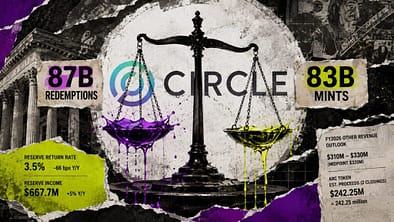
Circle, the issuer of USDC stablecoin, announced on September 8 that it would acquire Tazapay to solve a structural problem: a stablecoin transfer that crosses a blockchain in seconds still fails as a payment if the recipient cannot receive usable money in their local currency and banking system. The Form 8-K filing details $400 million in Circle Class A stock as consideration, adjusted for Tazapay’s debt, transaction expenses and cash on hand. The final share count will depend on Circle’s volume-weighted average closing price over the 20 trading days before completion. Tazapay connects to more than 60 banking and fintech partners and operates payout infrastructure across more than 100 markets, the regulated endpoints that convert stablecoins into local fiat and deliver funds to recipient accounts.
Tazapay’s $25 Billion Annualized Volume and Stablecoin-Heavy Mix
Tazapay processed more than $25 billion in annualized payment volume as of July 31, 2026, roughly $7 billion more annually than in the prior period, according to Circle’s acquisition announcement. Approximately 60% of that volume involved stablecoins, though Circle’s disclosure does not specify whether that figure refers to USDC alone or stablecoins collectively.
The company-supplied figures also do not define how annualized volume was calculated, whether the number is gross or net of reversals, or whether a payment can be counted at multiple processing stages.
Tazapay has operated as a design partner for Circle’s Payments Network since 2025, giving the two companies existing operational visibility. The payout operator’s customer base and routes have functioned outside Circle’s direct control until now, but the combination creates a clearer path to coordinate USDC settlement with regulated payout execution.
Institutional users of both systems currently depend on third-party partnerships to complete the full workflow from stablecoin settlement to local currency delivery.
How Circle’s Network Preserves Participant Independence But May Face Governance Tensions
Circle’s Payments Network (CPN) currently draws a formal boundary between network coordination and regulated work done by independent institutions. Under the self-managed fiat-payout model, an originating institution converts fiat into stablecoins while a beneficiary institution converts them back into local currency and pays the recipient. CPN coordinates quotes, routing and settlement between them. Critically, Circle’s governance design specifies that the operator does not hold customer funds, manage accounts, or become a party to transactions between participants, those institutions retain their own responsibilities and transact at their own risk.
Acquiring Tazapay does not automatically collapse this boundary. Circle would own Tazapay’s operating company, technology and customer relationships, but Tazapay’s partner banks and fintechs would remain independent. CPN’s current documentation also describes a parallel managed mode in which Circle handles licensing, custody, compliance and settlement for customers that want stablecoin payments without holding digital assets themselves. Tazapay could support either model, expanding partner choices for self-managed payments or providing infrastructure for a more integrated managed service.
The unsettled question is whether Circle will afford preferential treatment to its own subsidiary, steering volume toward Tazapay’s routes over independent competitors that also help set CPN rules.
Regulatory Approvals and Unresolved Financial Terms Through 2027
Circle expects the acquisition to close in 2027 subject to customary conditions and regulatory approvals, most notably sign-off from Singapore’s Monetary Authority. The company has not disclosed Tazapay’s revenue, expected contribution to Circle’s results, quantified synergies, integration costs or operating margin profile.
It also has not stated whether Tazapay’s routes will remain available on the same terms to companies that compete with Circle or USDC.
The deal reflects Circle’s strategic choice to treat regulated conversion and local delivery as scarce infrastructure rather than an interchangeable service attached to blockchain settlement. Software can reproduce settlement speed. Regulated permissions, bank connectivity, payout performance and institutional customer relationships must be built market by market.
Tazapay’s multi-jurisdictional licensing structure, with separate Canadian and Singapore entities serving different payment functions, exemplifies why the last mile is not a single global authorization but a collection of local capabilities.
The acquisition will be tested against a measurable outcome: if broader payout coverage and tighter integration improve execution while preserving participant choice, Tazapay could strengthen CPN as an open network; if Circle-owned routes receive preferential treatment over independent beneficiary institutions, the network could become more vertically integrated and less neutral. Circle and regulators have not yet disclosed an integration plan, and final share consideration remains subject to changes in Circle’s stock price and closing adjustments through the 2027 completion date.