CME Group set to launch Nasdaq CME crypto index futures in June
CME Group and Nasdaq will launch the first market-cap weighted cryptocurrency index futures contract on June 8, offering institutional investors a single tool to manage broad crypto exposure without assembling multiple individual token positions. The move signals deepening institutional adoption of digital assets, with CME reporting a 43% surge in crypto futures volume year-over-year.
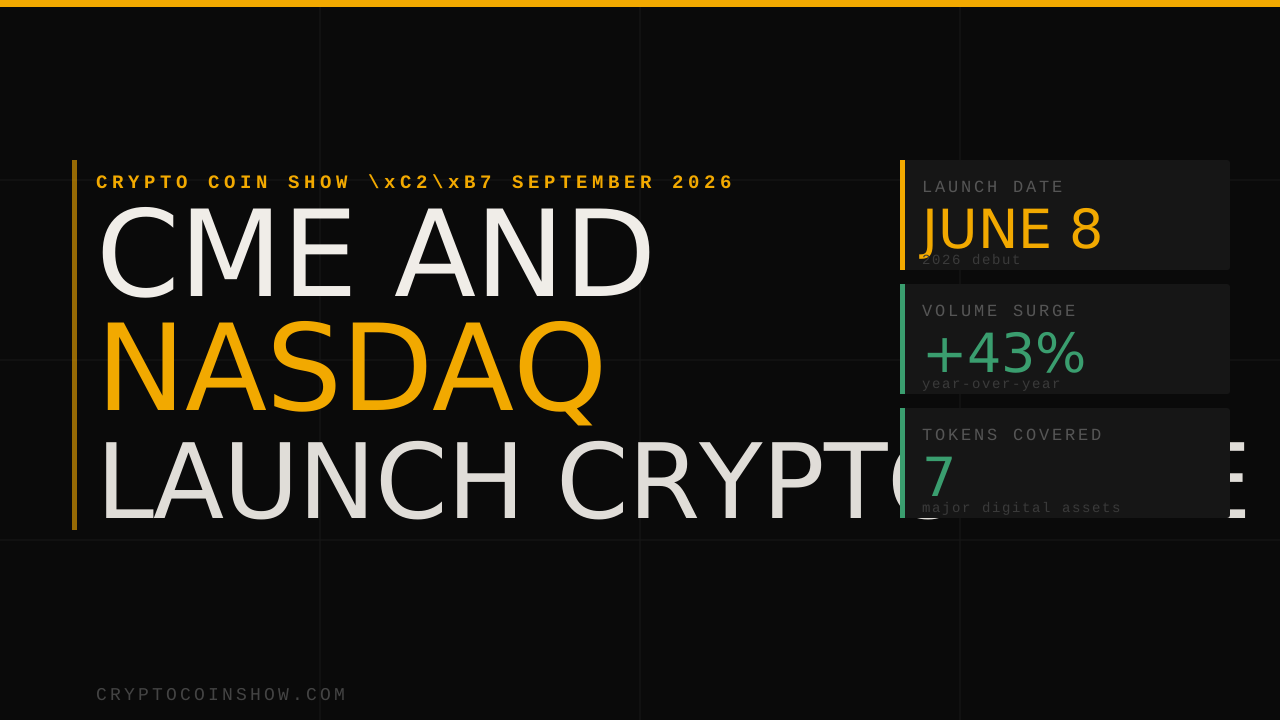
- CME and Nasdaq launch market-cap weighted crypto index futures on June 8, 2026
- CME crypto futures daily volume jumped 43% year-over-year, reflecting institutional demand
- Index covers Bitcoin, Ethereum, Solana, XRP, Cardano, Chainlink, and Stellar Lumens
- June 8 Launch date for Nasdaq CME Crypto Index futures contracts
- 43% Year-over-year increase in average daily volume across CME crypto futures
- 7 Major cryptocurrencies included in the settlement price index benchmark
CME Group, the world’s largest derivatives exchange, announced this week that it will debut the Nasdaq CME Crypto Index futures on June 8, marking the first time the firm has offered a single weighted contract spanning multiple cryptocurrencies by market capitalization.
Available in both standard and micro contract sizes, the new product will settle against the Nasdaq CME Crypto Settlement Price Index, which currently tracks Bitcoin, Ethereum, Solana, XRP, Cardano, Chainlink, and Stellar Lumens.
The launch follows regulatory approval processes and represents a structural shift in how institutional traders can access crypto markets through traditional derivatives channels.
CME Reports 43% Volume Surge as Institutions Scale Crypto Derivatives Trading
The timing of this launch reflects a measurable shift in institutional appetite for cryptocurrency exposure. Giovanni Vicioso, Global Head of Cryptocurrency Products at CME Group, pointed to a 43% increase in average daily volume across the firm’s entire crypto futures suite as evidence that professional investors are actively expanding their digital asset positions.
This growth trajectory has driven the exchange to expand its product offerings beyond the single-token futures it already operates on Bitcoin and Ethereum.
For institutional portfolio managers, the appeal of a market-cap weighted index futures contract lies in operational simplicity and cost efficiency. Rather than constructing a diversified crypto position by opening separate futures contracts on each token and then rebalancing those positions as market values shift, a manager can now execute a single trade through one index futures contract.
This mirrors the equity market model, where institutional investors use S&P 500 E-mini futures to gain broad market exposure without assembling a portfolio of individual stock futures.
Nasdaq’s Index Product Management Head Sean Wasserman framed the launch as a direct response to investor requests for transparent, governance-backed benchmarks in crypto markets.
The Nasdaq CME Crypto Index was designed to serve as a foundation, and the introduction of futures linked to the index is a natural extension of how index-based frameworks support market development over time.
Sean Wasserman, Head of Index Product Management, Nasdaq
The comment underscores a broader pattern: institutional adoption accelerates when exchanges offer the same infrastructure and governance standards in crypto that already exist in traditional markets.
CME’s Earlier 2026 Launches Accelerate Product Expansion Into Altcoin Derivatives
This index futures launch builds on a series of CME crypto product additions earlier this year. In the first half of 2026, CME launched individual futures contracts on Cardano, Chainlink, and Stellar Lumens, expanding beyond its earlier offerings on Bitcoin and Ethereum.
These additions reflect demand from portfolio managers seeking to hedge or gain exposure to mid-cap and large-cap tokens without routing orders through unregulated or fragmented spot markets.
The June 8 index futures debut will coincide closely with another new CME product: Bitcoin Volatility futures, scheduled to begin trading on June 1 under the ticker BVI.
Bitcoin Volatility futures occupy a distinct market niche. Rather than allowing traders to speculate on Bitcoin’s absolute price direction, they enable hedging against or exposure to the magnitude of price swings themselves. For institutional treasurers and fund managers holding Bitcoin reserves, the product offers a way to manage tail risk without liquidating positions.
The back-to-back launches in early June underscore CME’s strategy of layering new risk-management tools on top of existing crypto derivatives infrastructure.
Index Structure and Settlement Mechanics Determine Which Tokens Qualify for Inclusion
The decision to weight futures settlement by market capitalization rather than equal-weighting or price-weighting reflects institutional preferences and index construction best practices.
Market-cap weighting ensures that the largest and most liquid tokens, currently Bitcoin and Ethereum, carry proportional influence over contract movements, while smaller constituents like Stellar Lumens contribute less volatility. This structure aligns with how traditional equity indices operate, making the product intuitively familiar to institutional traders already versed in index futures.
The seven tokens currently in the index represent CME’s judgment about liquidity, regulatory clarity, and operational maturity. Bitcoin and Ethereum account for roughly 60-70% of crypto market capitalization depending on market cycles, so their inclusion is straightforward.
The inclusion of Solana, XRP, Cardano, and Chainlink reflects their established ecosystems, active developer communities, and sustained exchange liquidity. Stellar Lumens, historically a smaller-cap asset, may benefit from index inclusion by gaining access to institutional capital flows tied to the contract.
CME and Nasdaq have not disclosed the specific weighting methodology or rebalancing frequency, suggesting those details remain subject to regulatory sign-off prior to June 8.
Regulatory Approval and Contract Size Optionality Signal Institutional Demand Tiers
The announcement notes that the product is “subject to regulatory review,” a standard disclosure that typically means the U.S. Commodity Futures Trading Commission has preliminarily approved the concept but may impose conditions before or after launch.
CME’s track record with Bitcoin and Ethereum futures suggests approval risk is low; both products launched with CFTC oversight and have operated without significant restrictions. However, the inclusion of tokens with less established regulatory histories, particularly XRP, which faced a years-long SEC enforcement action, introduces a small compliance risk.
CME’s decision to offer both standard and micro contract sizes addresses different investor segments. Micro contracts, typically one-tenth the notional size of standard contracts, lower the capital requirement and margin cost for smaller fund managers or for investors testing the product before committing larger allocations.
This dual-size approach has proven effective for CME’s Bitcoin and Ethereum futures, which attract both hedge funds and family offices alongside larger asset managers.
The June 8 launch date aligns with the end of Q2, likely allowing institutions to adjust exposure heading into mid-year portfolio reviews and rebalancing cycles.
The real test of this product’s adoption will arrive within 30 days of launch, when trading volume and open interest data become public. If the Nasdaq CME Crypto Index futures attract meaningful volume from major asset managers and trading firms, it signals a structural shift in how institutional capital accesses digital assets. If volumes remain modest, it may indicate that existing single-token futures and spot trading venues are sufficient for current institutional needs. CME has signaled that further index-based products are under consideration, so the success or failure of this June 8 launch will determine the timeline and scope of future announcements.
Original reporting: cryptopolitan.com