A $1 billion meme coin purchase puts a huge 167% share dilution down to a single vote for ZeroStack
ZeroStack’s acquisition of nearly one billion MemeCore tokens for $1 billion in stock and warrants has triggered a shareholder vote on a 167% equity dilution, one of the largest warrant-contingent issuances on record for a Nasdaq-listed firm. The decision will determine whether current shareholders retain 37% ownership or face near-total dilution if all warrants exercise.
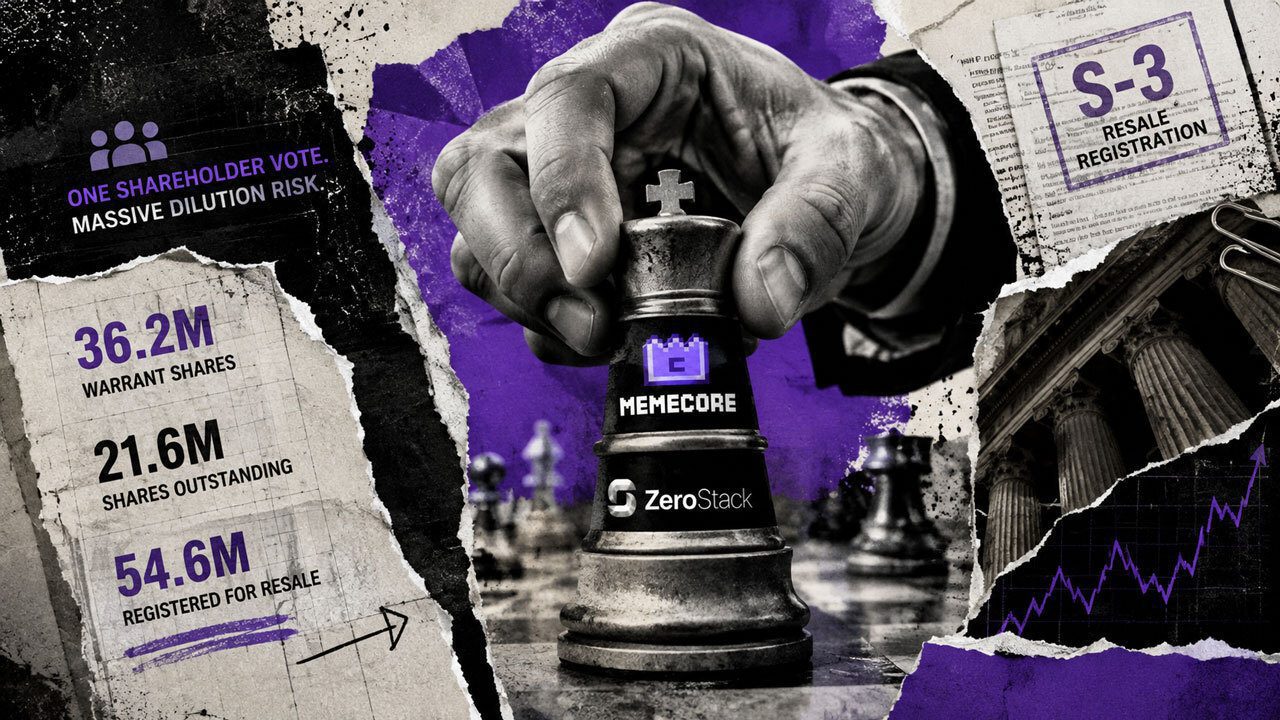
- ZeroStack issued 36.2 million warrant shares to MemeCore sellers, equal to 167% of its 21.6 million outstanding common shares.
- The company valued the 925.9 million MemeCore M tokens at $1.08 each, totaling roughly $1 billion in aggregate consideration.
- Shareholders must vote to authorize warrant issuance under Nasdaq Rule 5635, but no vote date has been set as of the Aug. 21 filing.
- 36.2M Warrant shares as multiple of current equity base outstanding.
- $1B Aggregate deal value versus cash-free token-for-stock structure.
- 37.4% Pro forma ownership stake for original shareholders if all warrants issued.
ZeroStack closed its acquisition of MemeCore tokens on August 19, exchanging 3.5 million common shares and approximately 36.2 million pre-funded warrants for 925.9 million M tokens. The two parties valued the tokens at $1.08 apiece, putting the total deal consideration near $1 billion, one of the largest equity-financed crypto asset purchases by a public company.
Unlike traditional acquisitions, ZeroStack issued no cash; instead, the seller received equity that could expand the company’s share count dramatically if exercised in full.
The transaction exposed a structural vulnerability in how Nasdaq-listed firms can dilute existing shareholders through warrant issuance. ZeroStack’s current cap table showed 21.6 million common shares outstanding as of the deal close. The warrant block covers 36.2 million additional shares, a 167% dilution relative to the base.
If all warrants are exercised and no other securities are issued, ZeroStack’s total outstanding shares would reach 57.8 million, compressing the original shareholder base to just 37.4% ownership.
Nasdaq Rule 5635 Vote Now Blocking 36.2 Million Shares From Issuance
Nasdaq Listing Rule 5635 requires shareholder approval before any publicly listed company can issue equity representing more than 19.99% of pre-transaction shares without a fair-value determination or independent fairness opinion. ZeroStack’s warrant block exceeds that threshold by wide margin, making a shareholder vote mandatory.
The company filed its resale registration on August 21, two days after closing, but has not announced a date for the required vote. That absence of timeline creates uncertainty for both current shareholders and warrant holders: until approval occurs, the 36.2 million warrant shares cannot legally be issued, even though they are fully pre-funded and held by MemeCore’s sellers.
The regulatory gate effectively freezes those securities in place pending shareholder action.
ZeroStack also filed a separate Form S-3, a broad registration statement covering 54.6 million shares eligible for resale.
That filing includes not only the MemeCore warrant shares but also private-placement shares issued in March, July, and August; shares issued to CEO Daniel Reis-Faria following earlier warrant exercises; executive stock options; and holdings by funds linked to Hack VC Management and Zero Gravity Labs.
The filing lists seven named holder groups, with Puple AI and Blockcat each registered to resell up to 19.8 million shares each.
Ten-Year Lockup on Warrant Shares Can Be Waived by Mutual Consent
The warrant shares are subject to a restrictive provision that other securities in the registration are not: a lockup period running up to ten years that prevents immediate resale. However, ZeroStack’s filing explicitly states that this restriction can be waived, released, or renegotiated by mutual written consent between the company and the warrant holders.
That language introduces a second layer of discretion beyond the shareholder vote. Even if shareholders authorize the warrant issuance, ZeroStack retains contractual flexibility to modify the lockup terms without returning to shareholders.
Such modifications could accelerate the timeline for warrant holders to convert and sell into the market, a consideration for institutional investors who hold current shares and face potential selling pressure.
The warrant holders are concentrated among a small set of entities. MemeCore’s sellers, represented through structures including the warrant block, hold the single largest allocation of the pre-funded securities. Insider executives including CEO Daniel Reis-Faria and Executive Chairman Michael Heinrich hold additional converted shares and options.
That concentration raises questions about whether early sellers of MemeCore tokens will pressure the company to accelerate warrant conversion or seek lockup relief once the shareholder vote passes.
Filing Inconsistencies Signal Potential Drafting Errors in Warrant Count
ZeroStack’s filings contain two distinct warrant-share counts, suggesting possible errors in the registration process. The company’s Form 8-K, filed immediately after closing, lists 36,198,293 warrant shares. The later S-3 resale registration increases that by one share to 36,198,294.
A separate discrepancy appears in the holder table for Zero Gravity Labs. The S-3 lists a maximum of 4.6 million shares for that entity in the resale base, yet the same filing states Zero Gravity Labs owns 4.6 million shares with no additional convertible securities.
The lower figure, 4,608,575 shares, is the one that mathematically reconciles all seven holder groups to the total 54.6 million shares registered. The filing does not explain why two different figures appear for the same holder.
Such inconsistencies, while minor in percentage terms, may signal hasty drafting or incomplete cross-checking between legal teams and financial reporting. For institutional investors evaluating the company’s governance maturity and operational rigor, these gaps warrant scrutiny ahead of any shareholder vote.
No Vote Date Set; Shareholder Approval Timeline Remains Unclear
ZeroStack has not announced when shareholders will vote on the warrant issuance. That omission is notable because it leaves both the company and MemeCore’s warrant holders in a legal limbo: the warrants are fully funded and owned, but cannot be exercised until shareholder authorization occurs.
For institutional holders of ZeroStack’s common shares, the pending vote represents the single largest near-term catalyst for dilution.
The company’s disclosure obligations do not end with the August 21 filing. Once a vote date is announced, ZeroStack must file a proxy statement or information statement at least ten business days prior, giving shareholders that window to review details and determine whether to approve.
The proxy filing will be the first clear window into management’s pitch for the deal: whether they frame it as a long-term value driver, a diversification into crypto-native assets, or a capital-efficient way to acquire liquidity.
ZeroStack valued the tokens at $1.08 each and the aggregate consideration at about $1 billion.
ZeroStack, Form 8-K filing August 19, 2024
The company will also need to address questions that have already emerged in institutional crypto markets: whether MemeCore tokens have liquid secondary markets, what lock-in period exists for the tokens themselves, and whether the $1.08 pricing remains realistic given market conditions. Until that proxy lands, current shareholders lack formal management commentary on the strategic rationale.
Institutional investors should monitor for ZeroStack’s formal announcement of a shareholder vote date, the critical juncture at which the 167% dilution either proceeds or faces rejection. The pending vote represents one of the largest warrant-contingent equity authorizations on Nasdaq in recent years, and its outcome will determine whether the company’s current owners retain meaningful equity stakes or face near-total dilution if all securities exercise.
Original reporting: cryptoslate.com