This Nasdaq-listed Bitcoin treasury diluted shareholders 18-fold to survive a $212 million crypto loss without selling its stash
GD Culture Group diluted shareholders by 18-fold while absorbing a $211.8 million unrealized Bitcoin loss, raising cash through equity sales rather than liquidating its 7,500-BTC reserve. The strategy reveals institutional tension between maintaining crypto treasuries and preserving balance-sheet solvency when asset values collapse.
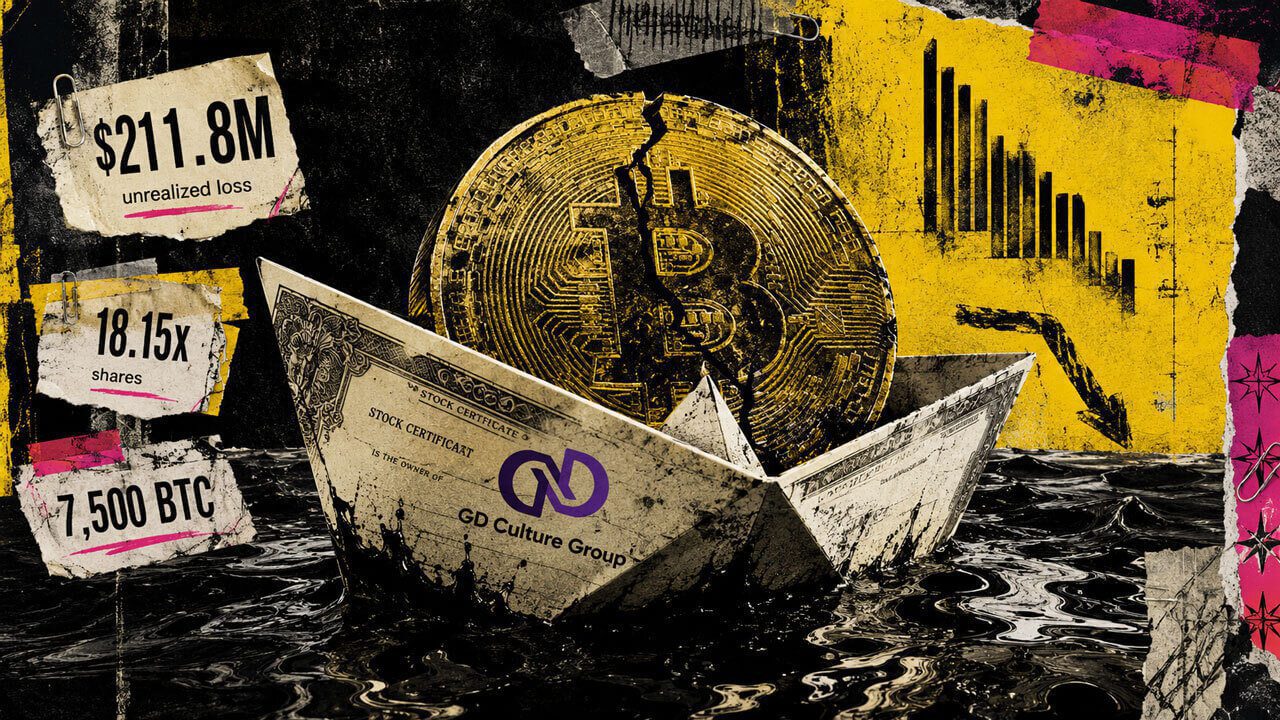
- GD Culture held 7,500 BTC worth $451.2 million on June 30, down from $842 million original cost basis.
- Share count rose from 229,278 at year-end 2025 to 4,162,500 by June 30, 2026, an 18-fold increase after reverse split adjustment.
- Cash offerings raised $47.45 million in the first half, with 99.65% of new shares issued purely for liquidity purposes.
- $211.8M unrealized Bitcoin loss, representing 97.9% of total net loss
- 18.15x share count increase from year-end 2025 to mid-2026
- 7,500 BTC held as strategic reserve, acquired via Pallas Capital deal
GD Culture Group, a Nasdaq-listed digital media and technology company, disclosed in its Aug. 14 quarterly filing that it absorbed a $211.8 million unrealized loss on Bitcoin holdings during the first half of 2026 while simultaneously diluting existing shareholders by more than 18 times to maintain liquidity.
The company held 7,500 BTC with a June 30 fair value of $451.2 million against an original cost of $842 million, generating a mark-to-market charge that accounted for nearly all of its $216.2 million net loss for the period.
Rather than liquidate any portion of its core Bitcoin reserve to cover operating cash needs and balance-sheet pressure, GD Culture issued massive quantities of new equity, raising $47.45 million through at-the-market offerings and direct placements, exposing a critical vulnerability in corporate treasury strategies when crypto volatility collides with cash constraints.
GD Culture’s 18-fold shareholder dilution driven entirely by working capital needs, not Bitcoin purchases
The arithmetic of GD Culture’s capital raise reveals a company in acute liquidity stress. Share count expanded from 229,278 shares outstanding at year-end 2025 to 4,162,500 by June 30, 2026, a jump of 3,933,222 shares after retroactive adjustment for a one-for-250 reverse split executed on June 29.
Of that increase, 3,919,455 shares, representing 99.65% of all new issuance, came from pure cash offerings rather than any acquisition or merger activity.
Between May and June alone, GD Culture sold 2,882,249 split-adjusted shares through an at-the-market program, netting approximately $42 million. A second offering in June placed 1,037,206 shares at $5.25 each, generating $5.45 million.
The company also received $25.1 million in other financing during the first half, while an additional $21.5 million from ATM proceeds remained in an underwriter brokerage account at quarter-end but was recorded as a receivable after management confirmed receipt immediately after the reporting date.
By June 30, GD Culture reported only $7.2 million in operating bank accounts and $36.6 million in working capital, against $12.3 million in cash burned through normal operations during the six-month period. The company’s Bitcoin holdings, acquired through its September 2025 acquisition of Pallas Capital Holding, remained entirely untouched despite the fair-value carnage.
The Bitcoin loss was a non-cash accounting charge reflecting fair-value restatement under applicable accounting standards, not a realized loss from selling any portion of the reserve.
Unrealized loss of $391 million on Bitcoin reserve dwarfs all other financial activity
The scale of GD Culture’s paper loss illustrates why corporate treasuries have become a liability for institutional shareholders when prices move sharply downward. The difference between the company’s $842 million cost basis and the $451.2 million June 30 fair value amounted to a $390.8 million underwater position on its 7,500-BTC position.
That loss, recorded through the income statement as an unrealized mark-to-market adjustment, consumed nearly all of the company’s reported net loss for the first six months.
A separate $28,799 realized loss on 1.08 BTC sold for short-term trading purposes demonstrated that GD Culture did execute some tactical sales from separate holdings, receiving $71,201 on that transaction. However, the 7,500-BTC core reserve, the primary asset that attracted investors to the Pallas Capital acquisition, never moved.
The company’s stated intended use for 2026 offering proceeds was working capital and general corporate purposes, not Bitcoin accumulation.
This distinction matters to institutional readers evaluating corporate treasuries: the accounting loss is real for valuation purposes and reduces book value per share, but the absence of forced Bitcoin liquidation suggests management retained conviction in holding the position despite balance-sheet pressure.
What it also reveals is that equity dilution became the mechanism to bridge the cash gap that the Bitcoin loss created.
Shareholder dilution pathway sets precedent as Bitcoin treasury model faces institutional skepticism
GD Culture’s decision to issue 3.9 million new shares rather than sell any portion of its 7,500-BTC position reflects a strategic choice with long-term implications for how corporate treasuries manage volatility.
The company finished the first half with $36.6 million in working capital (including the $21.5 million ATM receivable) and stated it had sufficient liquidity to meet obligations for at least the next reporting period, suggesting the equity raises accomplished their immediate purpose.
However, the 18-fold dilution of the shareholder base invites scrutiny of whether corporate Bitcoin holdings benefit equity investors or merely transfer volatility from the balance sheet to the cap table. A shareholder who held one share at year-end 2025 owned 1/229,278th of the company; by June 30, that same share represented only 1/4,162,500th of the enterprise.
The Bitcoin position did not grow; only the dilution did.
For institutional investors managing portfolio exposure to companies with crypto treasuries, GD Culture’s filing illustrates a critical risk vector that goes beyond simple mark-to-market losses. When Bitcoin prices fall sharply, companies with concentrated holdings face a choice: liquidate to preserve equity per share, or raise capital and dilute existing holders to preserve the Bitcoin position.
GD Culture chose dilution, signaling that management prioritized the long-term appreciation thesis for Bitcoin above shareholder equity stakes in the near term. That bet remains unpriced against the risk of extended weakness in Bitcoin valuations, which would necessitate further rounds of dilutive capital raises.
The critical open question for GD Culture’s next reporting cycle is whether the company can demonstrate positive cash flow from operations or whether bitcoin treasury companies face structural pressure toward perpetual dilution when crypto prices remain volatile.
Institutional investors should monitor the company’s third-quarter filing (due in November 2026) for share count trends and whether management signals additional equity offerings or, conversely, any shift toward realized sales from the Bitcoin reserve.
Dilution Math Exposes Liquidity Crisis Independent of Bitcoin Volatility
GD Culture’s decision to issue 3.9 million new shares for $47.45 million in cash, an average of $12.17 per share, occurred while the company’s Bitcoin holdings sat underwater by $390.8 million. The equity issuance pace suggests monthly cash burn of approximately $7.9 million, a rate that would exhaust the raised capital within six months even without operational losses.
This timeline distinction matters: the company faced a near-term solvency problem separate from the longer-term question of whether Bitcoin would recover to cost basis.
Comparable situations at MicroStrategy and Marathon Digital revealed different outcomes. MicroStrategy raised $2.6 billion in convertible debt in 2024 while holding 252,220 BTC, choosing leverage over equity dilution despite similar unrealized losses.
Marathon Digital, by contrast, issued $750 million in new equity in early 2024 when Bitcoin prices bottomed near $42,000, but did so while maintaining a 61% equity-to-debt capital structure.
GD Culture’s reliance on pure equity issuance, with no concurrent debt offering or credit facility, suggests either lender reluctance to extend credit against a depreciating asset base or management preference to avoid fixed obligations during uncertainty.
The June 30 filing does not disclose whether management attempted to secure a credit facility backed by the BTC reserve, a standard option available to institutional holders; GD Culture’s next quarterly filing in November 2026 should clarify whether asset-backed lending was pursued and, if rejected, at what loan-to-value ratio lenders would have required.
Original reporting: cryptoslate.com