
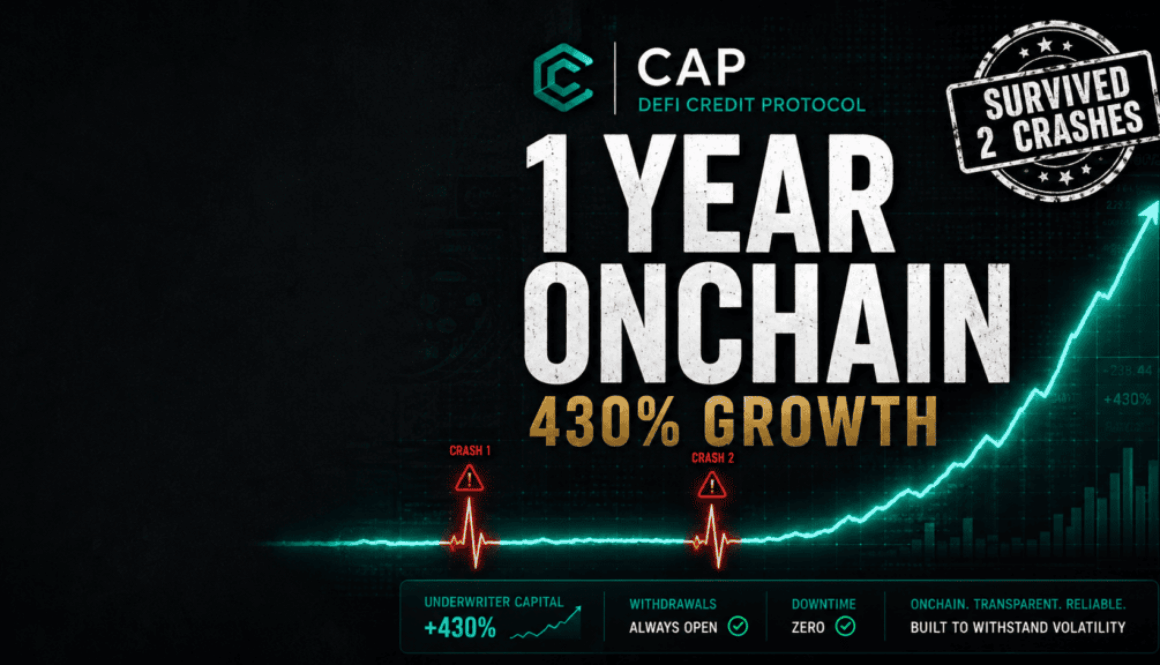
Cap Marks One Year Onchain With 430% Growth in Average Underwriter Capital
New York — August 18, 2026
Cap’s first year onchain: 430% growth in underwriter capital, two stress tests survived
The financial-guarantee credit platform kept processing redemptions through last October’s liquidation cascade and the Stream Finance contagion, then spent its second six months onboarding Susquehanna Crypto, Flow Traders, ether.fi, M11 Credit and FalconX.
Cap, a credit platform built on financial guarantees rather than pooled collateral, is one year into life on mainnet, and the numbers describe a project whose growth was concentrated almost entirely in its back half. Underwriter delegations averaged just $39.6M in Cap’s first six months, when most of its deposits sat idle earning little more than the risk-free rate. In the second six months, that average jumped to $209.6M, and utilized borrow liquidity climbed 4.3x, from $12.65M to $55.26M.
What makes that acceleration notable is the timing. It happened in a stretch that included two of the more severe stress events in recent onchain credit history, and Cap says it did not gate a single redemption or break its peg through either one.
The recordBuilt for the stress case, then stress-tested twice
Cap’s underlying structure keeps the party that borrows separate from the party that guarantees the loan. Every loan carries a dedicated underwriter who escrows their own capital against it, an arrangement meant to remove the principal-agent gap that lets originators book growth while lenders absorb the downside. Enforcement runs through smart contracts rather than courts, so it settles in seconds instead of years.
That design met its first real test in October 2025 and again weeks later during the Stream Finance contagion, two episodes that froze redemptions and impaired principal across a number of yield-bearing dollar products elsewhere in the market. Cap says its reserves are allocated by market dynamics rather than a human treasury desk, and that depositors can verify backing onchain rather than take the platform’s word for it.
The mechanicsThe design constraint most competitors skip
Most yield-bearing dollar products get more fragile as more of their supply gets staked, because the same yield gets spread across a larger staked base while an ever-thinner unstaked float ends up subsidizing it. Cap says it built for the opposite: today more than 88% of cUSD supply sits in stcUSD, well above what peers typically run, while underwriter deposits sit at 66% of TVL, which the platform frames as the buffer that keeps a high staking ratio from becoming a solvency problem. Stakers are currently earning 5.11%+, against what Cap cites as a 3.29% peer average.
Cap founder and CEO Benjamin Sarquis Peillard framed the year around incentives rather than capital availability: the real problem in credit, he said, was never a lack of capital but how risk gets priced and who answers for underwriting it going wrong.
“Aligning those incentives at the protocol level can produce a more resilient credit market.”
— Benjamin Sarquis Peillard, Founder & CEO, Cap
Who showed upFrom speculation to institutions
Cap’s back half was defined less by incentive-chasing than by counterparties with longer time horizons. Susquehanna Crypto and Flow Traders, the Amsterdam-listed market maker, both opened credit lines on the platform. ether.fi shows up on both sides of the ledger, as depositor and underwriter. M11 Credit, the underwriting arm of Maven 11, and prime brokerage FalconX now use Cap for scalable financing. Franklin Templeton’s tokenized money market fund BENJI and WisdomTree’s WTGXX were added as supported assets, each after clearing Cap’s institutional compliance review.
In July, Aave’s MegaETH instance listed stcUSD following a DAO vote, and the listing hit its supply cap within hours, then twice more inside the same week. Cap says institutions with a combined $2 trillion-plus in assets under management now touch the platform in some form, whether as investors, borrowers, or integration partners.
Growing average underwriter delegations 430% in six months is, in his words, “a strong signal that onchain credit is moving from experimentation toward real institutional adoption.”
— DeFi Dave, Head of Growth, Cap
| Metric | Year One |
|---|---|
| cUSD supply staked in stcUSD | 88% |
| Underwriter delegations | $240M |
| Average USD APY, trailing 12 months | 6.82% |
| Peer average APY | 3.29% |
| Cumulative volume | $5B |
| Total assets deposited | $344M |
What’s nextBeyond crypto-native credit
Cap says year two is aimed at carrying its underwriter-guarantee model into industries outside crypto entirely, pointing to media on the traditional end and robotics on the frontier end as early targets. Whether that model, and the strong second-half numbers behind it, hold up outside crypto-native counterparties is the open question the next twelve months will answer.
Cap is a private credit platform that uses blockchain technology to address problems facing legacy private credit systems, pairing every loan with a dedicated underwriter who backs it with their own capital. Depositors earn yield secured by that underwriting rather than a pooled collateral cushion. Cap’s investors include Franklin Templeton, Susquehanna and IMC Trading. The platform has processed more than $5B in cumulative volume and holds over $350M in deposits, with dollar deposits currently earning in the 5–7% range. Learn more at cap.app or follow @CapApp.