
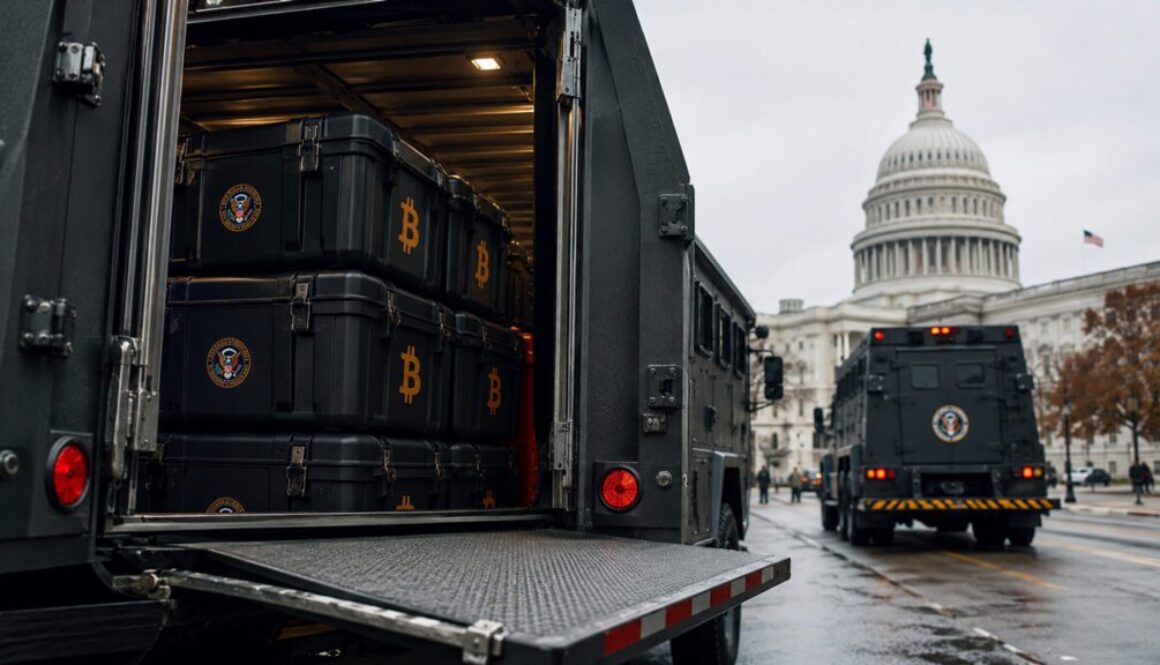
US lawmakers push new Strategic Bitcoin Reserve act to secure $25 billion federal stash
The US House has introduced legislation to formally establish a strategic Bitcoin reserve holding the government’s existing 328,372 Bitcoin stockpile, currently valued at more than $25 billion, with mandatory 20-year holding periods and quarterly public audits. The American Reserve Modernization Act signals institutional acceptance of cryptocurrency as a sovereign asset class and creates the legal framework for potential future acquisitions, reshaping how institutional investors and policymakers assess digital assets’ role in national financial strategy.
- 328,372 Bitcoin held by US government, valued at more than $25 billion, to be consolidated under single Treasury custody framework
- Bill mandates minimum 20-year holding period for all reserve Bitcoin, eliminating periodic auctions and establishing government as long-term holder
- Quarterly public “Proof of Reserve” reports and independent audits required, with separate Digital Asset Stockpile for non-Bitcoin cryptocurrencies
- 328,372 Bitcoin held by US government, compared to corporate and institutional holdings
- $25 billion Current value of federal Bitcoin reserves, compared to historical acquisition cost
- 20 years Mandatory holding period for strategic reserve Bitcoin, establishing long-term policy commitment
Representative Nick Begich unveiled the American Reserve Modernization Act (ARMA) of 2026 on Thursday, proposing the first comprehensive federal framework for managing the United States’ digital asset holdings.
The bill consolidates Bitcoin custody within the Treasury Department and creates a parallel “Digital Asset Stockpile” for other cryptocurrencies, ending the fragmented approach where multiple agencies hold seized digital assets independently.
The move reflects a fundamental shift in how Washington treats cryptocurrency, no longer as contraband to be liquidated, but as a strategic national asset requiring institutional stewardship.
The federal government accumulated its current holdings of 328,372 Bitcoin almost entirely through law enforcement seizures, not market purchases. At current valuations exceeding $25 billion, this represents the largest single Bitcoin holding by any sovereign entity globally.
However, the stockpile has grown without formal policy guidance, leading to inconsistent management practices and periodic public auctions that have sparked industry criticism about suboptimal timing and execution.
Begich-led coalition secures 17 House co-sponsors for Bitcoin reserve legislation
The bill enters Congress with significant bipartisan backing unusual for cryptocurrency legislation.
Representative Begich assembled 17 original co-sponsors spanning multiple states and districts, including Buddy Carter, Ben Cline of Virginia, Barry Moore of Alabama, Burgess Owens of Utah, Mariannette Miller-Meeks of Iowa, Mike Carey and Michael Rulli of Ohio, Mike Collins of Georgia, Mike Lawler of New York, Riley Moore of West Virginia, and Tim Moore of North Carolina.
This geographic and ideological diversity signals that support for strategic Bitcoin reserves has moved beyond fringe advocates into mainstream congressional positions.
Industry leaders have already mobilized behind the proposal. Matt Cole, CEO of Strive, a Bitcoin treasury management firm serving institutional clients, characterized ARMA as “the single most important crypto legislation that can come out of D.C.” for the long-term health and security of the United States.
The rapid endorsement from treasury-focused firms underscores institutional recognition that sovereign Bitcoin holdings now carry strategic weight comparable to foreign exchange reserves or gold stockpiles.
The legislative coalition’s composition matters for institutional investors evaluating regulatory trajectory. Bipartisan sponsorship in a divided Congress indicates the proposal has escaped narrow ideological positioning and entered the category of national asset management policy.
Mandatory 20-year holding period locks government into long-term Bitcoin accumulation strategy
The bill’s core mechanism, requiring all strategic reserve Bitcoin to remain held for at least 20 years, transforms federal digital asset policy from tactical liquidation to strategic accumulation. This creates a predictable policy floor that eliminates the previous pattern where the Treasury sporadically auctioned holdings, often at prices market participants deemed suboptimal.
By removing the government as a periodic seller, ARMA reduces a significant source of price volatility that institutional investors have tracked.
The 20-year mandate also establishes tacit government endorsement of Bitcoin’s relevance across multi-decade timeframes.
Institutional investors and corporate treasurers evaluating whether to hold Bitcoin alongside traditional reserves now face a materially different risk calculus: the US government itself has legislatively committed to hodling, signaling confidence that Bitcoin remains a legitimate store of value through 2046.
This carries institutional weight that private corporate Bitcoin allocations, however large, cannot independently establish.
Critically, the bill directs Treasury to study “budget-neutral acquisition strategies” for expanding the digital reserve without tax increases, deficit spending, or adding to national debt. This language opens the door to potential future Bitcoin purchases using mechanisms like redirecting existing asset sales or restructuring federal balance sheet management.
Institutional investors should monitor whether Treasury proposes any acquisition framework, as large-scale government buying would fundamentally shift Bitcoin’s supply dynamics.
Quarterly “Proof of Reserve” audits and transparency requirements reshape custody standards
To address persistent industry concerns about government custody practices, ARMA mandates quarterly public “Proof of Reserve” reports certified through independent third-party audits. The Treasury would also face direct congressional oversight on reserve management.
These requirements establish unprecedented transparency standards for sovereign Bitcoin holdings, likely higher than most institutional custodians maintain publicly, and create regular reporting cadences that professional investors can integrate into portfolio monitoring systems.
The auditing requirement signals recognition that custody integrity has become a material institutional concern. Unlike gold reserves held in Fort Knox, Bitcoin’s cryptographic nature allows far more granular and provable verification.
By legislating quarterly audits, Congress essentially commits to publishing auditable proof that holdings remain secure and unchanged, eliminating the speculation that periodically surrounds sovereign gold vault audits.
For institutional investors, mandatory public audits solve a critical information asymmetry: confirmation that the government’s stated holdings are cryptographically verifiable and professionally audited.
Separate Digital Asset Stockpile framework suggests readiness for post-Bitcoin cryptocurrency holdings
ARMA’s establishment of a parallel stockpile for non-Bitcoin cryptocurrencies signals Congressional recognition that the government’s digital asset base extends beyond Bitcoin. This structure leaves room for holding Ethereum, stablecoins, or other digital assets without requiring future legislative amendments.
While the current bill centers on Bitcoin, the only digital asset with sufficient historical accumulation through seizures, the separate framework acknowledges that US digital asset policy must eventually address a broader ecosystem.
The two-reserve structure also allows Congress to apply different holding standards and oversight mechanisms to Bitcoin versus other assets. Bitcoin’s 20-year mandate could logically differ from management policies for more volatile or regulatory-dependent assets.
This architectural flexibility suggests the legislation’s drafters understood that a one-size-fits-all approach would fail to accommodate the developing characteristics of different cryptocurrency classes.
Institutional investors should watch for Treasury’s regulatory interpretation of what qualifies for the Digital Asset Stockpile, specifically whether the department expands holdings beyond seized assets or whether the framework remains limited to existing law enforcement seizures. Additionally, monitor the timeline for Treasury’s budget-neutral acquisition study, expected within months of enactment, as the agency’s proposed mechanisms for expanding reserves without new appropriations will reveal whether federal Bitcoin accumulation remains a passive seizure-based strategy or transforms into active market participation.