
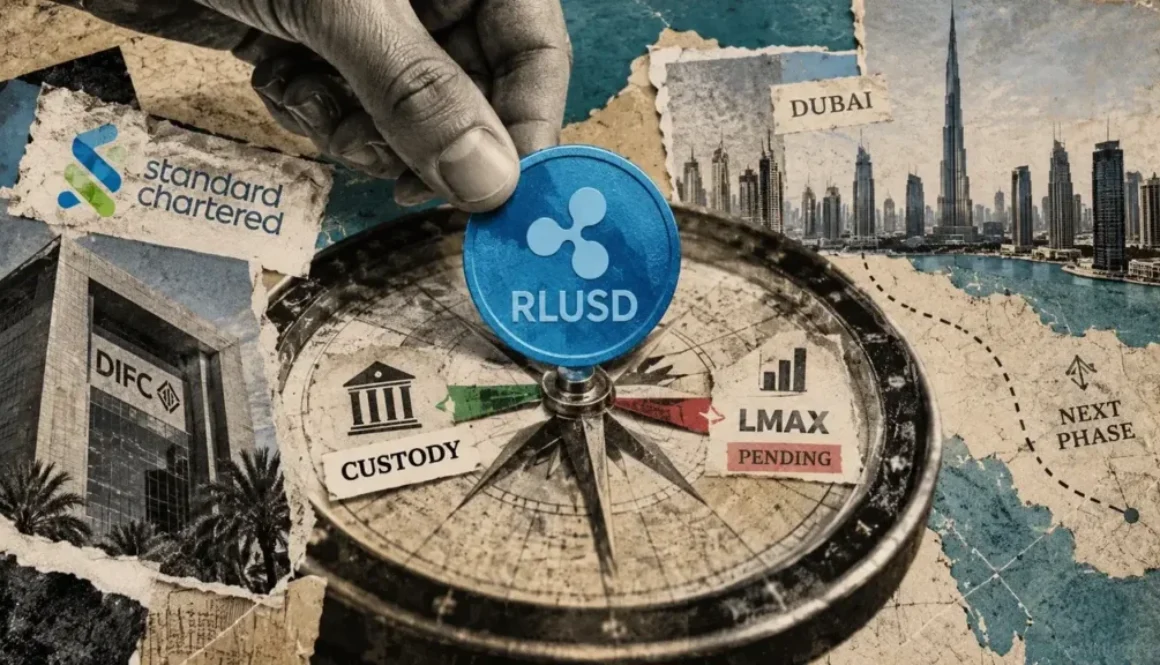
Standard Chartered opens RLUSD custody for institutions, plans collateral integration with LMAX
Standard Chartered has launched live custody for Ripple’s RLUSD stablecoin and committed to integrate it as collateral across LMAX Group’s institutional trading infrastructure, creating a custody-to-trading pathway for major financial institutions. The move signals a shift toward stablecoins as operational assets within regulated finance, not just payment rails, and could accelerate institutional adoption if collateral integration achieves technical and regulatory clearance.
- Standard Chartered’s Dubai branch now holds RLUSD issued on the XRP Ledger for eligible institutional clients, live as of October 12.
- RLUSD supply grew $765.3 million in Q3 2026, second only to Circle’s USDC at $915 million, and now totals $2.4 billion across XRPL and Ethereum.
- Collateral mirroring model allows clients to keep RLUSD in Standard Chartered custody while using it to margin trade on LMAX, pending final documentation and regulatory approval.
- $765.3M RLUSD supply growth in Q3 2026, second largest stablecoin increase after USDC
- $2.4B RLUSD’s total circulating supply across all blockchains as of latest count
- $150M Ripple’s committed financing to support LMAX’s institutional growth strategy
Standard Chartered announced on October 12 that it now supports institutional custody of RLUSD issued on the XRP Ledger through its Dubai International Financial Center branch, regulated by the Dubai Financial Services Authority. The bank is also joining a planned integration with Ripple and LMAX Group to enable RLUSD as eligible collateral for trading across LMAX’s institutional venues without requiring clients to transfer the underlying tokens off Standard Chartered’s platform. The arrangement mirrors the value of RLUSD holdings to LMAX, meaning clients retain custody at the bank while accessing margin and collateral functionality on the exchange. Standard Chartered described the model as reducing “transfer-related operational risk and optimise counterparty exposure while improving capital efficiency.”
RLUSD posts second-largest stablecoin supply gain in Q3 as Ripple targets institutional scale
The custody launch reflects accelerating demand for RLUSD among institutional players. According to the RWA Foundation, Ripple recorded the second-largest increase in stablecoin market capitalization during the third quarter of 2026, adding $765.3 million over 90 days. Only Circle’s USDC posted a larger increase at $915 million, while United Stables ranked third at $474.2 million. Data shows RLUSD’s total circulating supply has climbed to approximately $2.4 billion, with about $1.14 billion issued on XRPL and another $1.3 billion on Ethereum.
The growth underscores Ripple’s pivot beyond payments toward institutional collateral and treasury use cases. In January 2026, Ripple and LMAX announced a multiyear partnership to integrate RLUSD across LMAX’s cross-asset marketplace, with Ripple committing $150 million in financing to support the trading group’s expansion.
That deal targeted RLUSD adoption across spot cryptocurrency trading, perpetual futures, contracts for difference, and other institutional products.
Standard Chartered’s custody capability now provides the traditional banking infrastructure layer that major institutions require to participate in digital asset markets without moving their holdings onto decentralized platforms or third-party custodians.
Collateral mirroring model bypasses transfer friction but remains subject to regulatory clearance
The operational innovation lies in the collateral mirroring arrangement.
Rather than requiring clients to transfer RLUSD from Standard Chartered to LMAX to use it as margin or collateral, the model allows LMAX to recognize the value of RLUSD held at Standard Chartered, eliminating a transfer step that typically exposes clients to settlement delays, blockchain congestion fees, and counterparty concentration risk.
For institutions managing large positions, this reduces friction and operational complexity.
The arrangement is not yet operational, however.
Standard Chartered and its partners said implementation remains “subject to final documentation, successful testing, applicable laws and regulations, internal approvals and jurisdictional readiness,” and that “further details will be announced as implementation progresses.” No timeline has been disclosed for when RLUSD collateral functionality will go live on LMAX, nor has Standard Chartered disclosed the amount of RLUSD currently held in custody or named participating institutional clients.
Waqar Chaudry, Standard Chartered’s global head of digital assets in Securities Services, said institutional investors increasingly demand participation in digital asset markets “without compromising on how their assets are safeguarded or how risk is managed.” Jack McDonald, Ripple’s SVP for stablecoins, framed RLUSD as built “for exactly this kind of institutional use case,” combining the efficiency of a regulated stablecoin with custody standards established financial institutions already trust.
The framing positions RLUSD not as a fintech alternative to banking infrastructure but as a native component of it, bridging traditional and digital rails within a single regulated framework.
The CCS read. We see this as a custody adoption play, not a stablecoin demand story. Standard Chartered’s infrastructure legitimizes RLUSD for treasurers and fund managers who cannot hold digital assets on non-bank venues; the real test is whether collateral mirroring reduces enough friction to drive material margin usage on LMAX versus alternatives like USDC. Regulatory approval and technical integration are the gatekeepers; neither is guaranteed.
The material next step is LMAX’s implementation of collateral mirroring and disclosure of which trading products will accept RLUSD first, spot crypto, perpetuals, or CFDs. That decision will signal whether the partnership targets retail volatility trading or institutional treasury and treasury hedging. Standard Chartered has not committed to a launch date, and regulatory approval across relevant jurisdictions remains pending.