
Nvidia’s Huang slams partners over China chip smuggling but won’t give up on Beijing
Nvidia CEO Jensen Huang publicly rebuked the company’s supply chain partners over alleged chip smuggling to China while simultaneously signaling the chipmaker will not abandon the Beijing market, even as U.S. export controls tighten. For institutional investors, Huang’s comments expose the tension between compliance enforcement and market access that will define Nvidia’s profitability and geopolitical risk profile through 2025.
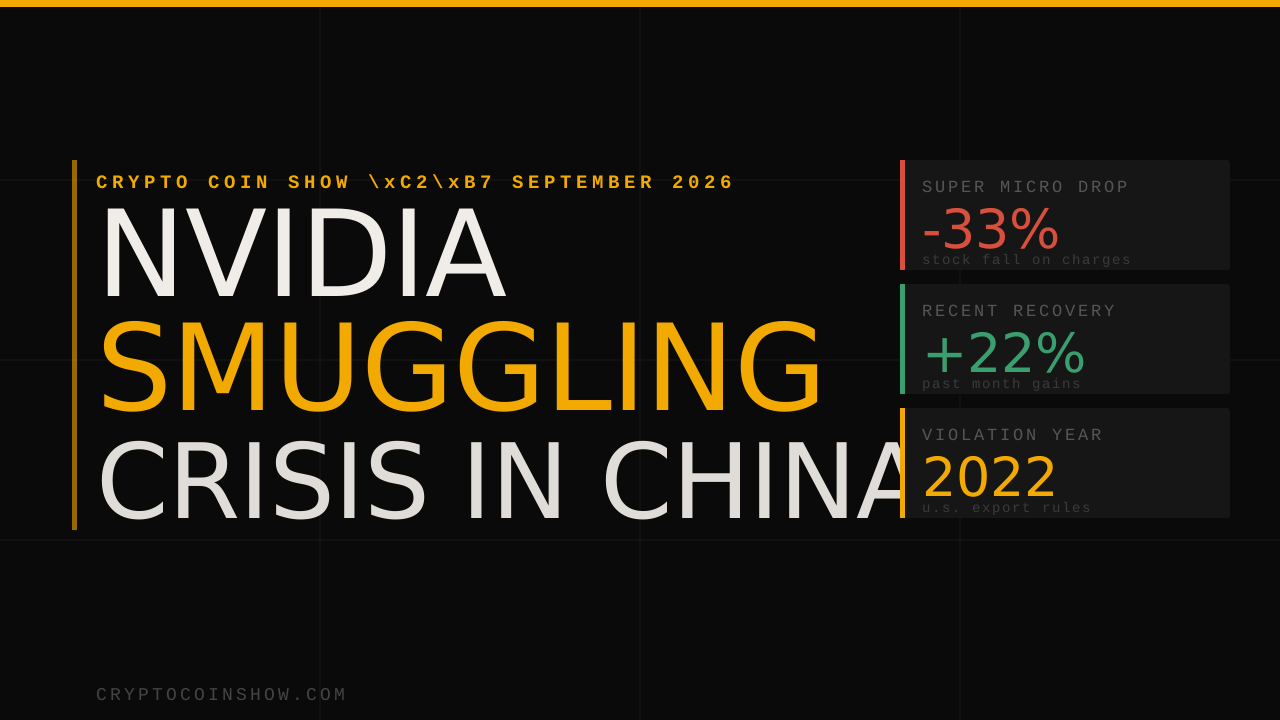
- Taiwan authorities arrested three people for allegedly smuggling Nvidia-powered Super Micro servers to China using false shipping documents, violating 2022 U.S. export rules.
- Super Micro stock fell 33 percent when U.S. charges were filed in March but recovered 22 percent in the past month amid semiconductor sector momentum.
- Huang stated Nvidia expects the China market to be included in a projected $200 billion CPU opportunity, directly contradicting the intent of U.S. trade restrictions.
- $464M Worth of Super Micro shares held by arrested co-founder Yih-Shyan Liaw
- 33% Single-day decline in Super Micro stock price when U.S. charges were announced
- $200B Projected market size Huang cited for new Nvidia CPUs, potentially including China
Jensen Huang arrived in Taipei on Saturday to confront an immediate crisis: within hours of landing, Taiwan authorities detained three individuals accused of attempting to export Nvidia-powered Super Micro Computer servers to China through falsified shipping documents.
The arrests underscore a widening enforcement gap between U.S. export controls, implemented in 2022 to restrict AI chip sales to China, Hong Kong, and Macau, and the operational reality of a global supply chain. Huang’s response was measured but unambiguous.
He told journalists at Songshan airport that Nvidia demands strict compliance from partners and expects them to strengthen internal controls to prevent future violations.
Yet Huang’s public stance on compliance masked a more complex message delivered moments later.
Super Micro faces parallel investigations in United States and Taiwan over shipment documentation
The legal exposure for Super Micro Computer (NASDAQ: SMCI) spans two jurisdictions and three continents. In March, U.S. prosecutors charged three individuals connected to the company: Yih-Shyan Liaw, a co-founder and board member whose personal stake exceeds $464 million in Super Micro equity, along with contractor Ting-Wei Sun. Taiwan sales manager Ruei-Tsang Chang was designated a fugitive.
The charges centered on allegedly circumventing restrictions that prohibit the sale of advanced servers containing Nvidia chips to restricted markets without explicit U.S. government authorization.
The March indictment triggered a sharp market reaction. Super Micro shares plunged 33 percent the day charges became public, reflecting investor concern about both criminal liability and the enforceability of export compliance at scale. The company’s server systems, which integrate Nvidia’s most advanced processors, form the backbone of AI data center infrastructure globally.
Any suggestion that Super Micro had systematically or negligently facilitated unauthorized exports could impair its customer relationships and regulatory standing.
Taiwan’s parallel detention of three additional individuals, allegedly for forging documentation on shipments to China, extends the compliance crisis into a new theater. Taiwan authorities have not disclosed the names of those detained, but the charges suggest a pattern rather than isolated misconduct.
The timing compounds reputational damage: Huang’s rebuke of his partners was essentially a public acknowledgment that export enforcement remains porous enough that his own supply chain partners face criminal prosecution.
Super Micro stock rebounds as semiconductor euphoria overrides compliance concerns
Paradoxically, Super Micro shares have recovered 22 percent over the past month, trading near $35.58 as of Huang’s Taipei visit, despite ongoing legal jeopardy. The rebound reflects a broader sector momentum tied to artificial intelligence adoption and investor optimism ahead of Nvidia’s earnings announcement.
For institutional investors, the disconnect between legal risk and stock performance reveals the current market’s willingness to discount regulatory headwinds in favor of growth narratives.
This pricing dynamic, however, may prove unstable if conviction charges advance or if Super Micro’s customers impose supply chain audits in response to the arrests.
Huang signals Nvidia will pursue $200 billion CPU market including China despite export rules
During Nvidia’s Wednesday earnings call, Huang had identified a $200 billion addressable market for the company’s new central processing units. When Taipei reporters directly asked whether that figure included China on Saturday, Huang’s response was laconic: “I would think so.” The comment, though brief, contained significant strategic weight.
It explicitly acknowledged that Nvidia views China as part of its long-term growth calculation, regardless of 2022 export restrictions nominally blocking such access.
Huang also used the Taipei press opportunity to trumpet Nvidia’s Vera Rubin product line, slated for third-quarter release this year. He characterized Vera Rubin as “the most successful generation so far,” signaling aggressive market expansion.
The new architecture targets autonomous AI systems capable of complex, independent reasoning, the category most likely to benefit from Chinese deployment in cloud infrastructure, financial modeling, and surveillance applications.
Huang emphasized that Nvidia now partners with all major AI companies, not just one or two, and described the upcoming rollout as the company’s “biggest and fastest” to date.
The tension in Huang’s dual message is instructive for institutional investors assessing Nvidia’s regulatory and geopolitical risk. He simultaneously demanded that partners comply with U.S. export controls while expressing confidence that China will represent a material portion of Nvidia’s future revenue. This is not a contradiction Huang can sustain indefinitely.
The company either expects to find legal pathways to serve China, through license approvals, subsidiary structures, or policy changes, or it is tacitly accepting that enforcement gaps will permit sales despite formal restrictions.
Institutional investors should monitor three pending developments: first, whether the U.S. Department of Justice secures convictions against Liaw, Sun, and Chang, which would establish criminal precedent for export violations and potentially trigger enhanced compliance audits across Nvidia’s entire partner ecosystem; second, whether Huang’s stated China inclusion in the $200 billion market opportunity receives official clarification from Nvidia investor relations, or remains an ambiguous off-the-cuff remark; and third, whether Nvidia applies for formal export licenses for Vera Rubin-based systems destined for Chinese customers, which would represent an explicit pivot from the current enforcement-gap strategy to regulatory accommodation. None of these outcomes is assured, and the contrast between Huang’s compliance rhetoric and his market-access posture will likely remain a source of earnings call scrutiny through at least Q3 2025.