
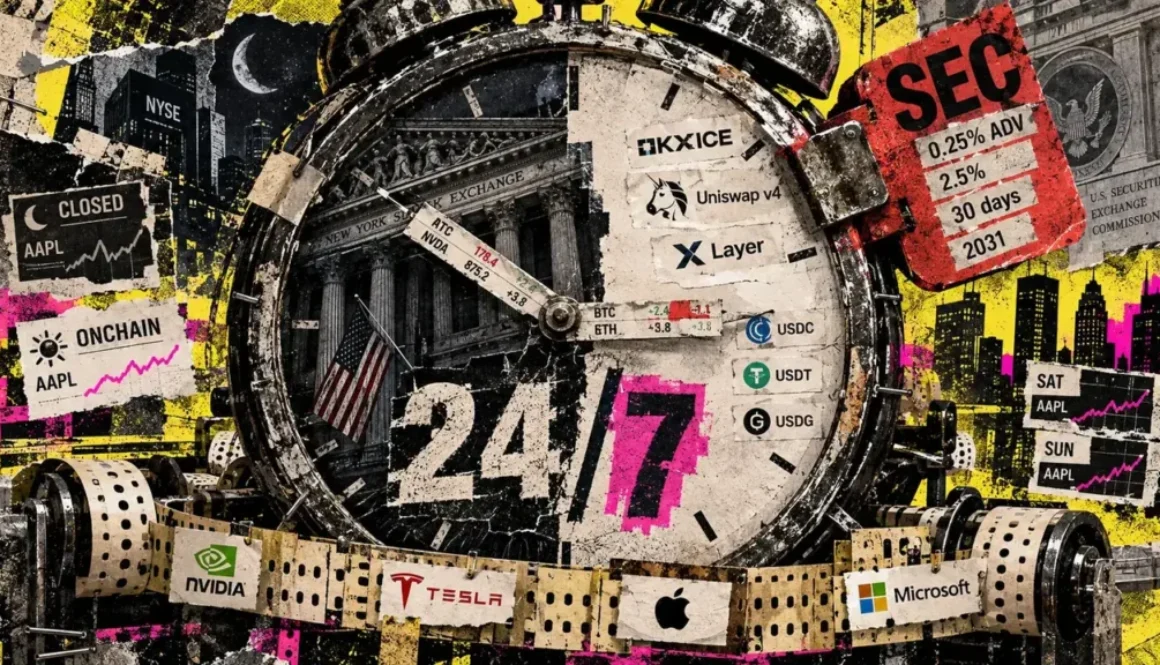
ICE and OKX seek SEC approval for round-the-clock tokenized stock trading
Intercontinental Exchange, owner of the New York Stock Exchange, and crypto exchange OKX have asked the SEC to approve a trading venue where tokenized US stocks keep repricing nights and weekends, when Wall Street itself is shut. For institutional investors, the filing is the first real test of whether blockchain-based equity trading can produce a usable price signal outside normal market hours without the liquidity gaps regulators have already flagged.
- OKXICE, the 50-50 joint venture between ICE and OKX, filed with the SEC on October 4, 2026, under the agency’s new Innovation Exemption.
- The venue would launch with 63 tokenized securities, including Nvidia, Tesla, Apple, Microsoft, JPMorgan, Goldman Sachs, Coinbase and Circle.
- Cerebras Systems has already objected, blocking its shares from being tokenized on the platform under the exemption’s 30-day notice window.
- 63 securities cleared for OKXICE’s initial tokenized stock launch
- 0.25% cap on Tier 1 trading versus a stock’s prior month average daily volume
- 2031 year the SEC’s Innovation Exemption expires, five years out
OKXICE notified the SEC in a filing dated October 4, 2026, that it intends to operate a Tokenized Securities Venue, according to a report from CryptoSlate. The Innovation Exemption is a temporary SEC relief program that lets firms test novel market structures under supervision before any permanent rule exists. The proposed venue would stay open continuously, letting tokenized shares of companies such as Nvidia and Tesla keep trading against stablecoins while the underlying stock sits halted on NYSE or Nasdaq.
Andrew Cuomo Calls the Filing a “Landmark Step”
OKXICE is co-chaired by former New York governor Andrew Cuomo, who framed the plan in a post on X as a shift toward continuous global markets.
This is a landmark step toward a truly global, 24/7 Wall Street.
Andrew Cuomo, co-chair, OKXICE
OKX founder and CEO Star Xu went further, describing the filing as a market-structure experiment worth running at scale. “Wall Street is moving onchain,” Xu wrote.
Uniswap v4 Pools, Not NYSE Prices, Set the Tokenized Rate
OKXICE’s smart contracts will not reference the prevailing NYSE or Nasdaq quote to price a tokenized stock. Instead, prices are set by the ratio of assets sitting in Uniswap v4 liquidity pools, an automated market maker design where a token’s price moves automatically as traders buy and sell against a pool of reserves, deployed on X Layer, OKX’s own blockchain network.
External stock data can feed displays and trading-halt checks but never the executable price itself.
Tokenized shares will trade against the stablecoins USDC, USDT or USDG, putting dollar-pegged tokens directly on the cash side of trades in some of America’s largest companies, a structure CCS has previously examined in the context of stablecoin issuance on alternative chains. Investors hold assets in self-custodial wallets but must clear identity, anti-money-laundering and sanctions checks before receiving a non-transferable credential to trade. Third-party tokenizers must back every token with one underlying share, with minting and redemption open to eligible participants during normal market hours, a model that echoes recent proposals to bring tokenized equities into onchain lending markets.
If a stock pool is thin, prices can swing far from where the underlying share eventually opens once NYSE trading resumes. The SEC flagged exactly that risk when it granted the exemption.
SEC Caps Volume and Sets a 2031 Expiration
The exemption limits Tier 1 securities to 75 symbols per venue, with trading capped at 0.25% of a stock’s prior month average daily volume, roughly a tenth of the latitude given to the lower Tier 2 category, which allows 250 symbols and a 2.5% volume ceiling. A venue that breaches its threshold for a given stock must halt trading in that token for three months. The SEC sought public comment on how overnight tokenized trading could affect liquidity and the opening and closing of conventional markets, a question regulators have also raised in parallel work on crypto custody standards for registered advisers.
The exemption runs through September 17, 2031, giving the SEC roughly five years to decide whether a permanent framework is warranted, though it can modify terms earlier. OKXICE must publish notice at least 30 calendar days before opening, which makes an early-November launch the earliest possible timing after its October 4 notice.
Companies get the same 30-day window to object before their shares appear on the venue, and Cerebras Systems has already used it, meaning its stock cannot be listed under the current exemption.
The CCS read. The volume caps make this a liquidity experiment, not a parallel exchange, so the number to watch is not listings but whether market makers actually post two-sided quotes on a Saturday night. If pools stay thin, the venue proves the concept without moving real price discovery, leaving ICE’s bigger strategic bet, extending its NYSE franchise onto blockchain rails, unresolved until volume data arrives.
OKXICE cannot open before early November 2026 under the SEC’s 30-day notice rule, and the next few weeks will show whether other issuers follow Cerebras Systems in objecting to having their shares tokenized without consent.