
peaq brings World ID to robots, and starts letting machines prove they’re really machines
Seoul — August 25, 2026
peaq brings World ID to robots, and starts letting machines prove they’re really machines
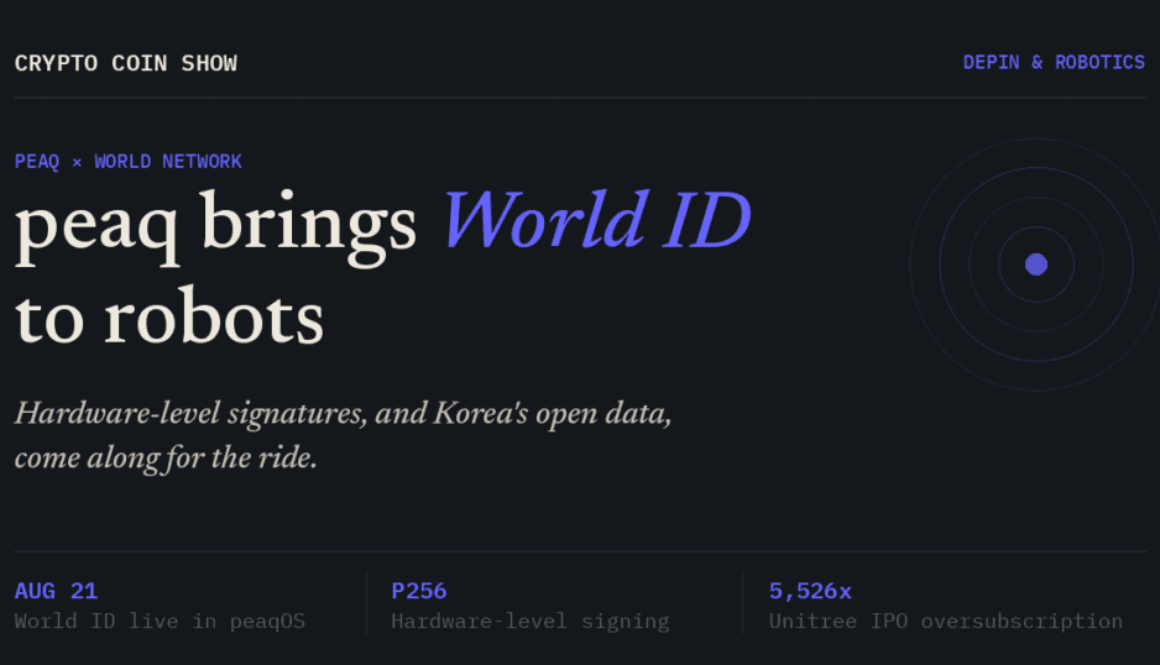
peaqOS now lets connected devices verify a human is real without learning who they are, backs that up with hardware-level P256 signatures so machines can prove their own identity too, and has opened Korea’s public data portal to any robot running on the network.
peaq, the layer-1 built for the machine economy, spent the back half of August shipping a run of updates that share one theme: getting machines to prove things about themselves and the humans around them, without anyone handing over more information than the interaction actually requires. The headline update, announced August 21, brings World Network’s World ID into peaqOS, giving any machine running peaq’s stack a way to check two things about the person standing in front of it: are they a real human, and are they the specific human who placed the order. Nothing else gets revealed. No name, no face, no ID, and it’s free to verify.
The HeadlinerWorld ID turns “prove you’re human” into a machine-native check
World ID works as a proof-of-human credential, generated through iris verification at physical Orb devices, producing an anonymous cryptographic proof of uniqueness rather than an identity record. Folded into peaqOS, that proof becomes something a robot can request and validate on the spot, using peaq’s existing decentralized identifier framework and machine market rather than a separate identity database bolted onto the device.
peaq’s own demo made the case concretely: a delivery robot in Seoul carries medication from a pharmacy to a patient, and has to be certain of two separate things before it can complete the delivery. First, that a real, unique human placed the order in the first place, verified through the World App before the order is even accepted. Second, that the human standing at the door when it arrives is the same one who ordered it. The pharmacist verifies too, before loading the medication. At no point does the robot, or anyone operating it, learn a name.
That three-way verification chain (patient orders, pharmacist loads, patient confirms) is the kind of use case that’s easy to describe and genuinely hard to build without either over-collecting personal data or leaving an obvious gap for spoofing. peaq says the same zero-knowledge approach extends to simpler cases too, like enforcing “one item per human” promotional limits without maintaining a user database at all.
The Other HalfMachines get their own version of proof-of-human
Verifying the human is only one direction of trust. peaq’s second update, announced the same week, addresses the other: how does a machine prove it is who it says it is? The answer is P256, a signature standard already built into secure hardware chips across millions of existing devices. With P256 support live, a machine running peaqOS can now cryptographically sign an action using its own chip-level key, creating proof that the action originated from that specific physical machine rather than software pretending to be it.
Unforgeable, hardware-level signatures for any machine running peaqOS are here. Nothing to copy, nothing to leak.
— peaq, August 2026
The pairing is deliberate. World ID answers “is the human real,” P256 answers “is the machine real,” and together they cover both sides of a transaction that, until recently, largely ran on trust and account logins. Neither one requires a new piece of hardware most devices don’t already have; P256 in particular is a matter of peaqOS exposing signing capability that secure elements already support, not asking manufacturers to add anything new.
Also This MonthKorea’s public data, and a bet on robotics IPOs
peaq also opened up a more mundane but practically useful integration on August 17: any machine running peaqOS on robotic.sh can now directly query data.go.kr, Korea’s official open data portal, for information like EV charger availability, weather conditions, and air quality readings. It’s a small piece of plumbing next to World ID, but it’s the same underlying idea: giving machines direct access to the data and verification they need to act autonomously, rather than routing everything through a centralized operator’s own backend.
Separately, peaq used Unitree Robotics’ public listing, where the retail tranche was oversubscribed 5,526 times over, to make the case for its Robotics Capital Market (RCM) product: exposure to humanoid robotics companies that are still private, including names like Figure, Apptronik, 1X, and NEURA, none of which have announced an IPO date. Whether RCM can actually deliver liquid, tradeable exposure to pre-IPO robotics companies is a different and harder question than whether the demand exists, and demand clearly exists.
Why It MattersIdentity is the thing every machine economy pitch needs and rarely has
Every version of the “machine economy” pitch, robots that transact, deliver, and coordinate autonomously, runs into the same wall eventually: how does anyone in the loop trust anyone else without a human in the middle checking IDs. peaq’s answer this month is to split that problem in half and solve each side with a credential that already exists rather than inventing new infrastructure: World ID for humans, chip-level P256 signing for machines. It’s a narrower claim than “solving trust for robotics,” but it’s a more testable one, and the Seoul delivery demo is a concrete enough case that it’s either going to work in production or fail in an obvious, visible way.
peaq EcosystemWhere to go deeper
For readers and builders who want the primary sources rather than this recap:
peaq is a layer-1 blockchain purpose-built as the economic infrastructure for the machine economy, giving robots, vehicles, and devices verifiable identity, payment rails, and data access through its peaqOS software stack. The network hosts millions of connected devices across dozens of DePIN projects. Learn more at peaq.xyz.