
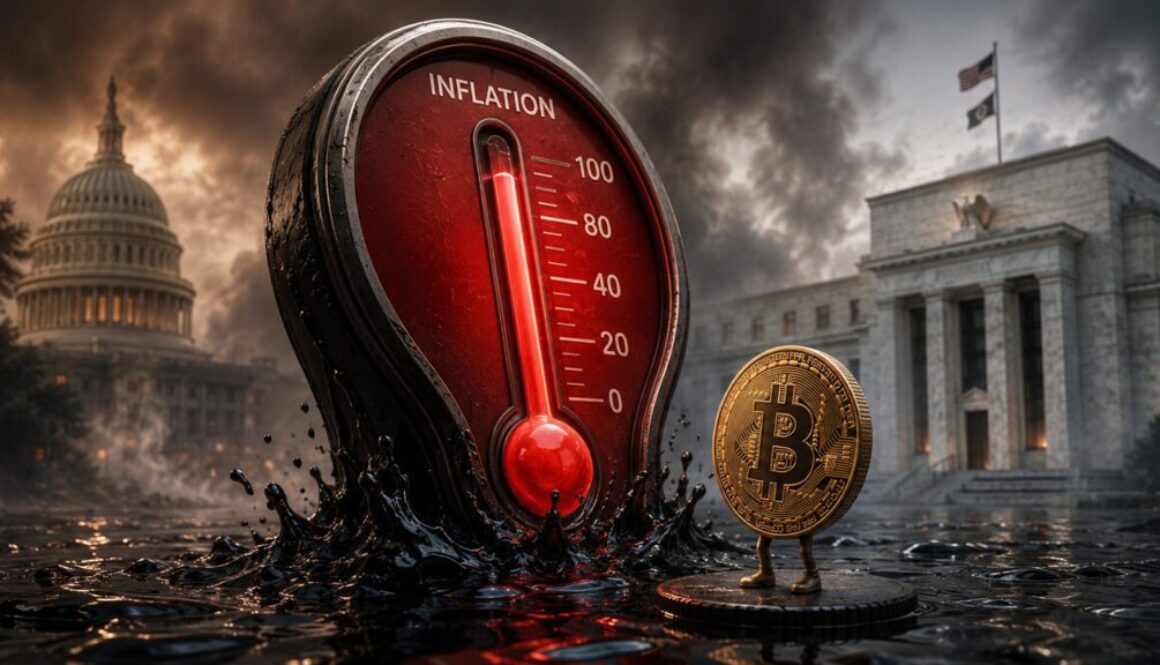
Hormuz oil contagion spreads to 8 major economies and Bitcoin has just one route through
The Strait of Hormuz disruption has crashed crude exports to less than 10% of pre-conflict levels, triggering coordinated emergency policy responses across eight major economies and forcing Bitcoin investors to recalibrate how geopolitical oil shocks propagate through monetary policy. The scale of supply loss, potentially 9.1 million barrels per day in April alone, now sits above the threshold where individual central banks act independently, creating two sharply divergent paths for risk assets through year-end.
- IEA members authorized 400 million barrel emergency release, largest coordinated action in agency history, plus 172 million barrels from US Strategic Petroleum Reserve
- Eight major economies enacted fuel rationing, driving restrictions, and price controls; EIA forecasts Brent crude averaging $115 per barrel in Q2 2026
- Bitcoin faces binary outcome: stagflation liquidity squeeze or policy accommodation trade; market response hinges on central bank reaction function to persistent inflation
- Less than 10% Current Hormuz crude exports versus pre-conflict baseline levels
- $115/bbl Expected Brent crude average in Q2 2026 versus prior year pricing
- 9.1M b/d Peak Middle East production shut-ins forecast for April 2026
The Strait of Hormuz disruption has evolved from a commodity pricing event into a structural shock forcing synchronized emergency intervention across eight nations.
Crude and refined-product exports through the strait have fallen below 10% of pre-conflict levels, compared to roughly 20 million barrels per day flowing through the route in 2025, representing approximately a quarter of global seaborne oil trade.
The International Energy Administration’s assessments now embed production shut-ins averaging 7.5 million barrels per day in March, peaking at 9.1 million barrels per day in April, with a forecasted 5.1 million barrel per day inventory draw in the second quarter.
The U.S. Energy Information Administration projects Brent crude averaging $115 per barrel in the second quarter of 2026 before potentially easing later in the year.
For institutional crypto investors, the critical question is no longer whether oil prices rise, but whether governments and central banks treat the shock as temporary market dislocation or structural inflation persistence, a distinction that determines monetary policy accommodation and, by extension, Bitcoin’s role in institutional portfolios.
IEA Coordinates 400 Million Barrel Emergency Release as Largest Intervention on Record
IEA member states have authorized the largest coordinated petroleum reserve release in the agency’s history, committing 400 million barrels to global markets. The U.S. Department of Energy separately authorized 172 million barrels from the Strategic Petroleum Reserve, with delivery expected over approximately 120 days at planned discharge rates.
These actions signal that policymakers view the Hormuz disruption as severe enough to justify extraordinary measures, but they also reveal the supply-side constraints now facing global energy markets.
OPEC+ members responded to the crisis by agreeing to add 206 thousand barrels per day in April, a marginal response that underscores the production loss magnitude. The announced increase sits far below the disruption estimates embedded in the EIA’s current outlook, meaning conventional supply-side responses cannot close the gap.
This asymmetry creates a decision point for central banks: either demand destruction through tight monetary conditions can rebalance markets, or additional fiscal support will be required to subsidize demand while production recovers.
Bitcoin investors should monitor which policy path governments prioritize, as the choice directly determines whether 2026 sees deflation through demand shock or inflation through policy accommodation.
Eight Governments Activate Emergency Fuel Controls and Demand Management Measures
The policy response has spread across major developed and emerging economies in ways that extend far beyond oil markets.
According to the IEA’s 2026 Energy Crisis Policy Response Tracker, updated May 6, eight nations have enacted consumer-facing emergency measures: Sri Lanka has introduced QR-based fuel rationing, South Korea has implemented odd-even driving restrictions coupled with fuel-price measures, India has activated LPG and fuel controls, Pakistan has mandated remote-work and public-transport priorities, Japan has implemented subsidy-backed fuel-price caps, Germany has deployed fuel-tax adjustments and pricing rules, China has imposed refined-oil price controls, and the United Kingdom has activated heating-oil and industrial support programs.
The breadth and speed of these interventions reveal a critical institutional dynamic: central banks can no longer treat energy shocks as purely commodity-price phenomena to be monitored from the sidelines. When eight governments simultaneously activate price controls and demand rationing, the inflation transmission mechanism becomes fragmented.
Some jurisdictions will suppress measured energy costs through subsidies and rationing, creating nominal deflation while real scarcity persists. Others will allow price signals to work, accepting higher headline inflation as a tax on demand.
This heterogeneity in policy response means that traditional inflation indicators will diverge sharply across major economies, complicating the global monetary policy coordination that Bitcoin’s valuation depends upon.
The IEA’s separate demand-side options list includes remote work, reduced speed limits, expanded public transport access, vehicle-access restrictions, LPG prioritization, and reduced air travel. These are demand-destruction measures, not stimulus.
Their implementation signals that governments expect supply constraints to persist through at least mid-2026 and view reduced consumption as the equilibrating mechanism.
For Bitcoin, this carries a specific implication: if demand destruction becomes the primary policy tool, stagflation risk rises sharply, and Bitcoin’s behavior would likely mirror high-beta risk assets into periods of monetary tightening.
Conversely, if governments pivot toward subsidies and price supports, the inflation-hedge narrative strengthens, but so does central bank balance-sheet expansion and currency debasement concerns.
Bitcoin’s Two Divergent Pathways Hinge on Central Bank Inflation Tolerance Through Q2 2026
Bitcoin enters 2026 facing a binary outcome that hinges on how central banks interpret the Hormuz shock within their inflation frameworks. The first pathway treats the oil disruption as a temporary supply shock that, while severe, does not justify policy accommodation.
In this scenario, central banks maintain tight financial conditions to prevent headline energy costs from feeding into wage-price spirals. Oil prices spike into $115+ territory, but monetary policy remains restrictive, pushing Bitcoin back into high-beta collateral behavior.
During this phase, institutions reduce risk exposure, leverage unwinds, and Bitcoin trades inversely to equity indices, a dynamic observed during the 2022 liquidity crisis. The alternative pathway acknowledges the shock’s severity and treats it as sufficient justification for policy support. Central banks cut rates or resume quantitative easing to cushion demand while supply normalizes.
In this scenario, Bitcoin reclaims its scarce-asset narrative, benefiting from expanded monetary aggregates and currency debasement concerns.
The critical decision point arrives in April 2026, when the EIA forecasts peak shut-ins at 9.1 million barrels per day. At that moment, central banks must communicate their reaction function: will they tolerate the inflation pass-through, or will they preemptively ease to prevent demand destruction? The Federal Reserve’s stance will likely anchor global expectations.
If the Fed signals that $115 Brent crude is consistent with its inflation target and does not warrant rate cuts, other central banks will follow. If the Fed pivots toward accommodation, citing supply-shock exogeneity and recession risks, a broad easing cycle becomes likely, and Bitcoin can move into a risk-on environment supported by expanding liquidity.
Institutional investors should view the next six weeks as a critical information-gathering period. Watch for central bank communications around the April production peak, monitor whether governments shift from demand destruction toward fiscal stimulus, and track real bond yields, if they begin compressing despite higher oil prices, policy accommodation is signaling.
The heterogeneous policy responses across the eight major economies mean that no single indicator suffices; instead, investors should construct a scorecard tracking how many central banks explicitly cite the energy shock as a risk to financial stability versus a temporary price event.
The next major decision point comes in mid-April when peak production shut-ins materialize and central banks issue forward guidance or policy moves. If the Federal Reserve or European Central Bank announces rate cuts or policy easing conditional on energy disruption, Bitcoin will likely move toward the policy-accommodation pathway and risk-on sentiment. If central banks reaffirm hawkish stances despite the shock, stagfl