
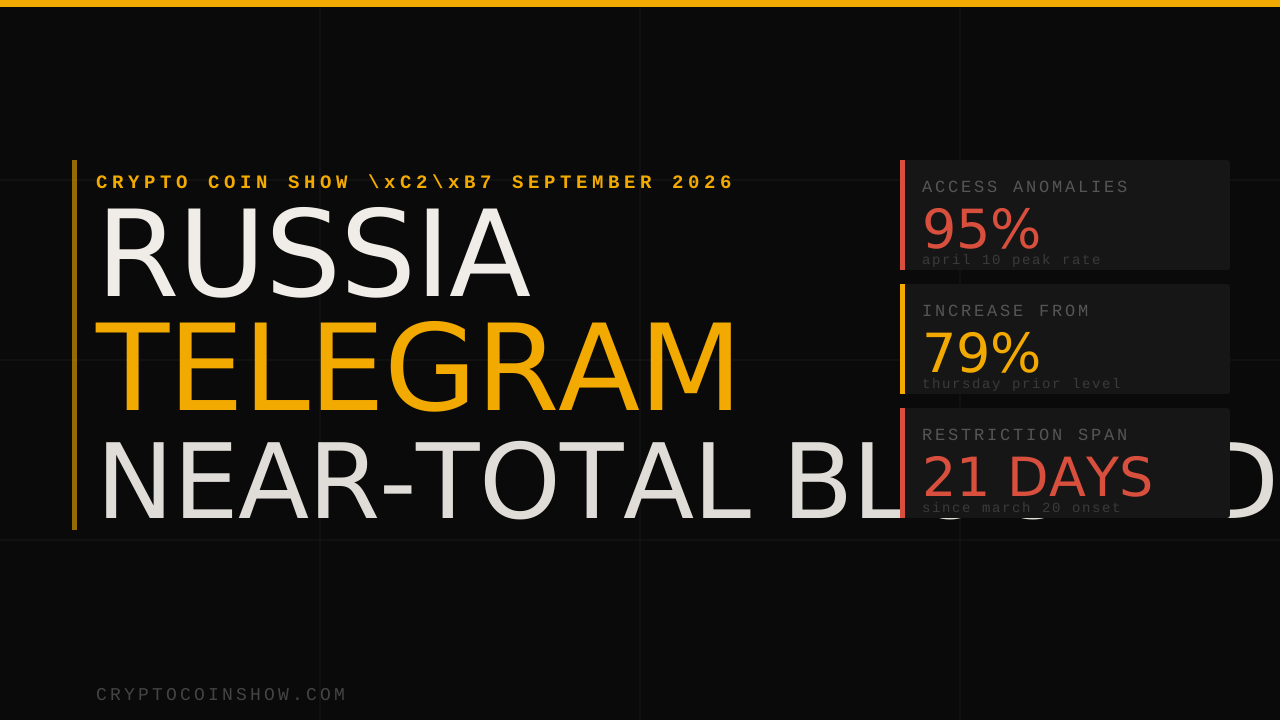
Attempts to completely restrict Telegram intensify in Russia
Russia has escalated its assault on Telegram to near-total blockade levels, with access anomalies hitting 95% on April 10, the highest rate since restrictions began in March, signaling Moscow’s determination to sever one of the few remaining uncensored communication channels ahead of potentially major geopolitical decisions. For institutional investors tracking emerging-market regulatory risk and digital asset infrastructure resilience, the intensifying crackdown illustrates the state’s willingness to weaponize telecom controls and raises questions about how decentralized networks might fill the void.
- Russia achieved 95% access anomalies to Telegram on April 10, jumping from 79% on Thursday, highest since March 20 restrictions began
- Roskomnadzor has now effectively blocked Signal, Discord, Viber, and substantially impaired WhatsApp after banning them officially by end of 2024
- Ukraine’s President Zelenskyy linked the Telegram blockade to Kremlin preparation for major geopolitical shifts, whether de-escalation or military escalation
- 95% Telegram access anomaly rate on April 10 versus prior monthly baseline
- 5,000+ Telegram outage complaints registered in 24 hours on Detector404.ru
- 89% Access anomaly rate for Signal and WhatsApp, lower than Telegram’s peak blockade
Russia’s campaign to completely restrict Telegram has entered a critical phase, with federal authorities achieving unprecedented blockade levels that now exceed the disruption inflicted on other banned messaging platforms.
According to independent Russian investigative outlet Agentstvo, citing data from the Open Observatory of Network Interference (OONI), access anomalies to Telegram spiked to 95% on the morning of April 10, a jump from 79% the previous day and the highest rate recorded since Russia’s formal restrictions campaign began on March 20.
The escalation marks a qualitative shift from the deliberate throttling that Russia’s telecom regulator Roskomnadzor (RKN) initiated in February, when it began slowing platform traffic in response to Telegram’s alleged non-compliance with demands to remove prohibited content.
Over 5,000 user complaints flooded into Russia-focused outage tracking sites within 24 hours, with the majority concentrated in Moscow and St. Petersburg, indicating the blockade affected the country’s largest population centers simultaneously.
Roskomnadzor achieves higher blockade intensity than other banned platforms
The April 10 anomaly rate of 95% represents a decisive intensification beyond the disruption already imposed on competing platforms. Signal, Discord, and Viber were formally banned by Russian regulators by the end of 2024, while WhatsApp was effectively blocked after the RKN deleted its domain in February.
On the morning of the Telegram spike, both Signal and WhatsApp recorded access anomaly rates of 89%, meaningfully lower than Telegram’s peak disruption, suggesting the state had calibrated a more aggressive blocking strategy specifically for Durov’s platform.
The distinction matters to institutional observers because it signals Moscow’s prioritization of eliminating Telegram over other messaging services, despite each platform having operated with over 90 million Russian users at the time restrictions began.
Roskomnadzor justified earlier restrictions on WhatsApp and voice calling features by claiming the platforms had become tools for fraud, extremism, and cybercrime, according to statements made when voice call limits were imposed in August 2025.
The timing of the blockade intensification follows a reported April 1 deadline by which Moscow demanded Telegram comply with content moderation requirements.
When the deadline passed without resolution, Agentstvo noted that disruption attempts accelerated, often clustering toward the end of the working week, a pattern suggesting the RKN may have been conducting incremental stress tests to measure and refine its blocking infrastructure.
The methodical escalation implies the blockade represents state policy rather than technical malfunction, a conclusion supported by the massive spike visible in user complaint data across multiple independent tracking platforms.
Zelenskyy sees Telegram blackout as signal of imminent Russian geopolitical moves
Ukrainian President Volodymyr Zelenskyy publicly linked Telegram’s blockade to Kremlin preparation for major decisions, framing the communication shutdown as potential cover for either war de-escalation or military escalation. In a statement Friday, Zelenskyy suggested the timing indicated Moscow anticipated unpopular announcements that would provoke significant domestic reaction.
His interpretation, that the state seeks to eliminate Telegram specifically because it remains an uncensored channel for internal dissent, aligns with independent analysis showing Telegram as the last major messaging platform with minimal state influence in Russia, making it uniquely valuable for independent reporting and civilian organizing.
The blockade campaign began immediately after Russia launched major policy initiatives in late March, creating institutional uncertainty about causation and motive.
Investors tracking geopolitical risk and regulatory crackdown patterns should note that telecom shutdowns of this scale historically precede either major military operations or significant domestic policy shifts that regimes anticipate will generate unmanaged social media reaction.
The fact that authorities chose to target Telegram with greater intensity than other platforms suggests they viewed it as uniquely threatening to information control during whatever transition lies ahead.
Zelenskyy’s public attribution of the blockade to imminent Russian decisions, without specifying which direction, underscores the ambiguity surrounding Moscow’s intentions and the international consequences of eliminating independent communication channels during periods of strategic uncertainty.
Market implications for decentralized networks and emerging-market infrastructure risk
The Telegram blockade demonstrates state capacity to sever access to centralized messaging platforms with minimal technical friction, a capability that extends institutional crypto and blockchain risk assessment beyond regulatory scrutiny to include outright infrastructure weaponization.
Centralized platforms depending on domain registration, telecom routing, or app store distribution remain vulnerable to sudden state disconnection.
By contrast, decentralized networks using peer-to-peer protocols or distributed domain systems could theoretically operate through state blockades, though few such platforms have achieved the user scale or reliability required for institutional reliance. The Russia case now serves as proof-of-concept for the strategic value of censorship-resistant infrastructure.
For institutional investors evaluating emerging-market operational risk, the escalating Telegram restrictions exemplify how rapidly state authorities can downgrade platform accessibility from merely throttled to functionally unavailable. Companies, financial institutions, and NGOs operating in Russia now face disrupted communications exactly when geopolitical uncertainty is highest.
This creates practical demand for communication tools that cannot be centrally disrupted, a category in which most blockchain-based messaging protocols, still in early stages, remain too immature for enterprise adoption. The gap between demonstrated need and available solutions represents both risk and opportunity for firms building decentralized communication infrastructure.
Observers should monitor whether the April blockade holds at the current 95% anomaly level or attempts complete disconnection in subsequent weeks, and whether Zelenskyy’s framing, that the blackout signals imminent Russian geopolitical decisions, proves accurate within 30 to 60 days. The durability and total nature of the blockade will directly inform assessments of whether centralized platforms can remain operationally viable in high-risk jurisdictions, and accelerate institutional interest in decentralized alternatives whose technical resilience has not yet been tested at scale in contested geopolitical environments.