
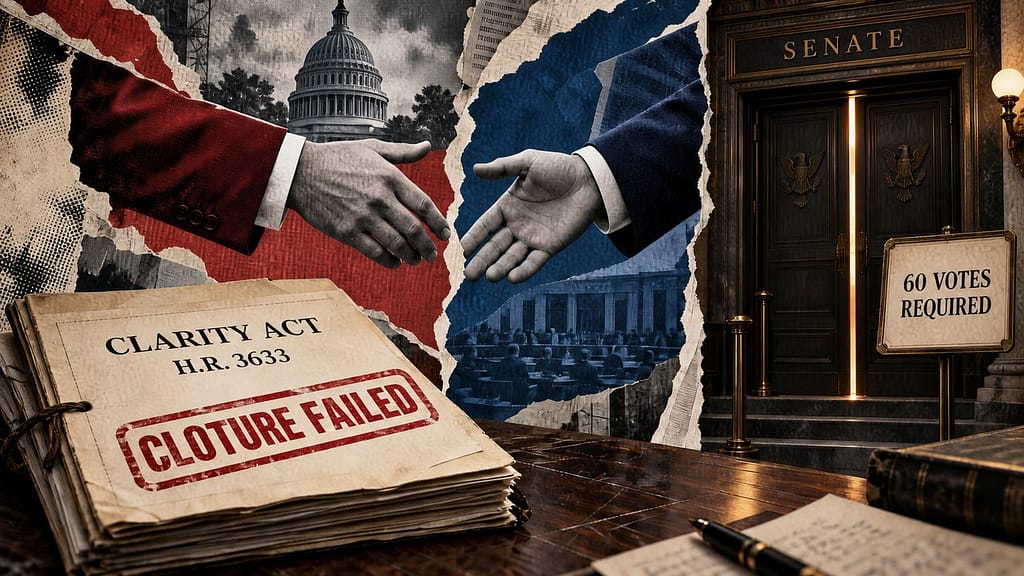
Senate Democrats block CLARITY Act over Trump ethics provisions
The Senate’s rejection of the CLARITY Act marks a decisive setback for institutional crypto infrastructure in the US, with bipartisan sponsors unable to hold a Democratic coalition over ethics safeguards tied to Trump’s financial interests. Institutional investors and trading firms now face ongoing regulatory uncertainty and delayed market-structure reforms that had been positioned as near-final.
- The CLARITY Act failed to secure 60 votes needed for cloture, blocking Senate floor consideration of H.R. 3633.
- Seven Democratic co-sponsors, Gillibrand, Warner, Booker, Warnock, Gallego, Alsobrooks, and Cortez Masto, voted against proceeding with the bill.
- Last-minute ethics negotiations broke down over restrictions on crypto holdings by Trump and senior officials, leaving Republicans without their Democratic coalition.
- 60 votes required for cloture; the CLARITY Act fell short of this threshold
- 126 substantive changes incorporated into the 635-page final text over the weekend
- $1.4 billion collected by Trump and his family from crypto-related ventures, per Sanders
The Senate blocked the CLARITY Act on a cloture vote that split both parties, ending months of negotiations meant to deliver the most comprehensive US crypto market-structure legislation since the SEC-CFTC framework emerged. According to reporting first published by CryptoSlate, Republican sponsors had released a sweeping 635-page rewrite over the weekend incorporating 126 changes Democrats had requested, while President Donald Trump agreed to tougher ethics restrictions on crypto holdings by him and senior officials. The measure still collapsed. The breakdown exposes a fracture within the bipartisan group that had shaped the legislation for months: seven Democrats who helped draft it voted to block its advance, withholding the 60 votes the Senate requires to proceed to floor debate.
Seven Democratic co-sponsors vote against their own bill over ethics safeguards
Sens. Kirsten Gillibrand, Mark Warner, Cory Booker, Raphael Warnock, Ruben Gallego, Angela Alsobrooks and Catherine Cortez Masto all voted no, signaling that concessions Republicans made on restrictions governing crypto interests held by Trump and administration officials remained insufficient. The defections came after staff negotiations in the Capitol hideaway office of Sen.
Thom Tillis failed to close remaining gaps on ethics rules. Senate Banking Committee Chairman Tim Scott’s staff ended talks without agreement, leaving Republicans to approach the vote without the Democratic coalition they had spent months assembling.
Ethics emerged as the decisive fault line in the final hours.
Sen. Elissa Slotkin, who had been closely involved in drafting the bill, said she opposed it because restrictions on crypto holdings by Trump, his family and administration officials remained too weak, adding that “The ethics provisions in this bill are simply too thin.” Slotkin argued that Congress needed rules robust enough to bind any future administration, regardless of party. She also raised national-security concerns, questioning whether the Commodity Futures Trading Commission and other enforcement agencies possessed adequate staffing to detect money-laundering channels linked to terrorist groups, North Korea and Iran.
Sanders ties crypto industry spending and Trump’s financial stake to the legislative collapse
Sen. Bernie Sanders framed his opposition more broadly, linking opposition to the bill to crypto billionaires’ political spending and Trump’s financial interests in the sector. Sanders noted that crypto industry figures had spent nearly $300 million on the midterm elections, while Trump and his family had collected more than $1.4 billion from crypto-related ventures.
He accused the industry of using that capital to seek favorable legislative treatment and urged senators to reject the bill.
Sanders’ argument implicitly questioned whether any ethics framework tied to Trump could credibly govern conflicts of interest at the highest levels of government.
Republicans face a choice between reopening ethics or abandoning the CLARITY Act
The failed vote leaves Republican sponsors with a narrow path forward, should they choose to pursue one. Reviving the CLARITY Act would require reopening provisions they had already designated as final compromise, most critically the ethics rules that failed to retain support from Democratic co-authors most closely involved in the bill’s construction.
Slotkin indicated she remained open to future negotiations and acknowledged that the bill’s market-structure provisions offered a bipartisan foundation for another attempt, but only if ethics safeguards were strengthened materially.
The timing of the collapse carries institutional weight: market participants have watched the CLARITY Act’s window narrow as the legislative calendar tightens and political priorities shift. The defeat removes what had been positioned as the most plausible near-term path to comprehensive market-structure reform, leaving trading venues, derivatives platforms and asset managers operating under fragmented SEC and CFTC jurisdiction with no clarity on whether a unified framework will emerge before the next Congress.
The CCS read. We view the collapse not as final death of the bill but as evidence that any legislation governing crypto must credibly separate financial incentives from regulatory authority, a hurdle Trump’s involvement has raised, not lowered. Institutional investors should prepare for an extended period of regulatory ambiguity rather than assume ethics concerns, once resolved, deliver a vote. The real question for sponsors is whether reopening negotiations strengthens or weakens their coalition further.
Republican leadership must decide within weeks whether to attempt fresh negotiations on ethics safeguards or let the CLARITY Act expire with the current session; any revival would require at least some Democratic signers to reverse course, a prospect neither side has publicly committed to pursuing.