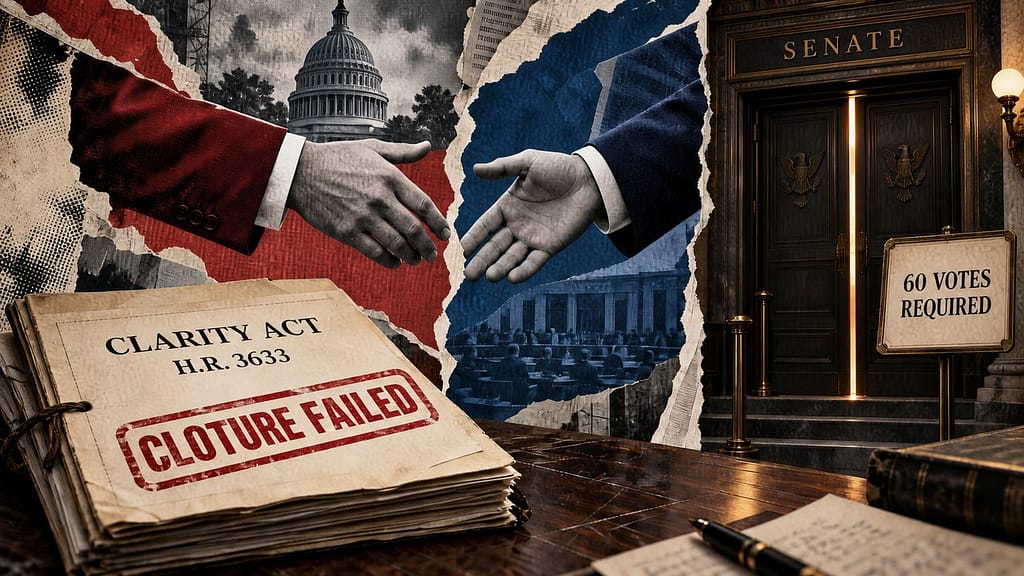
Seven Senate Democrats withdraw CLARITY Act support over Trump ethics provisions
Senate Democrats who spent months drafting crypto market-structure legislation withdrew support over weak ethics rules for Trump and his family, killing the CLARITY Act before floor debate. The vote failure signals institutional crypto investors that regulatory clarity remains frozen and the political dynamics around self-dealing by senior officials have become a dealbreaker in Washington.
- The CLARITY Act fell short of 60 votes needed for cloture, blocked by seven Democrats including Gillibrand, Warner, and Booker who had shaped the bill.
- Sen. Elissa Slotkin cited ethics provisions as “simply too thin” to restrict Trump and his family’s crypto interests under the proposed framework.
- Republicans must now choose whether to reopen negotiations on ethics rules or abandon the most significant US crypto regulation attempt this year.
- 60 votes needed for cloture; the bill fell short before Senate floor reached it.
- 635 pages of final text incorporating 126 substantive changes Democrats requested.
- $1.4B collected by Trump and family from crypto ventures, per Sanders’ statement.
The CLARITY Act stalled in the Senate on Tuesday (September 15) after final bipartisan negotiations over ethics rules collapsed and seven Democrats who had helped write the measure withdrew their support, according to first reported by CryptoSlate. The vote to invoke cloture on the motion to proceed with H.R. 3633 failed to reach 60 votes, leaving the most substantial US crypto market-structure proposal off the Senate floor and forcing sponsors to decide whether another negotiating round is viable. The outcome marks a sharp reversal: Sens. Kirsten Gillibrand, Mark Warner, Cory Booker, Raphael Warnock, Ruben Gallego, Angela Alsobrooks and Catherine Cortez Masto all voted against moving forward, abandoning months of collaborative work on provisions governing how digital-asset firms operate under federal oversight.
Senate staff ended ethics talks without agreement, derailing compromise on Trump family interests
The breakdown centered on restrictions governing crypto interests held by public officials, particularly President Trump, his family and administration officials. Senate staff met in Capitol hideaway offices to discuss final changes to the ethics package, with the Banking Committee Chairman Tim Scott’s team reportedly engaged in the talks.
Staff working for Scott ended negotiations without reaching an agreement on language that would satisfy Democratic drafters, leaving Republicans without the coalition they had spent months assembling.
Republicans had released a 635-page final text over the weekend that incorporated 126 substantive changes Democrats sought, and Trump had agreed to tougher restrictions on crypto-related financial interests held by senior officials. Those concessions still fell short of the ethical guardrails key Democrats demanded, ending hopes that a compromise package would hold the necessary bipartisan votes.
Slotkin calls ethics provisions “simply too thin” to prevent future administrations using office for crypto gain
Sen. Elissa Slotkin said she opposed the bill because its restrictions on Trump and his family’s crypto interests remained insufficient to prevent future administrations from using public office to benefit from digital-asset ventures. She stated that Congress should impose rules strong enough to apply to any future government, regardless of party.
The ethics provisions in this bill are simply too thin.
Sen. Elissa Slotkin, U.S. Senator, Michigan
Slotkin also raised national-security concerns, arguing that lawmakers needed more work on money laundering and financing channels linked to terrorist groups, North Korea and Iran. She questioned whether agencies tasked with enforcing the new framework, including the Commodity Futures Trading Commission, had sufficient staffing and oversight capacity to carry out the rules.
Critically, Slotkin did not reject market-structure legislation altogether, signaling that bipartisan provisions in the bill could form the foundation for future negotiations if ethics safeguards were strengthened.
Sanders ties bill defeat to crypto industry spending and Trump family wealth from digital assets
Sen. Bernie Sanders took a broader approach, linking the failed vote to what he characterized as the crypto industry’s attempt to secure favorable congressional treatment. Sanders said crypto billionaires had spent nearly $300 million on the midterm elections, while Trump and his family had collected more than $1.4 billion from crypto-related ventures.
He urged senators to reject legislation he said would benefit industry insiders at the expense of ordinary investors.
Sanders’ framing connected the ethics collapse to a larger debate about regulatory capture: whether Congress was being asked to write market-structure rules that would simultaneously protect Trump family financial interests. Unlike Slotkin, Sanders did not indicate openness to revised negotiations, positioning the vote as a choice between protecting public trust or deferring to crypto wealth.
Republicans face choice between reopening ethics negotiations or abandoning crypto regulation this term
The failed cloture vote leaves the Republican leadership with a strategic dilemma. Reviving the CLARITY Act would likely require reopening ethics provisions they had already presented as final, particularly the restrictions on senior officials’ crypto interests that failed to retain the support of Democrats most closely involved in drafting the bill.
No timeline for a renewed attempt has been announced, and the political damage from the public defection of seven Democratic co-authors may complicate future coalition-building.
The CCS read. We see the ethics guardrails as the real institutional issue here. The market-structure plumbing in the CLARITY Act, clearing, custody, derivatives oversight, was largely settled. What broke the deal was whether the bill’s authors and the sitting administration could be trusted to enforce it fairly. That is an enforcement problem masquerading as a drafting problem, and it is unlikely to resolve without explicit firewalls between elected officials’ crypto portfolios and their votes on regulation.
Senate Banking Committee Chairman Tim Scott has not yet announced whether he will move to reopen negotiations or whether the CLARITY Act’s legislative window has closed for this year. The timing matters: the Senate is entering its final weeks before year-end recess, and any revised bill would need to clear both chambers before the holiday break to avoid indefinite stalling.