Iran Threatens U.S. Tech Giants as Middle East Conflict Escalates — Crypto Coin Show
Breaking News · Middle East · Geopolitics
Iran Threatens U.S. Tech Giants as Middle East Conflict Escalates
Oracle’s Dubai tower takes debris strike. Iran’s Revolutionary Guard names Nvidia, Apple, Microsoft and Google as targets. A missing U.S. airman, two downed aircraft and a 48-hour ultimatum from Trump.
AA
Ashton AddisonFounder & CEO · Crypto Coin Show · Since 2014
5 April 2026
Refinitiv TV · 600K+ Subscribers
Location
Dubai Internet City — Oracle Building
Threats Intercepted (UAE)
Dozens in 24 hours
U.S. Aircraft Lost
F-15E downed · A-10 crashed (Kuwait)
Trump Ultimatum
48 hours · Hormuz Strait
01 —
Oracle Building Hit as American Corporate Sites Enter the Blast Zone
Iran launched a broad wave of missile and drone attacks across the Middle East on Saturday, marking a significant shift in the conflict’s geography. The UAE said it intercepted dozens of incoming projectiles in the 24 hours prior — and debris from one intercept struck the facade of the Oracle building in Dubai Internet City.
The Dubai Media Office confirmed no injuries and described the incident as minor. Damage was limited. But the symbolic weight was not: American corporate infrastructure in the Gulf is no longer sitting outside the blast zone.
Iran’s Revolutionary Guard simultaneously issued direct threats against a wider group of U.S. technology companies operating across the region — naming Nvidia, Apple, Microsoft and Google by name.
⚠ Iran’s Revolutionary Guard has directly threatened U.S. tech infrastructure in the Middle East, including Nvidia, Apple, Microsoft and Google.
02 —
Missing Airman, Two Downed Aircraft and Trump’s 48-Hour Warning
The U.S. military continued searching Saturday for a missing airman after an F-15E was shot down over southwestern Iran on Friday — the first U.S. combat aircraft successfully downed by Iranian forces since the conflict began in late February. One crew member was rescued. The second remained missing, with both U.S. and Iranian forces searching the same area.
In a separate incident, an A-10 Warthog pilot ejected after the aircraft was struck by Iranian fire over Kuwait. Two Black Hawk helicopters deployed in the search operation also came under fire inside Iranian airspace, though both returned safely. U.S. officials privately expressed concern the missing airman could be captured and used as political leverage by Tehran.
“Time is running out — 48 hours before all Hell will reign down on them.“
Donald Trump · Truth Social · 5 April 2026
President Trump posted on Truth Social on Saturday referencing his earlier ultimatum over the Strait of Hormuz, warning Iran it had 48 hours before consequences. The threat followed his earlier demand that Iran open the strait or make a deal within ten days.
03 —
India Resumes Iranian Crude as Bushehr Plant Takes Strike
India’s oil ministry confirmed its refiners had secured crude supplies including Iranian oil, after disruptions to Strait of Hormuz shipping lines cut into global supply. India had not received Iranian crude since May 2019, when U.S. pressure pushed buyers away from Tehran’s exports. The ministry also confirmed that 44,000 metric tons of Iranian liquefied petroleum gas had berthed at Mangalore this week aboard a sanctioned vessel.
The move signals a realignment in energy trade. The United States had temporarily removed sanctions on Iranian oil and refined products to reduce supply shortages — a decision now being tested by the ongoing strikes.
Near Bushehr, a projectile struck close to Iran’s nuclear power plant overnight, killing at least one worker and damaging part of the site. The International Atomic Energy Agency confirmed radiation levels remained normal but issued a warning against further strikes near nuclear facilities. Iran’s Foreign Minister said Tehran was not ready to rush into negotiations and would accept only a “conclusive and lasting” resolution to the war.
Russian state nuclear company Rosatom evacuated an additional 198 staff from the Bushehr site. It has been withdrawing workers since the conflict began at the end of February.
This article is based on reporting from Reuters, official statements from the Dubai Media Office, India’s oil ministry, the International Atomic Energy Agency, and Truth Social. Crypto Coin Show has not independently verified all claims made by parties to the conflict.
What looks like a geopolitical threat aimed at US multinationals could quickly become a crypto story too.
That is because several of the companies threatened by Iran now sit inside the infrastructure, payments, and corporate treasury layers that parts of the digital-asset industry rely on.
According to the Wall Street Journal, the IRGC warned that US companies in the region would be targeted from April 1 and named firms including Microsoft, Google, Apple, Intel, IBM, Tesla, and Boeing. Other multinationals mentioned in the reports included JPMorgan Chase, Oracle, Palantir, Cisco, HP, and Nvidia.
Why this matters: Crypto is no longer exposed only through exchanges and token prices. It now depends on cloud platforms, banking rails, and public companies with Bitcoin exposure, which means geopolitical threats aimed at mainstream firms can spill into digital assets faster than many investors expect.
The group said those companies would be treated as “legitimate targets” in retaliation for US and Israeli strikes on Iran.
For crypto markets, the significance is not that these are digital-asset companies in the narrow sense. It is that several of the firms named by Iran sit inside the operating stack that now supports large parts of the industry, from cloud computing and data processing to tokenized payments, treasury management, and corporate Bitcoin exposure.
The threat also comes after the war had already begun to hit infrastructure across the Gulf. Last month, Amazon Web Services data centers in the United Arab Emirates and Bahrain were damaged by drone strikes, disrupting cloud services and prolonging recovery efforts.
Meanwhile, the broader conflict has already expanded well beyond a conventional military exchange. Over more than a month of fighting, the US and Israel have struck Iranian energy and other national infrastructure, while Iran has launched more than 3,000 drones and missiles toward the United Arab Emirates, Saudi Arabia, Bahrain, and Kuwait.
Against that backdrop, the IRGC’s threat points to a wider phase of economic and corporate pressure, one that could extend into parts of the infrastructure surrounding crypto.
Which crypto-related firms are affected?
Not all of the companies named by the IRGC are crypto-native businesses. Still, several already have direct or indirect ties to the industry, making them relevant to the market beyond the usual reaction of Bitcoin and other tokens to war headlines.
Google is the clearest example because it sits deep inside crypto’s operating stack, and its Web3 business is not a peripheral effort.
Google Cloud, a subsidiary of Google, offers managed node infrastructure, analytics tools, and developer services for blockchain applications, and works with firms such as Cardano-backed Midnight blockchain, Coinbase, and others.
In fact, the firm recently took a major step into blockchain infrastructure development with the launch of the Google Cloud Universal Ledger (GCUL). This is a Layer 1 blockchain network designed to enable faster payments and cross-border settlement.
Rather than acquiring mining companies outright, the Alphabet-owned company has provided at least $5 billion in disclosed credit support tied to a handful of miners’ AI projects.
That backing has helped reframe some previously unrated Bitcoin miners as infrastructure-linked borrowers that lenders can view less as pure commodity businesses and more as counterparties with strategic data-center potential.
All of this does not make Google a crypto company, but it does place the firm close to one of the industry’s most important restructurings.
JPMorgan’s link is different, but just as relevant.
For context, JP Morgan launched Kinexys in 2020 as a digital-asset service platform and has since processed more than $3 trillion of transactions.
The bank describes Kinexys as a blockchain-based payment rail that allows participating clients to move funds around the clock, including across borders, with availability spanning Europe, the Middle East, and Africa.
The bank reportedly plans to double daily transaction values on its Kinexys blockchain platform to $10 billion.
Apart from that, JPMorgan has also pushed further into on-chain finance through its asset-management arm.
Tesla is the most direct balance-sheet link among the companies named.
The Elon Musk-led company is not part of crypto’s infrastructure in the same way as Google or JPMorgan, but it remains one of the listed firms with measurable digital-asset exposure on its books.
According to data from BitcoinTreasuries.com, Tesla holds 11,509 Bitcoin as of press time, making it one of the top 20 public firms worldwide with BTC exposure. In fact, Tesla is the only top 10 company by market capitalization with exposure to the top crypto.
This stands it out in the broader market and confirms its conviction in the emerging industry.
Outside of Bitcoin, the company has also shown significant adoption for Dogecoin, the largest memecoin by market capitalization.
These efforts, alongside Musk’s enduring interest in the crypto industry, make it a significant player within the sector.
The core shift here is simple: crypto risk is no longer confined to crypto-native companies.
As the sector becomes more entangled with big tech, banks, and public-company treasuries, threats aimed at those firms can become market-relevant for digital assets even when no exchange or blockchain company is directly named.
Other firms with crypto links
Beyond those first-order examples, the IRGC list also includes companies with looser but still notable ties to digital assets.
NVIDIA is one of them. The company is now defined primarily by AI computing and data-center revenue, but it previously had a long and sometimes contentious history with crypto mining.
However, NVIDIA is no longer central to mining as it once was, but its historical connection to the sector remains part of the market’s memory, especially when crypto and AI capital spending begin to overlap.
The company’s crypto exposure has centered on enterprise blockchain through Azure rather than direct token holdings. It has accepted Bitcoin through BitPay in limited contexts, while also pursuing blockchain-as-a-service tools, decentralized identity work through ION, and research into secure computing systems relevant to digital infrastructure.
At the corporate treasury level, Microsoft has kept its distance. Its shareholders voted against adding Bitcoin to the balance sheet after the board recommended rejecting it. The board said such an assessment was unnecessary and preferred stable, low-risk investments over the volatility of crypto.
Taken together, the companies named by Iran show how far crypto’s exposure now extends beyond exchanges and token prices.
The industry’s links to cloud providers, global banks, AI infrastructure, and corporate treasuries mean geopolitical threats aimed at mainstream US firms can quickly become relevant to digital assets as well.
The next test is whether this threat remains rhetorical or starts to affect the companies and infrastructure layers that parts of crypto now depend on. If that happens, the market impact may show up first through cloud resilience, payments flows, and risk sentiment before it appears in token prices themselves.
Mohammad Bagher Ghalibaf, the speaker of Iran’s parliament, posted a striking piece of market commentary on X before the latest futures swing. Adding fuel to the online propaganda proxy war being fought on social media, the comments lean into accusations of insider trading on Polymarket war bets.
“Pre-market so-called ‘news’ or ‘Truth’ is often just a setup for profit-taking,” he wrote. “If they pump it, short it. If they dump it, go long.”
The market then traded almost exactly as described.
The Kobeissi Letter tracked the move in time order, with S&P 500 futures opening sharply lower on Sunday evening, recovering by late evening, then extending higher after President Trump said on Truth Social that “great progress” had been made on Iran peace talks.
Annotated 30-minute S&P 500 E-mini futures chart showing a sharp overnight rebound after headlines about Trump’s comments on Iran peace talks, with markers highlighting key time-stamped moves from the futures open to the morning recovery.
MarketWatch confirmed the validity of the account that had so publicly offered contrarian trading advice to U.S. investors shortly before the Sunday futures open, and Barron’s described Monday’s rebound as another early-morning market jolt driven by Trump’s social-media messaging on Iran.
Trump’s posts around Iran have repeatedly altered short-term pricing across equities, oil, and crypto.
Bloomberg reported that billions of dollars in oil and stock-index futures changed hands shortly before one of Trump’s Iran posts sent crude lower and equities higher, while The Wall Street Journal described a burst of futures activity ahead of another Trump message that drew scrutiny across trading desks.
The economic climate for the week ahead sits inside that backdrop.
The market faces a geopolitical risk premium in oil, a rising probability of slower growth, and a political communications channel that now functions as an immediate pricing input.
Monday’s cross-asset move makes the interaction plain.
S&P 500 futures added to gains after Trump said the U.S. was in “serious discussions” with a “new, and more reasonable regime” in Iran.
The same message cycle has also included a threat to “completely obliterate” Iran’s energy and water infrastructure if a settlement failed to materialize.
That combination, conciliatory language on one side and escalation risk on the other, shaped the session. The Wall Street Journal reported WTI above $100 a barrel and Brent above $108, while Brent then surged above $116 as the conflict intensified.
Investors are now dealing with diplomacy and disruption at the same time, and the energy channel remains the main route into inflation, rates, and growth.
Bitcoin enters this equation with one structural advantage over every major U.S. risk asset.
It trades through all of it, through weekends, through Asia hours, through the periods when Wall Street’s core cash market is closed.
Bitcoin tracked the same macro shock as equities, then formed its own pattern while Wall Street was offline
Bitcoin’s value in this sequence comes from timing.
It trades continuously, so it acts as a live macro market when U.S. equities are closed.
That gives it two roles at once.
It responds to the same geopolitical inputs that move the S&P 500, and it also offers a real-time view of how those inputs are being absorbed outside the U.S. cash session.
The pattern in the charts around this latest Iran-Trump sequence clearly carries that distinction.
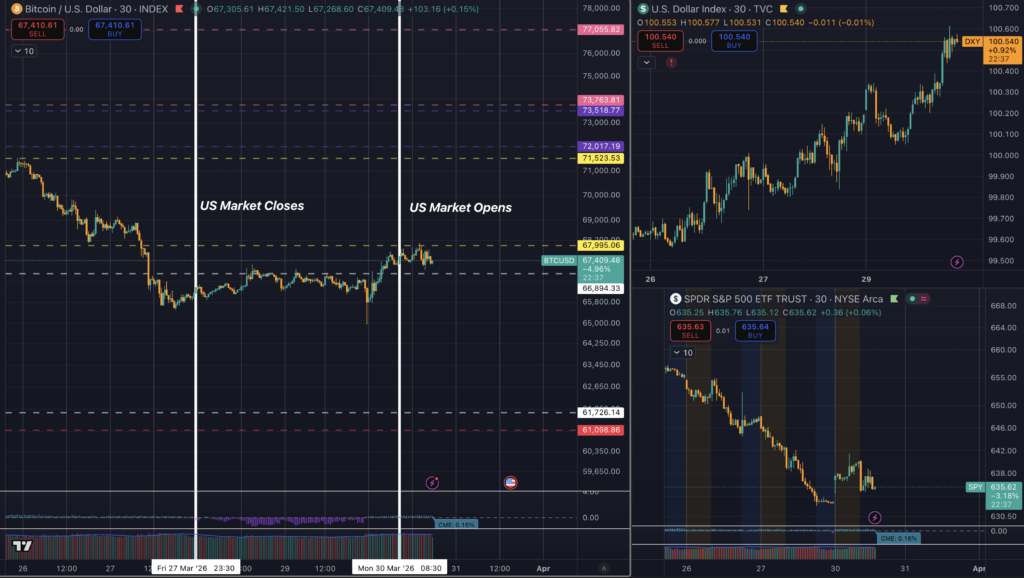
Bitcoin sold off hard into the weekend and into the period around the U.S. close, then moved into a long stabilization band while U.S. equities sat offline.
Bitcoin price fell to the March 27 close, then spent much of the closeout period in a broad range around the mid- to upper $66,000s, before firming into the U.S. open on Monday.
The S&P’s intraday sequence was sharper and more discrete.
Bitcoin’s sequence was earlier, more continuous, and more gradual.
That broad structure lines up with broader market reporting from earlier in the month.
Bitcoin was the first liquid asset to price the Iran war when the initial attack cycle began on a Saturday, dropping 8.5% while traditional markets were closed.
In the days that followed, Bitcoin slid as far as $67,300 before turning higher after Trump said the U.S. had begun talks with Iran. Bitcoin then climbed back above $71,000 when war concerns eased.
Bitcoin also slid below $68,500 last week as another round of mixed messaging from Iran whipsawed markets. There’s a simple interpretation.
Bitcoin has been trading as a macro-sensitive asset throughout this conflict, with oil, rates, and political signals shaping direction.
The latest charts add a more refined point.
Three market charts showing Bitcoin, the U.S. Dollar Index, and the 10-year Treasury yield around the U.S. market open.
Bitcoin mirrored the S&P at the regime level, with both assets weakening under geopolitical stress and firming when Trump’s rhetoric shifted toward talks. Within that regime, the path diverged.
During the hours when the S&P cash market was closed, Bitcoin spent more time absorbing losses and building a base than extending a strong relief move.
The visible lift came closer to the U.S. open.
That timing suggests Bitcoin functioned as a pre-open sentiment gauge for the Monday rebound in equities, with the strongest upside leg appearing from around 00:01 UTC on Monday into the U.S. session.
The U.S. Dollar Index has also climbed steadily into Monday, which gives the move extra texture.
A firmer dollar usually tightens the backdrop for BTC and other risk assets.
Bitcoin’s ability to stabilize and then rise alongside a rising DXY points to a move driven by repricing around Iran and Trump’s messaging, supported by positioning and relief, with less help from the currency side of the macro equation.
Oil, payrolls, retail sales, and Bitcoin’s 24/7 signal define the week ahead
The macro calendar now arrives with crude oil at the center.
The Wall Street Journal said WTI had climbed roughly 50% since the U.S. and Israel began bombing Iran in late February.
Axios wrote that the OECD now sees U.S. inflation reaching 4.2% in 2026, up 1.2 percentage points from expectations in December, because the war and the energy shock have altered the inflation path.
That turns this week’s economic releases into a concentrated stress test.
The Bureau of Labor Statistics says the March Employment Situation arrives Friday, April 3, at 8:30 a.m. ET.
The Census Bureau says the delayed February advance retail sales release lands on April 1.
The Institute for Supply Management says the March Manufacturing PMI will be released at 10:00 a.m. ET on Wednesday, April 1.
Each of those reports now carries a second layer. Investors will judge growth through the lens of oil. That raises the pressure on every risk asset, including bitcoin.
Bitcoin has already outperformed many major assets at points during the stress.
The immediate week-ahead setup is narrower and more practical.
Bitcoin is serving as a high-beta macro instrument during geopolitical repricing, and it is also serving as a 24/7 discovery venue for sentiment shifts that hit outside U.S. cash hours.
That combination makes Bitcoin unusually useful right now.
If Trump posts over a weekend, bitcoin trades first.
If oil surges in Asia hours, bitcoin absorbs that input before New York.
If a diplomatic turn emerges in the early morning, bitcoin can begin revaluing risk before the S&P cash market gets a vote.
The unresolved question for the week sits exactly here.
Trump’s Iran posts have shown enough market impact to count as a working transmission channel, and traders have been watching these moments closely, including bursts of trading activity that arrived shortly before some of the posts.
Markets still need confirmation from events on the ground, from oil, and from the incoming U.S. data.
Bitcoin offers one of the clearest real-time views of how investors are processing that uncertainty.
The recent pattern suggests a sequence with three phases, initial risk repricing, stabilization through the closure, then a firmer advance into the U.S. reopen.
If that sequence repeats during the next round of Iran-related messaging, bitcoin’s weekend and overnight behavior will offer one of the earliest clues about whether traders see another temporary relief move forming, or whether the energy shock is taking control of the week.