
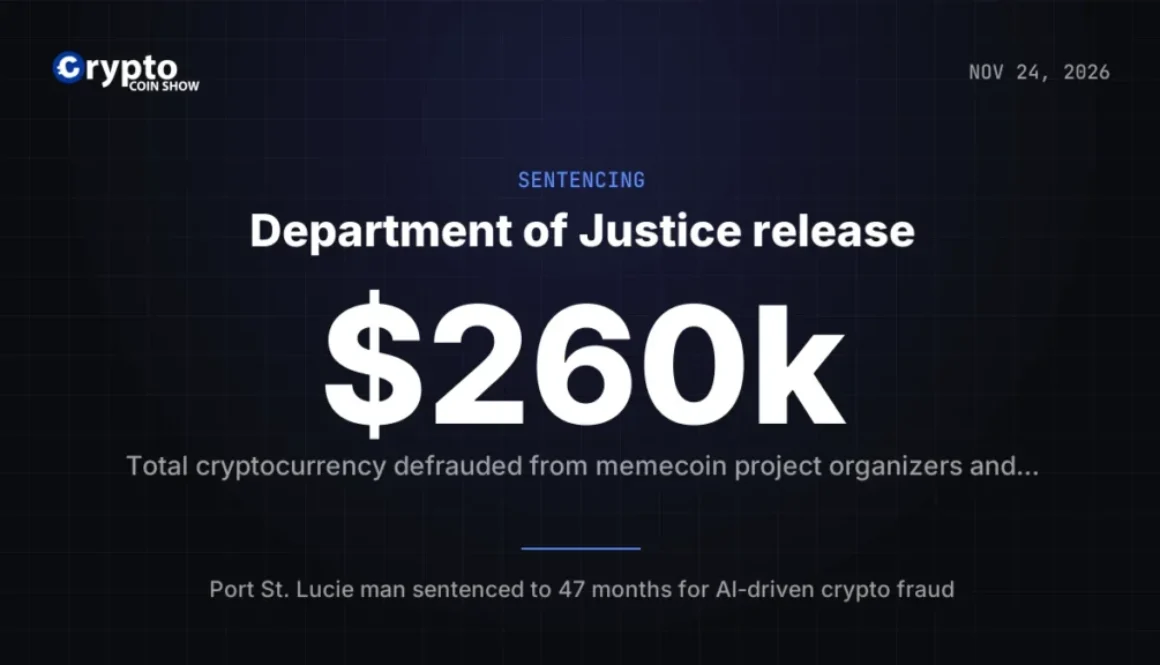
Port St. Lucie man sentenced to 47 months for AI-driven crypto fraud
A Port St. Lucie man has been sentenced to 47 months in federal prison for using AI-generated voice recordings and forged accounts to impersonate online streamer N3ON, defrauding cryptocurrency memecoin project organizers of approximately $260,000. The case marks an enforcement action against a defendant who weaponized emerging technology to manipulate victims into transferring digital assets.
- David Anthony Sanchez pleaded guilty to money laundering and aggravated identity theft.
- Sanchez created fake accounts mimicking N3ON and sent AI-generated voice recordings to falsify participation in a cryptocurrency memecoin project.
- Victims transferred $260,000 in cryptocurrency to accounts Sanchez controlled; he then converted substantial portions to U.S. dollars to obscure the proceeds.
- $260k Total cryptocurrency defrauded from memecoin project organizers and victims.
- 47 mo Prison sentence imposed by U.S. District Judge Melissa Damian.
- 36 Age of David Anthony Sanchez at sentencing.
The Department of Justice release from the U.S. Attorney’s Office for the Southern District of Florida details how Sanchez exploited artificial intelligence and social engineering to target organizers of a cryptocurrency memecoin project. Rather than targeting retail token holders directly, Sanchez focused on project stakeholders who controlled distribution and credibility mechanisms, using impersonation to gain their trust and capital.
AI Voice and Forged Identity in a Memecoin Endorsement Scheme
Sanchez operated under multiple aliases including “Dave the Jewler” and “Rueben Alexis De Jesus Santana.” He created online accounts designed to appear as though they belonged to N3ON, the targeted streamer, and communicated with memecoin project organizers while posing as both the streamer and his representative. The defendant executed agreements using N3ON’s identity without authorization.
The technical centerpiece of the scheme was the AI-generated voice recording. Sanchez sent an audio file that mimicked N3ON’s voice to falsely confirm the streamer’s participation in the memecoin project. Project organizers, deceived by the synthetic voice and forged correspondence, transferred approximately $260,000 in cryptocurrency to accounts Sanchez controlled.
Money Laundering and Asset Conversion
After receiving the cryptocurrency transfers, Sanchez executed financial transactions designed to conceal the nature, source, and ownership of the fraud proceeds. He converted a substantial portion of the cryptocurrency into U.S. dollars, a money laundering step that created distance between the digital assets and their use for personal benefit.
The court documents do not specify which cryptocurrency tokens were transferred, the name of the memecoin project, or which financial platforms or services facilitated the conversion to fiat currency. Sanchez was ordered to pay restitution to victims, though the release does not disclose the amount or repayment terms.
Emerging Technology as a Tool for Financial Fraud
Acting U.S. Attorney Yara Lorenzo Klukas stated that the sentence “reflects our commitment to protecting victims, safeguarding the integrity of our financial markets, and holding accountable those who exploit emerging technologies to defraud others.” The case signals that federal prosecutors view AI-enabled identity fraud as a priority, particularly when applied to digital asset schemes.
The sentencing follows a guilty plea to both money laundering and aggravated identity theft. Sanchez did not contest the charges or the facts underlying the scheme, suggesting a cooperation agreement or straightforward factual record. No counterclaim, defense statement, or rebuttal from Sanchez is documented in the release.
The CCS read. Memecoin projects are governance- and social-credential-dependent; they live or die on perceived endorsements. Sanchez exploited that dependency. The scheme required no exchange compromise, no smart contract exploit, and no protocol vulnerability. It required only convincing project leads that a trusted influencer had agreed to participate. As AI voice synthesis improves, impersonation fraud will scale unless projects implement out-of-band verification for celebrity endorsements and enforce cryptographic proof of consent from public figures.
Sanchez’s sentencing is final; case documents are available through the Southern District of Florida pacer system under case number 26-cr-60089. Watch for whether the FBI or other agencies announce coordinated enforcement against AI-enabled crypto fraud rings, or whether platforms hosting impersonation content face civil liability for facilitating memecoin schemes.