
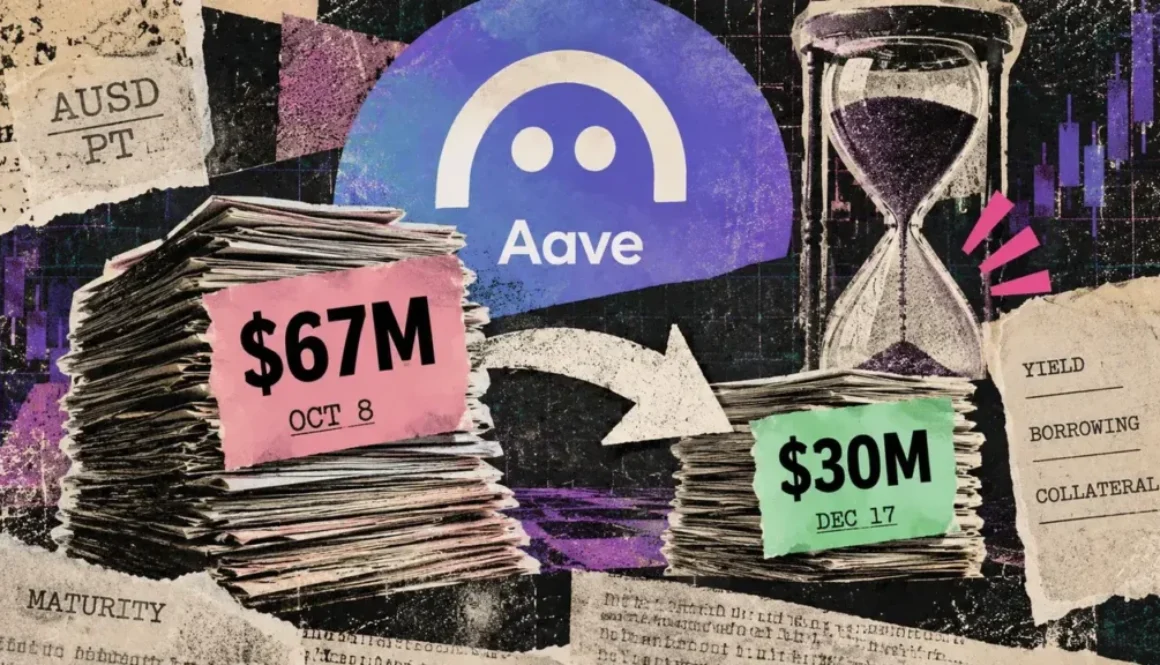
Aave governance proposes rolling Pendle fixed-yield position into December successor token
A rollover mechanism designed to keep Pendle’s fixed-yield AUSD collateral inside Aave’s Monad lending market rather than letting it exit at maturity is being proposed. A Direct-to-AIP proposal now before Aave governance would list a December 17 Pendle principal token as the designated successor to an October position that grew eightfold past its original cap, a structural test of whether stablecoin credit cycles can roll forward indefinitely on-chain.
- PT-AUSD-8OCT2026 matures October 8, 2026, with 67.4 million tokens supplied against an 80 million cap.
- TokenLogic’s proposal would list PT-AUSD-17DEC2026 using identical risk parameters, starting at a 20 million supply cap.
- LlamaRisk estimates up to 67.4 million in Aave collateral could migrate into the December market as the October token expires.
- 67.4M PT-AUSD tokens supplied versus Aave’s 80M cap
- 58.9% share of global AUSD supply held on Monad, ahead of Ethereum’s $76.0M
- 113% rise in active AUSD loans on Aave in 15 days
The Direct-to-AIP proposal on the Aave governance forum states that PT-AUSD-8OCT2026 redeems 1:1 for AUSD at maturity on October 8, 2026, two days after this report, and that fixed-yield appreciation stops at that point. The original October listing passed as AIP 513 following an ARFC and a Snapshot vote carrying 99.99% support, and the December listing would reuse that same oracle methodology and token factory rather than build new infrastructure.
TokenLogic’s Proposal Reuses October’s Exact Risk Parameters
The proposal sets borrowing disabled on the new token and restricts its use to a dedicated stablecoin eMode, matching PT-AUSD-8OCT2026’s configuration down to the discount-oracle design. Each oracle instance carries a fixed maturity date, so Aave needs a fresh deployment for every new Pendle expiry even when the underlying parameters do not change.
By October 2, 67.4 million PT-AUSD-8OCT2026 sat against the 80 million cap, according to the proposal. That figure climbed to 67.4 million by October 2, a pace first tracked by CryptoSlate, which also reported that TokenLogic, an active Aave service provider under stream 100086, authored the rollover listing. Pendle announced the December market’s launch in a post on X, confirming the same AUSD underlying and factory used in October.
LlamaRisk’s August Review Found an 18-Supplier Cohort at 1.02 Health
In its Aug. 31 risk review, LlamaRisk recommended doubling the PT-AUSD-8OCT2026 cap from 40 million to 80 million after the prior ceiling filled within days. The review found the top 18 suppliers held health factors between 1.01 and 1.32, median 1.02, and that all 18 carried outstanding debt, mostly USDC, followed by GHO, USDe and USDT0. LlamaRisk called that tight cluster “the expected steady state” for the pairing because both the collateral and the debt are dollar-denominated, letting borrowers run loan-to-value ratios near the category’s 95% liquidation threshold without the directional risk typical of crypto-backed leverage.
What changes in practice is the exit path. Under the October-only structure, a borrower with debt against PT-AUSD would have to repay or post fresh collateral at maturity; the December listing lets that same position roll directly into a new fixed-term token without first unwinding, preserving leverage that LlamaRisk’s own data shows sits close to liquidation limits.
The open question the proposal does not resolve is scale: the December Pendle pool held just $1.61 million in liquidity, 904,717 PT outstanding and $44,000 of trading volume as of October 2, far short of the tens of millions that may need to migrate, and TokenLogic separately proposed a 20 million opening cap while LlamaRisk recommended starting at 30 million, both well below the 67.4 million sitting in the expiring market.
TokenLogic Tracked AUSD Borrowing Up 113% in Two Weeks
On October 3, TokenLogic reported that active AUSD loans on Aave had jumped 113% to $8.7 million from $4.1 million over 15 days, while user deposits more than doubled to $11.2 million, according to a post on X. That growth sits apart from the stablecoin debt raised specifically against PT-AUSD but points to the same underlying demand for AUSD-linked credit on Monad, where AUSD’s circulating supply of $249.0 million is now 58.9% concentrated on that chain versus $76.0 million on Ethereum.
DeFi researcher Andree described the mechanism linking Pendle and Aave in a separate post on X.
Fixed yield becomes collateral. Collateral creates credit. Then the next maturity keeps the cycle moving.
Andree, DeFi researcher
The arithmetic still favors rolling forward for now. LlamaRisk put the December PT’s implied yield at 5.64% on October 2, lifted to 6.64% by a temporary one-point incentive, against Aave borrowing rates of 4.28% for mUSD, 4.64% for GHO, 5.10% for USDT0 and 6.09% for USDC at the same snapshot, though it trailed USDe’s 6.82% borrowing rate. TokenLogic’s own broader Monad roadmap, including its V4 deployment proposal with tokenized equities, suggests the firm views this rollover as a template rather than a one-off, a framing Aave governance has also weighed in its separate review of a hub-and-spoke lending structure for V4.
The CCS read. The real signal here is that Aave’s risk stewards, not just Pendle traders, are underwriting maturity risk by pre-approving a successor market before the predecessor expires. That turns a one-time cap increase into a recurring governance template, and it means the December pool’s thin liquidity, not borrower appetite, is now the binding constraint on how much collateral can roll forward.
Aave’s risk stewards will need to decide whether to raise PT-AUSD-17