
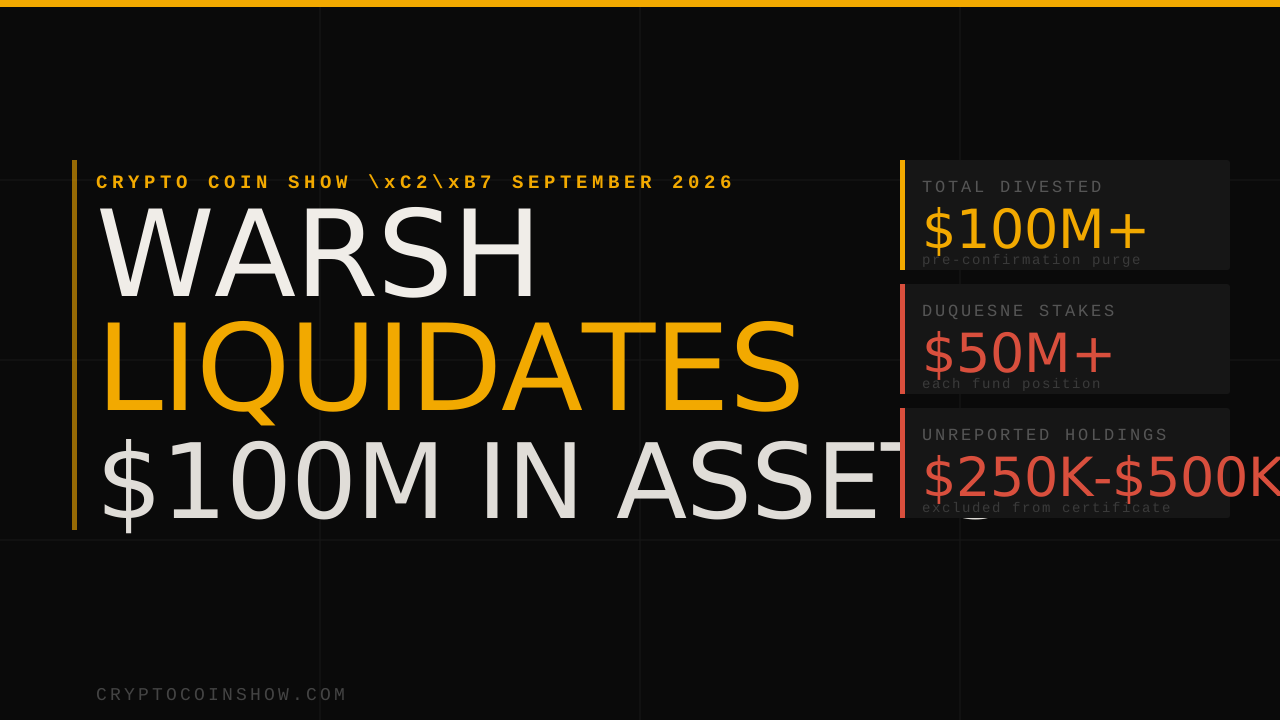
Kevin Warsh sold at least $100 million in assets before taking over as Fed chair
Kevin Warsh sold over $100 million in investment holdings before assuming the Federal Reserve chair role, following intense scrutiny from Senator Elizabeth Warren over undisclosed assets and potential conflicts of interest. The divestiture marks a rare and substantial pre-confirmation purge of holdings by a Fed nominee, raising questions about transparency standards for the nation’s top monetary official.
- Warsh liquidated more than $100 million in assets after ethics office review, including two stakes in Duquesne Family Office fund valued above $50 million each
- Two unreported holdings worth $250,000 to $500,000 were excluded from the official divestiture certificate provided May 16
- Warren pressed Warsh on hidden assets and potential ties to Trump, Epstein, and firms under criminal investigation before confirmation
- $100M+ Investment holdings sold by Warsh before taking Federal Reserve chair
- $192M Warsh’s disclosed net assets according to nomination papers, potentially understated
- May 16 Date ethics office issued certificate of divestiture after Warsh sales
Kevin Warsh has unloaded more than $100 million in investment holdings as a condition of taking over the Federal Reserve chair role, according to an ethics filing dated May 16.
The divestiture came after his wealth and private asset structure became a central flashpoint during his Senate confirmation process, with Elizabeth Warren, the top Democrat on the Senate Banking Committee, questioning whether hidden holdings posed conflicts of interest for someone about to oversee U.S. monetary policy and bank regulation.
The Office of Government Ethics granted Warsh a certificate of divestiture confirming the sales, though the filing leaves critical gaps: two unreported holdings valued between $250,000 and $500,000 each were excluded from the official certificate, and Warsh declined to disclose underlying fund details citing confidentiality agreements.
Warsh sold $50 million stakes in Duquesne fund managed by veteran investor Druckenmiller
The largest confirmed liquidations involved two positions in the Juggernaut Fund, a private investment vehicle managed through Stan Druckenmiller’s Duquesne Family Office. Each stake was valued above $50 million, making them the dominant sales in Warsh’s pre-confirmation divestiture.
Warsh served as an adviser to Duquesne from 2011 until this year, giving him deep ties to the fund and its investment strategy during a period when his roles on Trump’s economic team and in federal finance elevated his profile and regulatory authority.
The decision to liquidate positions at Duquesne, a major player in hedge fund investing with a track record of complex, often opaque financial strategies, signals how aggressively Warsh was forced to clean his balance sheet to pass Senate vetting.
Warren questioned whether Warsh’s holdings included Trump ties, criminal entities, or banned Fed investments
Senator Warren made Warsh’s financial opacity a central line of attack during the confirmation process, invoking both the Ethics in Government Act of 1978 and the Federal Reserve Act to argue that his undisclosed assets violated the spirit and letter of transparency rules.
She pressed Warsh on whether any private holdings had connections to President Donald Trump, financier Jeffrey Epstein, or firms caught up in criminal investigations.
Warren also raised concerns that Warsh’s funds might own shares in financial companies that Federal Reserve officials are statutorily prohibited from holding under the Federal Reserve Act, a conflict that could undermine the independence of monetary policy decisions.
Warren’s core argument rested on a simple principle: Fed officials wield extraordinary power over interest rates, bank regulation, liquidity provision, and financial markets themselves. The standard for disclosure and conflict avoidance must be higher for the chair than for most government positions.
She noted that ethics officers, lawmakers, and nominees need full visibility into asset sources and holdings to identify and remedy conflicts before someone takes office, not after.
After Warsh’s confirmation was announced, Warren sent a follow-up letter requesting updated information on the divestiture process and asking a question Warsh had sidestepped during hearings: who exactly purchased the assets, and on what terms?
Now that you have been officially confirmed as the Chair of the Federal Reserve, I write to request an update on the status of your divestments and to once again request information on which entities or individuals you sold your assets to.
Senator Elizabeth Warren, Senate Banking Committee
Warsh and spouse committed to sell remaining holdings within 90 days of confirmation
Beyond the initial $100 million-plus divestiture documented in the May 16 ethics certificate, Warsh and his wife agreed to sell additional assets, both previously disclosed and undisclosed holdings, within 90 days of his confirmation as Fed chair. Some of those follow-on sales already appear on the ethics certificate, suggesting Warsh moved quickly to meet the deadline.
The commitment to further liquidation underscores the scale of his investment portfolio and the breadth of holdings the ethics office deemed problematic for a sitting Fed leader.
According to Warsh’s nomination papers, his total disclosed net assets stand at least $192 million, though that figure likely understates his true wealth because the forms use wide dollar ranges for holdings rather than precise valuations. The actual value of Warsh’s estate could exceed that floor substantially.
Warren and other senators noted that the range-based disclosure system, while standard, obscures the true scale of a nominee’s financial interests and makes it harder for ethics officers and Congress to spot potential conflicts or undisclosed links between holdings and policy decisions.
Warsh cited confidentiality agreements to justify withholding details about specific fund investments from Congress, citing investor privacy and competitive considerations.
Opacity of private fund holdings raises long-standing questions about Fed governance and conflicts
The Warsh divestiture illustrates a structural tension in Federal Reserve governance: the chair and board members often come from backgrounds in finance, private equity, and asset management, where complex holding structures, blind pools, and confidentiality agreements are standard practice.
When these figures move into government, the ethics apparatus must reconcile financial disclosure requirements with the privacy norms of elite investment partnerships. Warsh’s invocation of confidentiality agreements to shield fund details from Congress reflects a common pattern in which private-sector norms clash with public accountability.
Warren’s challenge to this dynamic, by demanding to know not just what Warsh owned but who bought his assets and on what terms, attempts to close a loophole that has long allowed wealthy nominees to move assets around during confirmation without full transparency into the buyers’ identities or potential conflicts of interest.
If a fund or entity with ties to a regulated industry or political ally purchases Warsh’s holdings at above-market terms, the appearance (or reality) of a quid pro quo arrangement could arise. Warren’s persistence on this question signals that Senate Democrats intend to scrutinize such arrangements more rigorously in future Fed nominations.
The May 16 ethics certificate does not name the buyers of Warsh’s assets, leaving open the question of whether his divestiture reflected genuine conflict mitigation or merely a transfer of holdings to entities that may still benefit from his regulatory decisions.
Warren has stated she will monitor the status of Warsh’s 90-day divestiture commitment and has explicitly requested documentation of which entities and individuals purchased the remaining holdings, a request that Warsh has not yet answered in detail. The Senate Banking Committee may revisit this question in oversight hearings or demand additional disclosures if the identity of buyers or the terms of sales remain obscured, setting a precedent for how thoroughly future Fed nominees must disclose asset transactions.