
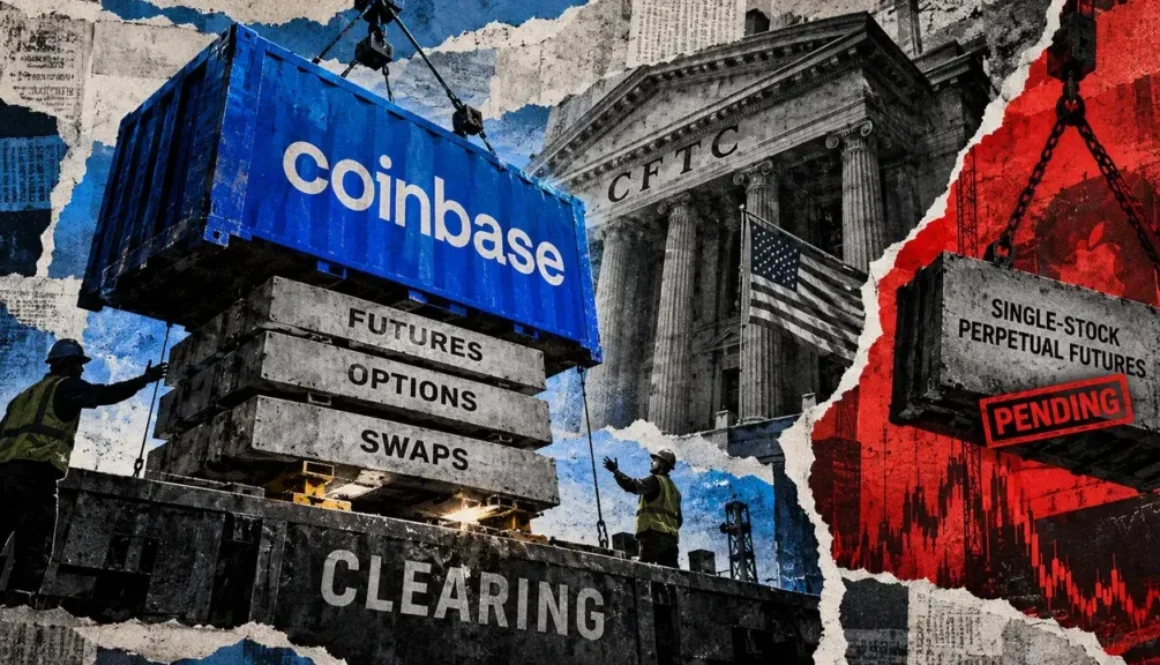
CFTC registers Coinbase Clearing as derivatives clearinghouse while stock perpetuals await approval
Coinbase has closed the final structural gap in its US derivatives business after the CFTC registered Coinbase Clearing LLC as a derivatives clearing organization, giving the exchange control over trading, listing and clearing for the first time. Yet the product Coinbase has promoted hardest, single-stock perpetual futures, still depends on a rival clearer and remains stuck in regulatory review.
- The CFTC registered Coinbase Clearing LLC on Sept. 28 (Monday), authorizing it to clear fully collateralized futures, options on futures and swaps.
- Coinbase’s Single Stock Perpetual Futures Contract, filed Sept. 18 (Friday) with Apple as the representative contract, still showed “Approval Pending” as of Sept. 30.
- The Apple perpetual names Nodal Clear LLC, not Coinbase’s own clearinghouse, as central counterparty, and trades only from 8 p.m. ET Sunday through 5 p.m. Friday.
- Sept. 28 date CFTC registered Coinbase Clearing as a DCO
- Sept. 18 date Coinbase filed its stock-perpetual futures proposal
- 24/7 settlement Coinbase claims versus stock perp’s five-day window
Coinbase now sits atop all three layers of the regulated US derivatives market. Coinbase Financial Markets operates as a futures commission merchant, Coinbase Derivatives as a designated contract market, and the newly registered Coinbase Clearing as the clearinghouse that settles trades.
Coinbase Clearing Wins Authority Over Fully Collateralized Contracts
The registration, first detailed by CryptoSlate, lets Coinbase Clearing create and settle fully collateralized futures, options on futures and swaps without routing them through an outside clearing partner. That is a structural shift for an exchange that previously depended on third parties for the function that guarantees trades and manages counterparty risk. Coinbase said the new entity gives it end-to-end infrastructure to bring regulated products to market.
The pitch centers on USDC collateral and 24-hour settlement, features Coinbase is building around always-on crypto markets rather than the fixed hours of legacy futures venues. Owning the clearing layer can shorten product-development cycles for contracts that stay within its collateral model, since Coinbase no longer needs a third party’s sign-off to launch.
That advantage matters for institutional desks that already use Coinbase’s credit lines, as it signals deepening reliance on Coinbase-run financial infrastructure beyond spot trading.
Apple Perpetual Filing Still Routes Through Nodal Clear
The clearinghouse approval does not extend to Coinbase’s most closely watched planned product. The CFTC’s product record for Coinbase Derivatives continued to list the Single Stock Perpetual Futures Contract as “Approval Pending” as of Sept. 30, twelve days after Coinbase submitted the proposal.
The Sept. 18 filing proposes cash-settled perpetual futures on individual US equities and ETFs, using Apple stock as the representative contract with no fixed expiration and periodic funding payments to track the underlying share price. That structure mirrors the tokenized-equity products already moving through DeFi. Critically, the Apple contract names Nodal Clear LLC rather than Coinbase Clearing as central counterparty, and its trading window runs 8 p.m. Eastern Sunday through 5 p.m. Friday, a schedule at odds with the round-the-clock settlement Coinbase is marketing for its own clearinghouse.
CFTC Decision on Stock Perpetuals Remains the Open Milestone
Coinbase said it intends to list the stock perpetuals shortly after approval, subject to any additional regulatory requirements, but gave no firm date. Until the CFTC rules, the contracts will launch, if approved, on infrastructure Coinbase does not control, splitting its derivatives business between an owned clearing system and a partner arrangement for its highest-profile equity product.
The CCS read. Owning the clearing layer lets Coinbase keep more of the margin it currently pays to outside clearers on eligible contracts, a quiet revenue lever institutional holders should weigh alongside trading fees. Investors watching Coinbase’s diversification beyond spot volume should treat clearinghouse ownership as the more durable balance-sheet story, with stock perpetuals as a separate, still-unresolved regulatory bet.
The next milestone is procedural rather than technical: whether the CFTC clears the Apple-referenced stock perpetual filing, and whether any approval requires Coinbase to eventually shift clearing from Nodal Clear onto its own newly registered system.