
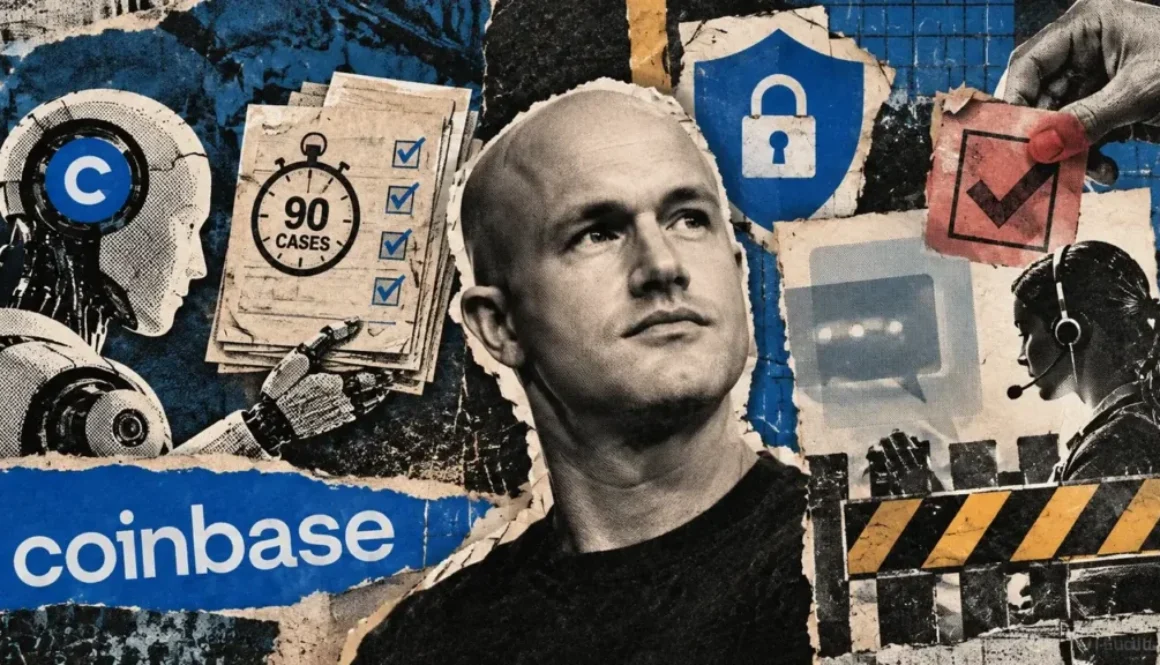
Coinbase Autopilot cuts support test cycle to 30-45 minutes from weeks
Coinbase disclosed that its internal Autopilot system now completes a 90-case support testing cycle in 30 to 45 minutes, work that previously took engineers one to two weeks of manual setup. The figure gives CEO Brian Armstrong’s push for an AI-native operating model a concrete efficiency number, but it says nothing about whether customer problems get resolved any better or faster.
- Coinbase engineers reported the 90-case testing cycle in a disclosure dated Sept. 21, cutting setup time from one to two weeks.
- Armstrong cut roughly 14% of Coinbase’s workforce in a May 5, 2026 memo that cited AI-driven changes to how employees work.
- A separate Coinbase security platform logged more than 150,000 production scans and over 128,000 pull-request reviews on Sept. 15.
- 30-45 min New time for a 90-case support test, versus 1-2 weeks manually
- 14% Workforce cut Armstrong announced in his May 2026 restructuring memo
- 150K+ Production scans Coinbase’s security platform ran since mid-2026
Coinbase said it can now run a 90-case support testing cycle in 30 to 45 minutes, down from the one to two weeks that manual setup and execution previously required, according to a Sept. 21 engineering disclosure first reported by CryptoSlate. The tool behind the gain, called Autopilot, tests the procedures that Coinbase’s support bots follow when handling customer issues, and it still requires human approval before any procedure change reaches production. That constraint matters because the disclosure arrives four and a half months after Armstrong cut roughly 14% of Coinbase’s staff, framing faster internal testing as evidence his AI restructuring is working rather than just a headcount story.
Autopilot Runs Isolated Test Accounts to Score Bot Behavior
Coinbase’s bots look up account state, take bounded actions, and escalate anything requiring judgment to a person. Autopilot’s testing service creates isolated test users and mock account states, simulates conversations, records transcripts and tool results, then grades the outcome against expected behavior.
Coinbase says it shipped a hybrid system combining that service with GitHub Actions release gates and an interface usable by both engineering and non-engineering teams.
The reported figure measures only the validation cycle. Customer response times and the cost savings tied to Armstrong’s workforce reduction fall outside its scope entirely.
Autopilot also runs adversarial conversations, not just expected-behavior checks, and an AI model scores the results. Coinbase acknowledges that judge can be wrong, so scores feed human review and release gates rather than independently clearing a procedure for production.
Agents can suggest changes, but a person must still approve production writes, a safeguard against the automated loop promoting its own work unchecked.
Control Center Splits Proposing a Change From Executing It
A separate Aug. 18 (Tuesday, August 18, 2026) internal-operations disclosure addresses who can access customer data and who can change it. Coinbase describes Control Center as a shared platform for support, compliance, legal, risk and engineering, where authorization checks, audit records, approvals and rate limits sit in front of underlying services. Access is tied to assigned cases, limited to the customers involved, and set to expire; missing customer context on a customer-scoped request triggers denial.
For sensitive changes such as refunds, account-state changes and limit overrides, the platform separates proposing a change from executing it. A proposal enters review, required approvals must arrive, and a separate executor performs the change, with failures reserved for human handling.
Coinbase has not specified how much of Autopilot’s output runs through that same permission layer, leaving the overlap between the two systems unclear.
New client types, including automated agents, must still be brought under those authorization and rate-limiting rules as they go live. Coinbase says authentication boundaries get revalidated as callers change, which keeps that work ongoing rather than finished.
No Customer-Outcome Numbers Have Been Published Yet
The distinction between passing a test and performing well in production is central to the National Institute of Standards and Technology’s July 2024 generative-AI risk profile, a voluntary federal framework that recommends evaluating AI systems in real-world scenarios because controlled testing can miss problems. Autopilot already tracks customer-intent labels, resolution rates and satisfaction signals to flag weak high-volume support flows, which suggests Coinbase recognizes the gap between completing a test suite and solving a customer’s actual problem.
What Coinbase has not published is quantified before-and-after data on customer resolution, escalation accuracy or unauthorized-action rates, the kind of evidence that would show the faster testing cycle is actually improving outcomes rather than just moving work faster. The same question is shaping how institutions think about AI agents operating inside financial infrastructure more broadly, an issue BlackRock has raised in its own research on agentic demand, and one explored in prior Crypto Coin Show reporting on whether AI systems need enforceable guarantees rather than promises.
The CCS read. We read this as Coinbase building the accountability scaffolding institutional custody clients will eventually demand of any exchange running agentic support, not as a customer-service story. The real signal isn’t the 30-minute test cycle; it’s that Control Center forces a human executor between a proposal and a refund, which is the kind of control large counterparties will ask to audit before trusting bots with their accounts.
Coinbase has not committed to a date for publishing resolution-rate or unauthorized-action data tied to Autopilot, leaving the next disclosure, and whether it covers live customer outcomes rather than test-suite speed, as the open question for Armstrong’s AI-native operating model.