
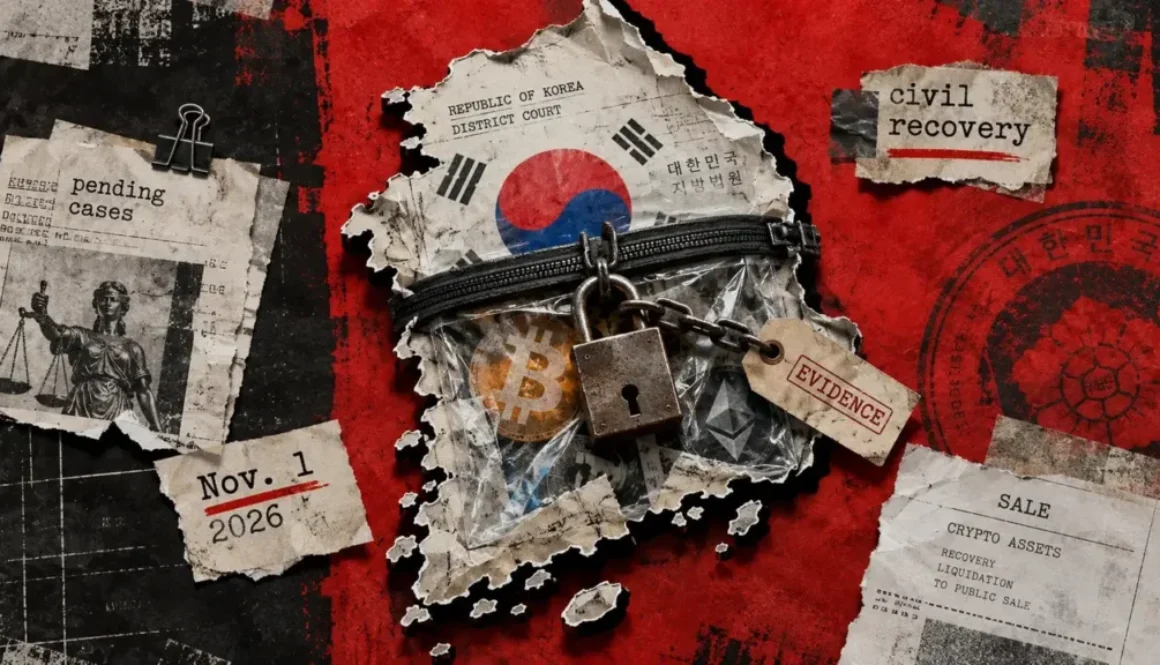
South Korea’s Supreme Court enables courts to seize and liquidate crypto for unpaid debts starting November 1
South Korea’s Supreme Court has promulgated formal procedures letting courts freeze, seize and sell debtors’ cryptocurrency to satisfy unpaid civil debts, with the rules taking effect November 1. For institutional investors, Seoul is now treating digital assets as recoverable property on par with bank deposits or securities, closing a legal gap that previously made crypto harder to attach than conventional financial holdings.
- Rule 3280 was promulgated on October 12 and takes effect November 1, covering both exchange-held and self-custodied crypto.
- Exchanges must disclose a debtor’s holdings, including type, quantity and competing creditor claims, within one week of a court order.
- Court officers can take physical possession of self-custodied crypto before a debtor receives formal notice of attachment.
- Oct. 12 date the Supreme Court promulgated the enforcement rule
- Nov. 1 effective date, about three weeks after promulgation
- 1 week deadline for custodians to disclose debtor holdings to courts
South Korea’s Supreme Court promulgated Rule 3280, the judiciary’s new enforcement regulation, on October 12, establishing standardized procedures for freezing, transferring and liquidating digital assets to recover unpaid civil debts. The rules take effect November 1, roughly three weeks after promulgation, and apply to crypto held on exchanges as well as holdings controlled directly in private wallets, according to its report from CryptoSlate.
The timing is not incidental. South Korean courts have seen a rising volume of debt-recovery cases involving cryptocurrency, assets that move fast and historically sat outside the standardized attachment procedures used for bank accounts or securities.
Exchanges Face One-Week Disclosure Deadline on Attached Crypto
Under the framework, a creditor seeking repayment from exchange-held crypto can obtain a court order attaching the debtor’s right to receive those assets. Once served, the exchange must block any transfer of the covered holdings to the debtor, who is barred from disposing of the claim or receiving the cryptocurrency directly.
Creditors can also compel custodians to disclose information about the targeted holdings within one week of receiving the order, a disclosure obligation that reaches the type and quantity of crypto held, whether the exchange recognizes the debtor’s claim, and whether other creditors already hold competing claims or priority rights.
That one-week window gives creditors a defined mechanism to map out what is actually available for repayment before pursuing a sale, something South Korean courts previously lacked for digital assets.
For exchange-held crypto, judges can authorize a sale through the existing custodian, a transfer to an enforcement officer’s account, or conversion into an asset that liquidates more easily. Sales must use the market price on the transaction date or another defined valuation method, a deliberate check against crypto’s sharp intraday price swings during enforcement.
Officers Can Seize Self-Custodied Crypto Before Debtors Are Notified
The toughest enforcement gap closed by Rule 3280 involves crypto held directly by debtors rather than on an exchange. Courts can now prohibit transfers and order enforcement officers to take delivery of the assets, and the rule explicitly allows that handover to happen before the attachment order is formally served on the debtor.
If the officer receives the cryptocurrency first, the attachment becomes effective on receipt, a sequencing designed to prevent debtors from moving funds the moment they sense a claim is coming. Even so, enforcement against self-custodied holdings remains constrained wherever a debtor alone controls the private keys needed to authorize any transfer.
Debtors retain the right to appeal any order authorizing a transfer or sale, and those orders take legal effect only once final. The regulations also set out procedures for restoring seized assets if an enforcement action is later withdrawn or canceled, a safeguard that did not previously exist in a standardized form for crypto cases.
Existing Cases Fall Under the New Rules From Day One
The November 1 start date is not limited to new filings. Proceedings already pending before South Korean courts will fall under the new framework, and existing attachment and preservation orders remain valid once the rule takes effect.
Exchanges and other custodians already handling those pending cases will need to apply the new disclosure, transfer and sale procedures as soon as the rules go live, with no grace period to retrofit compliance systems. The Supreme Court framed the amendments as an effort to improve legal certainty for courts handling a growing caseload of crypto-related enforcement.
The CCS read. We read this as South Korean custodians now carrying a civil-enforcement compliance burden on top of existing AML duties, with one-week disclosure deadlines that will force exchanges to build dedicated attachment-order desks. Institutions holding crypto through Korean custodians should expect faster, court-ordered freezes than they would see on equities, and should treat self-custody as the only real hedge against that exposure.
The open question is how courts will handle enforcement where debtors refuse or are unable to surrender private keys, since Rule 3280 sets procedure but cannot compel disclosure of a key a debtor declines to produce. How South Korean judges resolve that gap in the first self-custody cases after November 1 will determine whether the new framework closes the enforcement loophole in practice, not just on paper.