America wants to win the AI race but its own contradictions keep getting in the way
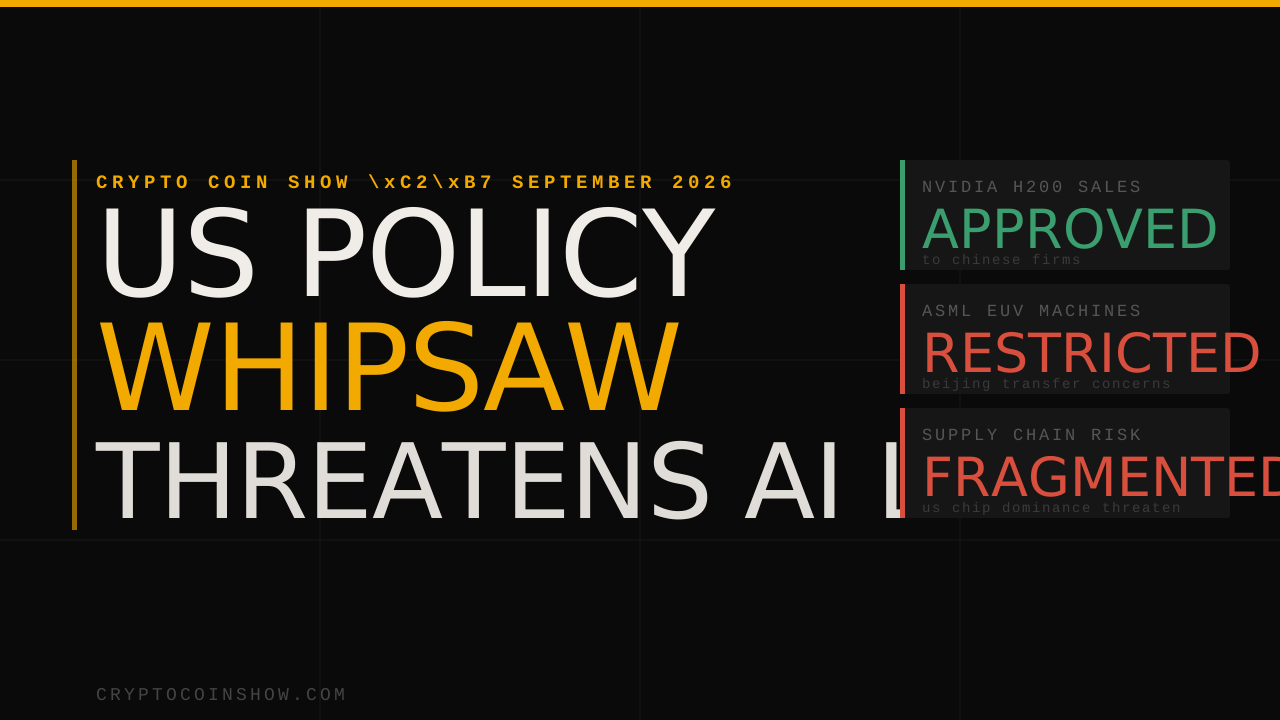
The Trump administration is simultaneously tightening restrictions on advanced chipmaking technology to China while loosening export controls on AI chips, creating contradictions that threaten US technological leadership and alarm both allies and competitors. This policy whipsaw, exemplified by Commerce Secretary Howard Lutnick’s pressure on Dutch chipmaker ASML over alleged EUV machine transfers to Beijing, offset by recent approvals for Nvidia H200 sales to Chinese firms, signals Washington remains uncertain how to compete in AI without fragmenting the international supply chains that underpin US chip dominance.
- Commerce Secretary Howard Lutnick held multiple meetings with ASML executives expressing concerns that extreme ultraviolet lithography machines reached Chinese hands.
- ASML denied ever shipping EUV machines or specialized components to China, while US lawmakers proposed legislation in April to align allies’ export controls.
- Trump administration approved Nvidia H200 AI chip sales to China in January and cleared ten additional Chinese buyers last month, directly contradicting restrictive messaging.
- 180 metric tonnes The physical weight of EUV machines, roughly the size of a school bus.
- One-fifth ASML’s revenue share from deep ultraviolet system sales to Chinese buyers.
- April Month when US lawmakers introduced bill naming ASML, targeting stricter allied export controls.
The US intelligence establishment views extreme ultraviolet lithography as a chokepoint technology in the global semiconductor race. EUV machines, produced only by Dutch company ASML and weighing 180 metric tonnes, represent the frontier of chip manufacturing: they enable production of the most advanced semiconductors that power artificial intelligence systems and military applications.
Taiwan Semiconductor Manufacturing Company (TSMC), which operates EUV equipment, produces cutting-edge processors for Nvidia and other US technology leaders. China lacks access to these machines and the expertise to operate them, which has so far kept Beijing’s domestic chip capacity trailing US and allied manufacturers by multiple technology nodes.
Commerce Secretary Lutnick’s repeated communications with ASML executives, first reported by Bloomberg without supporting evidence, reveal Washington’s anxiety that this technical advantage could erode.
The concern is not theoretical: Reuters reported last year that China recruited a former ASML engineer to lead development of a domestic EUV prototype, framing the effort as a national priority comparable to the Manhattan Project. Should China succeed in producing functional EUV machines independently, the entire rationale for US export controls on ASML equipment collapses.
ASML denies EUV transfers to China while US lawmakers push allies toward stricter controls
ASML issued a formal statement on Friday categorically denying any shipment of EUV machines, components, or specialized modules to China.
The company stated it had “never shipped an EUV machine to China, nor have we shipped to China any component, module, or equipment specially designed to be used in an EUV machine.” The Dutch government backed this position, telling Reuters it “strictly applies its licensing rules” to chipmaking equipment and technology explicitly covered by export regulations.
The denial matters because it suggests either Lutnick’s concerns rest on unconfirmed intelligence or the administration was testing ASML’s responsiveness to pressure. Either way, the episode illustrates how the US is attempting to use diplomatic channels and legislative threats to lock down the international supply chain for advanced manufacturing.
In April, US lawmakers introduced legislation that directly named ASML and sought to compel American allies to adopt export control standards matching Washington’s own restrictions on China. ASML responded by reaffirming its commitment to both US and Dutch national security rules, a carefully neutral posture that avoids alienating either government.
The real tension emerges not from ASML’s conduct but from the contradictory signals Washington is sending. While Lutnick pressed ASML on hypothetical EUV leakage, the Trump administration was simultaneously loosening restrictions on semiconductor exports that fall outside the EUV category. In January, Nvidia received approval to sell H200 AI accelerator chips to China.
Last month, that permission expanded to ten additional Chinese companies as direct buyers. These approvals suggest the administration views competition in AI inference and training as a different strategic category than foundational chipmaking equipment, yet they undermine the rhetorical case for maximum pressure on ASML.
Nvidia chip approvals to Chinese firms clash with hardline ASML messaging
The H200 approval marks a significant shift from the Trump administration’s first term, when blanket restrictions on Chinese technology purchases dominated policy. Nvidia’s H200 represents advanced silicon, though not at the bleeding edge of process technology, and is explicitly designed for AI workloads.
Chinese firms including Huawei have received licenses to purchase these chips, signaling that Washington distinguishes between the raw manufacturing capability (represented by EUV) and downstream applications of semiconductor technology.
This distinction creates a coherent argument: restrict the tools that enable leading-edge production, but permit sales of mature chips where US firms already dominate the market and can capture revenue that would otherwise go to domestic competitors or non-allied producers.
Yet the timing and scale of these approvals, announced weeks apart from Lutnick’s ASML pressure campaign, sent mixed signals to Beijing, Amsterdam, and US allies about whether technology decoupling is the actual strategy or merely rhetoric surrounding selective commerce.
Beijing has responded by accelerating domestic chip substitution efforts, instructing state enterprises and key industries to source semiconductors from Chinese suppliers where possible. This defensive posture reduces the value of Nvidia’s export license: if major Chinese customers face regulatory or reputational pressure to avoid foreign chips, the commercial benefit to Nvidia shrinks.
The administration’s inability to maintain consistency between rhetorical hardline positions and tactical commercial approvals may inadvertently accelerate China’s alternative supply chain development rather than slowing it.
European anxiety over US-China competition leaving allies behind reshapes geopolitical calculus
A week of Group of Seven meetings was overshadowed by publication of an essay titled “Europe 2031,” authored by Brussels-based researchers and circulated widely among policymakers.
The speculative piece warned that a future technological arms race between Washington and Beijing could leave Europe marginalized, unable to compete in datacenters, robotics, and artificial intelligence because it failed to make decisive investments during the current decade.
The essay’s timing, appearing one day before the Trump administration reportedly moved to restrict “foreign nationals” from accessing Anthropic’s Fable AI model, amplified European frustration.
The Fable restriction, if confirmed, represents the latest instance of US policy fragmenting access to foundation models and computational infrastructure along national lines.
European AI companies and researchers increasingly face barriers to US computational resources and cutting-edge models, while simultaneously lacking the domestic scale or state backing to match Chinese or American capabilities.
This creates a secondary policy crisis for Washington: the more strictly the US restricts technology access to allied nations in the name of China containment, the more likely those allies are to develop alternative infrastructure and partnerships that ultimately reduce US technological influence.
For institutional investors in blockchain and crypto infrastructure, this geopolitical contradiction carries direct implications.
If the US fractures the global technology supply chain through inconsistent export controls and AI access restrictions, the regulatory environment for decentralized systems, which explicitly operate across borders and deliberately resist single-nation control, becomes more volatile.
Conversely, if Washington maintains loose enough controls that China accelerates its independent chip and AI development, the pressure for sovereign blockchain and payment infrastructure outside US financial systems intensifies.
The critical question ahead is whether the Trump administration will commit to a coherent China technology strategy or continue the current pattern of tactical moves that lack strategic consistency. Lutnick and the Commerce Department are scheduled to engage with Congress on a potential tighter ASML export framework in coming months, while Nvidia’s H200 approval sets a precedent for additional chip sales that flatly contradicts maximum-restriction rhetoric. Watch for whether the administration permits further semiconductor export licenses to China in Q2 2025 or reverses course, that decision will clarify whether recent approvals represented genuine policy shift or temporary leverage-building before tightening.