
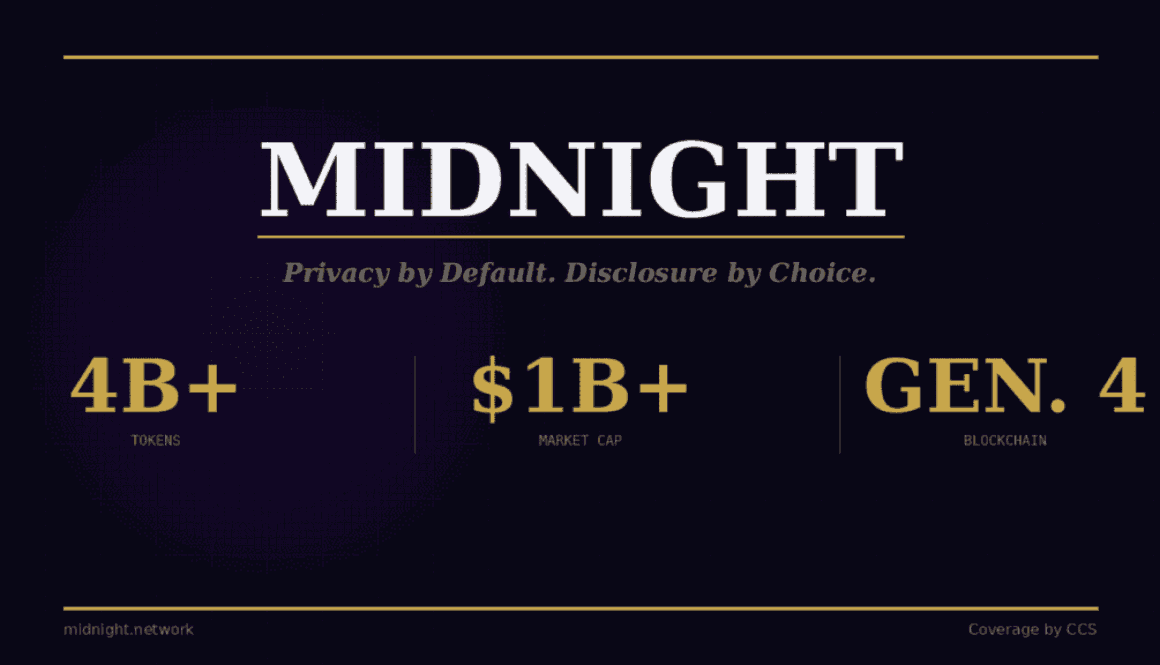
Midnight Launches to Make Privacy the Default in Web3
Midnight Launches to Make Privacy the Default in Web3
The world’s first fourth-generation blockchain goes live, aiming to unlock real-world adoption by protecting sensitive data on-chain without sacrificing compliance or transparency.
Disclosure by Choice.”
The Midnight Foundation, an independent organisation dedicated to advancing the development, adoption, and real-world impact of the Midnight network, announced on March 30, 2026, that the Midnight network is now live — marking a defining step in the evolution of blockchain infrastructure and the beginning of what Midnight’s founder Charles Hoskinson has described as the fourth generation of blockchain.
The fourth generation addresses the fundamental barriers that have prevented blockchain from supporting the real world at scale — the ability to protect sensitive data, execute compliance logic on-chain, and make blockchain as accessible as any other technology. Most blockchains require users to sacrifice privacy in order to participate. Midnight is built to change that.
“Midnight is the first public blockchain that gives the world the infrastructure it needs to come on-chain — without sacrificing privacy or compliance.”Charles Hoskinson — Founder & CEO, Input Output Global
The launch follows significant early market traction, including the completion of Midnight’s Glacier Drop — one of the largest and fairest token distributions in crypto history — where more than four billion tokens were claimed by users across multiple blockchain ecosystems.
Midnight also introduces an innovative dual-component tokenomics model that addresses one of the most persistent barriers to blockchain adoption: token volatility. By separating the asset used to govern and secure the network (NIGHT) from the resource used to pay for transactions (DUST), Midnight ensures operational costs remain predictable, while creating a path toward a future where users no longer need to hold volatile crypto assets simply to use the network.
Midnight’s Genesis block was created on March 17th, with the network opening to the public on March 30th following two weeks of infrastructure testing and validation. The network is launching with a deliberate, phased rollout — an approach designed to ensure stability, security, and long-term resilience as applications launch and the ecosystem expands.
Early development on the network is expected to explore use cases including on-chain multi-trade facilities, confidential vaults, and privacy-preserving financial applications — categories that have historically been constrained by the transparent nature of existing blockchains. Launching alongside partners including Google Cloud and MoneyGram, Hoskinson noted that “for the first time, organisations of this scale have committed not only to running critical infrastructure but also to building and deploying live applications on a public network.”
“When privacy is built into the system itself, it becomes possible to bring real-world activity and assets on-chain without exposing the underlying data — unlocking entirely new forms of economic value.”Fahmi Syed — President, Midnight Foundation
Cardano price prediction 2026-2032: Will ADA recover to $1 soon?
Key takeaways:
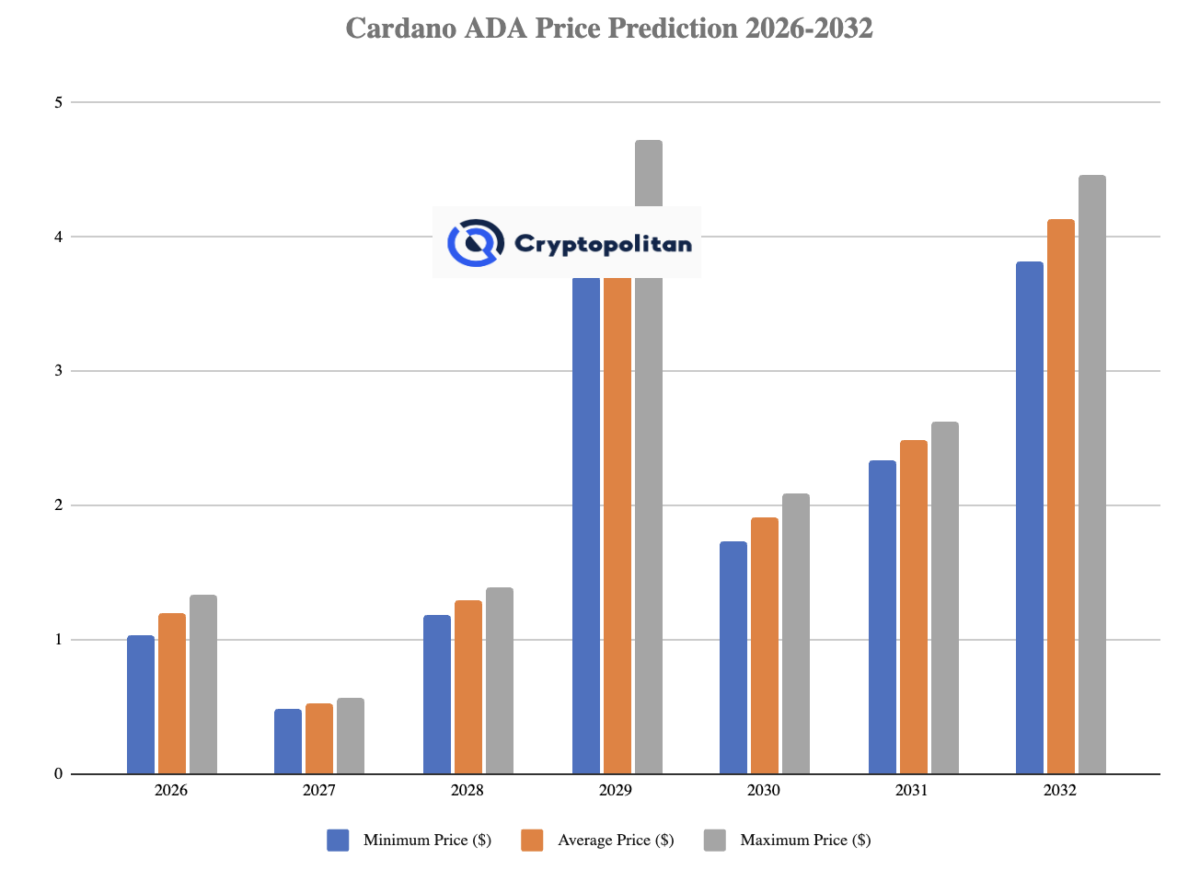
- Cardano’s price is expected to surpass $1.33 in 2026.
- By 2029, ADAUSD could reach $4.72.
- By 2032, Cardano might reach a maximum price of $4.46.
Cardano is a third-generation blockchain platform launched in 2017 by Ethereum co-founder Charles Hoskinson. Designed for decentralized applications and smart contracts, it uses Ouroboros—a unique, energy-efficient Proof-of-Stake consensus mechanism.
Cardano’s two-layer architecture separates transactions from smart contracts, enhancing scalability and flexibility. Its native cryptocurrency, ADA, is used for transaction fees, staking, and governance, allowing holders to influence the platform’s future. Emphasizing a research-driven, peer-reviewed development approach, Cardano aims to address challenges in blockchain, such as scalability and sustainability, making it a strong alternative to platforms like Ethereum.
Perhaps you’re wondering: with its innovative technology, can Cardano’s ADA reach new all-time highs soon?
Let’s uncover what the future holds for Cardano.
Overview
| Cryptocurrency | Cardano |
| Token | ADA |
| Price | $0.2417 |
| Market Cap | $8.71B |
| Trading Volume (24-hour) | $479.76M |
| Circulating Supply | 44.99B ADA |
| All-time High | $3.10 on Sept 02, 2021 |
| All-time Low | $0.01735 on Oct 01, 2017 |
| 24-hour High | $0.2486 |
| 24-hour Low | $0.2361 |
Cardano price prediction: Technical analysis
| Metric | Value |
| Volatility (30-day Variation) | 4.10% (Medium) |
| 50-day SMA | $ 0.2745 |
| 14-Day RSI | 40.14 (Neutral) |
| Sentiment | Bearish |
| Fear & Greed Index | 11 (Extreme Fear) |
| Green Days | 13/30 (40%) |
| 200-day SMA | $ 0.4569 |
Cardano (ADA) price analysis
- ADA failed to hold above $0.26 leading to continued selling pressure
- Price is forming lower highs showing a clear short term downtrend
- Weak momentum and low demand are preventing any strong recovery
Cardano price analysis 1-day chart: Cardano holds near $0.24 as bearish pressure persists
On the daily chart on Mar 31, Cardano (ADA) shows a continued downtrend with weakening bullish attempts. After peaking near $0.29, price faced strong rejection and has since formed lower highs and lower lows, confirming bearish momentum. Currently, ADA is consolidating around the $0.24 level, with small candles indicating reduced volatility and indecision.
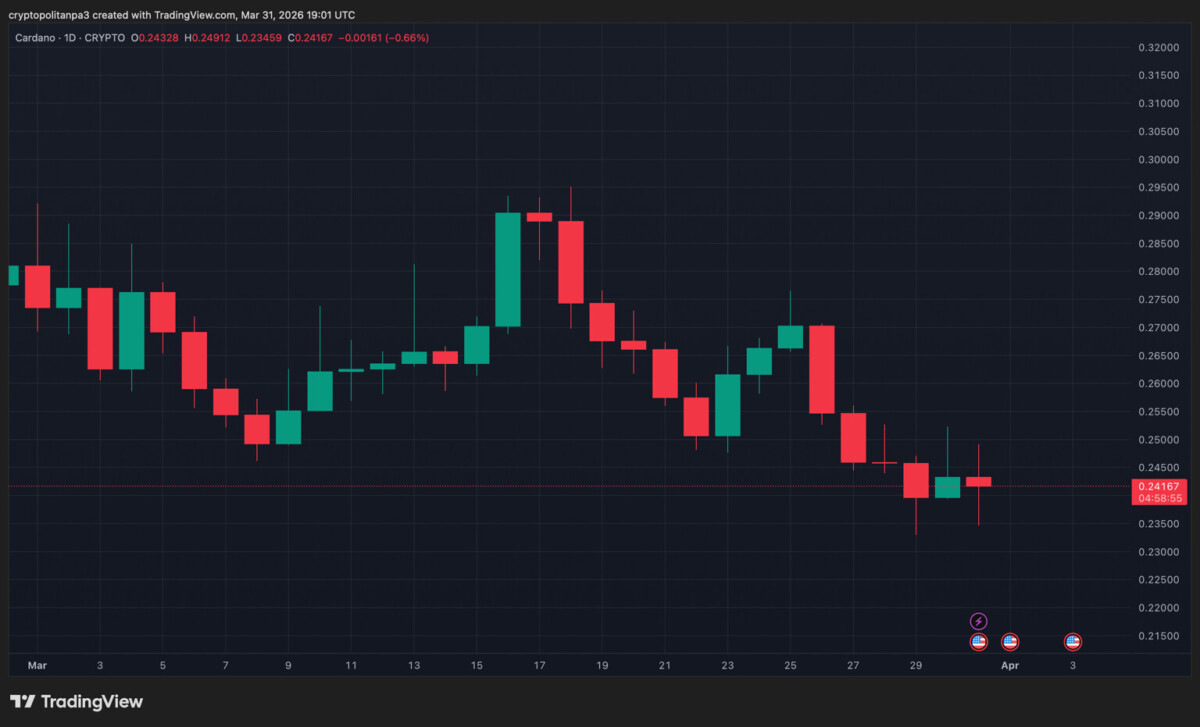
While buyers are defending lower levels, repeated rejections near $0.29–$0.30 indicate strong resistance. Momentum remains neutral, with no clear trend dominance. A sustained break above $0.28 could signal bullish continuation, while a drop below $0.25 may resume downside pressure. Overall, ADA is consolidating within a defined range.
ADA price analysis 4-hour chart: Cardano slides toward $0.24 as bearish momentum persists
On the 4H-chart, Cardano (ADA) shows a clear bearish structure with brief recovery attempts failing to hold. After topping near $0.29, price entered a downtrend marked by consistent lower highs and lower lows. Recently, ADA dropped toward the $0.235–$0.240 support zone, where a minor bounce is forming. The rebound lacks strong momentum, suggesting weak buyer conviction.
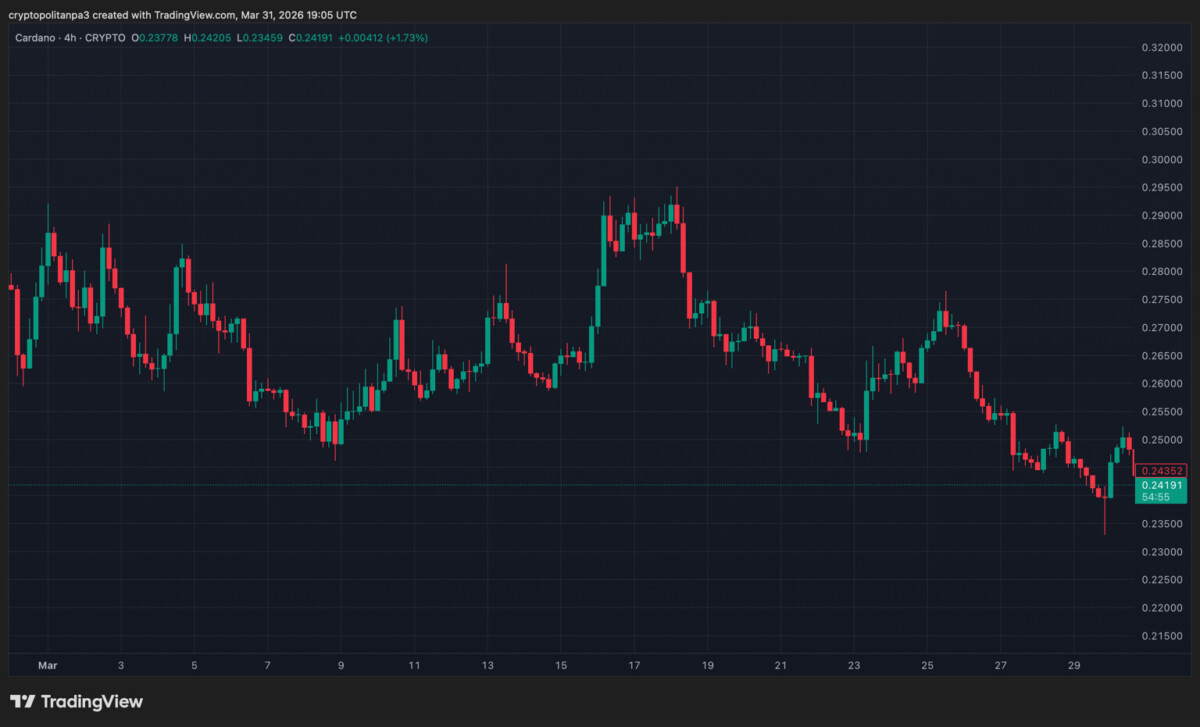
Resistance is now seen around $0.250–$0.260, while support remains near $0.235. If bulls fail to push above resistance, downside pressure may continue. Overall, ADA remains bearish in the short term with signs of tentative stabilization near support.
ADA technical indicators: Levels and action
Daily simple moving average (SMA)
| Period | Value | Action |
|---|---|---|
| SMA 3 | $0.3076 | SELL |
| SMA 5 | $ 0.2769 | SELL |
| SMA 10 | $ 0.2626 | SELL |
| SMA 21 | $ 0.2677 | SELL |
| SMA 50 | $ 0.2745 | SELL |
| SMA 100 | $ 0.3222 | SELL |
| SMA 200 | $ 0.4569 | SELL |
Daily exponential moving average (EMA)
| Period | Value | Action |
|---|---|---|
| EMA 3 | $ 0.2660 | SELL |
| EMA 5 | $ 0.2776 | SELL |
| EMA 10 | $ 0.3042 | SELL |
| EMA 21 | $ 0.3349 | SELL |
| EMA 50 | $ 0.3878 | SELL |
| EMA 100 | $ 0.4737 | SELL |
| EMA 200 | $ 0.5700 | SELL |
What to expect from the Cardano price analysis next?
Cardano (ADA) is likely to remain under short-term bearish pressure while attempting to stabilize near the $0.235–$0.245 support zone. The recent downtrend with lower highs suggests sellers still dominate, but the slowing decline indicates possible consolidation. If buyers defend support and push price above $0.250–$0.260, a recovery toward $0.270 could follow. However, failure to hold current levels may trigger another drop toward $0.220. Momentum remains weak, and volume appears limited, reflecting cautious sentiment. Overall, ADA is expected to trade sideways with a bearish bias until a clear breakout confirms the next directional move.
Why is Cardano down today?
Cardano (ADA) is down today mainly due to continued bearish market structure and weak buying momentum. After failing to hold gains near the $0.26–$0.29 resistance zone, sellers regained control, pushing price lower. The formation of lower highs has reinforced negative sentiment, prompting traders to exit positions. Additionally, low trading volume and lack of strong catalysts have limited any recovery attempts. Broader crypto market softness is also contributing, as capital rotates or remains cautious. Overall, the decline reflects a technical continuation of the downtrend, resistance rejection, and subdued demand, rather than any major fundamental issue.
Is Cardano a good investment?
Cardano (ADA) presents a mixed investment opportunity. It is a third-generation blockchain that aims to solve scalability issues and enhance security through its Proof-of-Stake mechanism. While some analysts predict significant price increases by 2030, others caution that it remains a high-risk investment due to the volatile nature of the crypto market.
Investors should consider their risk tolerance and research before investing, as Cardano’s future performance is uncertain and contingent on market conditions and technological advancements.
Will Cardano recover?
Cardano’s recovery potential depends on market sentiment and adoption. Despite past challenges, its projected price increase in 2026, potentially reaching $1, has significantly bolstered confidence in the coin’s future.
Will Cardano reach $5?
Cardano hitting $5 seems quite achievable given past levels. With its ATH around $3.10, $5 would only need to beat that peak by about 60%. A solid bull run and significant adoption could drive the unit price to $5.
Will Cardano reach $10?
Cardano hitting $10 is a long shot. Its all-time high was around $3.10 back in 2021, so $10 would mean more than tripling that peak. From current prices, that’s over a 13x jump. While crypto can be unpredictable, that would need massive adoption and a bull run far beyond what we saw in 2021.
Will Cardano reach $50?
Cardano hitting $50 is extremely likely. With ADA’s current supply of around 35 billion tokens, a $50 price would require a market cap of approximately $1.75 trillion. Even in crypto’s craziest bull runs, that kind of valuation doesn’t happen for altcoins.
What is the Cardano forecast for 2040?
Predicting Cardano’s (ADA) price in 2040 is highly speculative as it depends on multiple factors, including adoption, regulatory developments, technological advancements, and macroeconomic conditions. However, if Cardano continues its development in smart contracts, decentralized applications (dApps), and blockchain efficiency, it could see widespread adoption, driving its price higher.
Some optimistic projections suggest that ADA could reach double-digit prices, possibly ranging from $10 to $50 or more. However, in a bearish scenario, where regulatory hurdles and competition slow its progress, ADA could struggle to maintain high valuations.
What will be the future price of Cardano in 2050?
Predicting Cardano’s (ADA) price in 2050 is highly speculative, but if blockchain adoption continues to grow and Cardano successfully scales its smart contract ecosystem, its price could see significant appreciation. What that number will be remains to be seen.
Does Cardano have a good long-term future?
Cardano (ADA) has the potential for a positive long-term future, primarily driven by its technological advancements and growing ecosystem. The platform’s unique features, such as its focus on scalability and partnerships with various institutions, position it well for future adoption. However, its success will depend on overcoming regulatory scrutiny and challenges related to developer engagement.
Recent news/opinion on Cardano
Cardano gains retail adoption as $ADA becomes accepted payment at 137 SPAR supermarkets in Switzerland through Cardano Foundation and DFX partnership.
Cardano price prediction March 2026
Cardano’s February 2026 forecast is expected to be $0.3134-$0.4006, averaging $0.3513, driven by steady network development, including smart contract enhancements and scaling upgrades. The growing use of Cardano-based DeFi, NFTs, and governance projects supports moderate bullish sentiment. However, cautious market conditions and slow institutional momentum may limit rapid price expansion, maintaining this controlled range.
| Cardano Price Prediction | Potential Low | Potential Average | Potential High |
| Cardano price prediction March 2026 | $0.3134 | $0.3513 | $0.4006 |
Cardano price prediction 2026
According to the Cardano price prediction, ADA might reach a maximum price of $1.33, with an average trading price of about $1.20 and a minimum price of $1.03
| Cardano Price Prediction | Potential Low | Potential Average | Potential High |
| Cardano price prediction 2026 | $1.03 | $1.20 | $1.33 |
Cardano price predictions 2027-2032
| Year | Minimum Price | Average Price | Maximum Price |
| 2027 | $0.4838 | $0.5282 | $0.5725 |
| 2028 | $1.19 | $1.29 | $1.39 |
| 2029 | $3.71 | $4.21 | $4.72 |
| 2030 | $1.73 | $1.91 | $2.09 |
| 2031 | $2.33 | $2.48 | $2.63 |
| 2032 | $3.81 | $4.13 | $4.46 |
Cardano price prediction 2027
Cardano price is forecast to reach a lowest possible level of $0.4838 in 2027. As per analysts, the ADA price could reach a maximum possible level of $0.5725, with the average forecast price of $0.5282. This growth is driven by Cardano’s expanding DeFi ecosystem, Hydra scalability upgrades, and rising institutional adoption.
Cardano price prediction 2028
The Cardano price is forecast to reach a minimum of $1.19 in 2028. As per findings, the ADA price could reach a maximum possible level of $1.39, with the average forecast price of $1.29. This is expected as network upgrades, DeFi expansion, and institutional integration strengthen ADA’s utility and demand, supporting steady long-term growth.
Cardano price prediction 2029
According to detailed market projections and historical trend analysis, Cardano (ADA) could trade at a minimum of $3.71 in 2029, reaching as high as $4.72, with an average price of $4.21. This anticipated rise is fueled by ecosystem expansion, broader institutional adoption, and increasing real-world blockchain implementations.
Cardano price forecast 2030
Based on comprehensive technical evaluation and market trends, Cardano (ADA) could see its price bottom around $1.73 in 2030, with highs near $1.91 and an average of $2.09. This projection stems from expanding real-world utility, growing institutional participation, and continued upgrades enhancing Cardano’s scalability and ecosystem strength.
Cardano price prediction 2031
The price of 1 Cardano (ADA) is expected to reach a minimum level of $2.33 in 2031, with a potential peak of $2.63 and an average of $2.48. This forecast is driven by Cardano’s expanding enterprise adoption, stronger smart contract capabilities, and growing integration in global blockchain infrastructure, supporting steady long-term value growth.
Cardano price prediction 2032
As per the forecast and technical analysis, in 2032, ADA coin price prediction is expected to reach a minimum of $3.81, a maximum of $4.46, and an average of $4.13. This upward outlook is supported by Cardano’s full ecosystem maturity, large-scale enterprise integration, and increasing global adoption of decentralized applications built on its network, driving long-term demand and value appreciation.
Cardano ADA price prediction: Analysts’ ADA price prediction
| Firm Name | 2026 | 2027 |
| DigitalCoinPrice | $0.31 | $0.31 |
| Coincodex | $ 0.3915 | $ 0.6216 |
Cryptopolitan’s Cardano price prediction
According to Cryptopolitan projections, the price of ADA could reach a maximum of $0.35 in 2026. By 2027, Cardano’s price could trade at a maximum of $0.51.
Cardano’s historic price sentiment
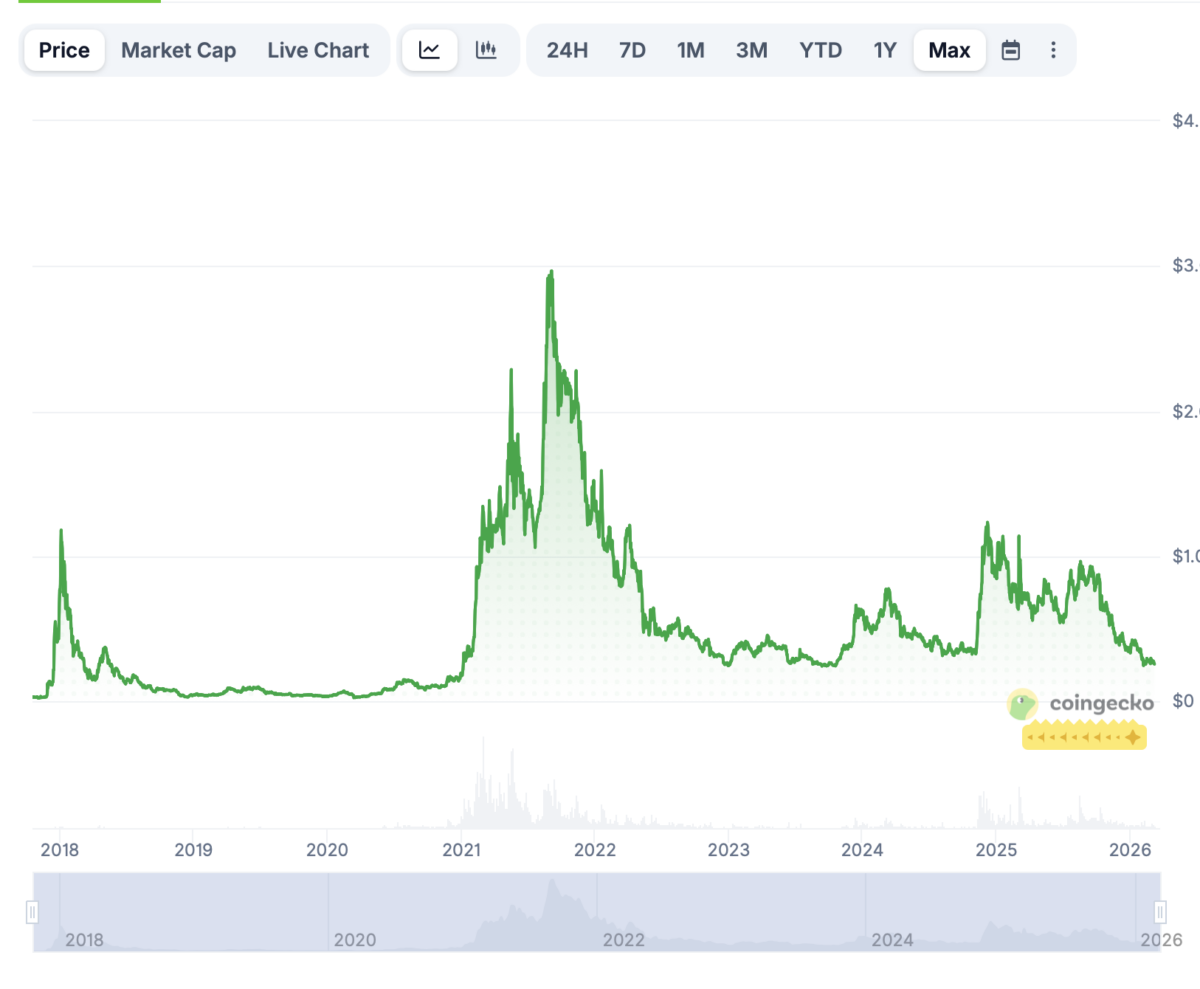
- ACH launched near $0.02 in 2020, surged to $0.1975 in August 2021, then slid below $0.10 by year end.
- During 2022 and 2023, it fell to $0.0133, later rebounded toward $0.049, but stayed volatile
- In 2024, it dropped to $0.0145, recovered above $0.02, and briefly ranged up to $0.0397 in December.
- Early 2025 saw swings between $0.016 and $0.040, before weakening again toward $0.020 by mid-year.
- Late 2025 into early 2026 marked heavy losses to $0.0070–$0.0078, followed by stabilization near $0.0082.
- In early January 2026, Cardano traded around the $0.36 to $0.38 range as buyers tried to stabilize the price after the December decline and defend support in the mid $0.30 area.
- By late January into February 7 price slipped toward roughly $0.33 to $0.34, showing continued corrective pressure and consolidation near a key support zone.
- Cardano traded around $0.40 on Jan 7, 2026 but steadily declined through the month, falling to roughly $0.29 by Feb 1 as selling pressure increased across the broader altcoin market.
- The price briefly recovered afterward, rising from about $0.25 on Feb 5 to around $0.27 on Feb 7, showing a short-term rebound after the early February dip.

Charles Hoskinson says Cardano treasury won’t cover listing fees for SNEK or Midnight
Cardano founder Charles Hoskinson has put to rest persistent questions about whether the network’s treasury would fund exchange listing fees for ecosystem projects. In a statement on X, Hoskinson made clear that neither SNEK, a prominent meme coin within Cardano, nor Midnight, the network’s privacy-focused sidechain, would receive ADA from the treasury to cover costs associated with exchange listings.
The SNEK Listing Request and Treasury Boundaries
SNEK had explored the possibility of requesting 5 million ADA from the Cardano Treasury to fund a listing on a major centralized exchange. The project’s leadership had identified Hyperliquid as a potential target, though securing a position on a top-tier exchange typically carries substantial costs.
Industry data suggests that listing fees on leading platforms range between $100,000 and $500,000. Projects seeking such listings generally raise capital through independent fundraising efforts rather than relying on community treasuries. The SNEK proposal represented a notable departure from this standard practice.
Treasury funds should be used to develop public infrastructure that benefits the entire network, not to cover marketing or commercial expenses for individual projects.
— Cardano Community Principle
Hoskinson’s position applies uniformly across the ecosystem. Even Midnight, despite his personal involvement in its development, must pursue self-funded pathways for exchange listings rather than drawing on public treasury reserves.
Listing fees on major centralized exchanges typically range from $100,000 to $500,000, making them substantial commercial expenses that projects are expected to finance independently.
Treasury Allocation Focuses on Core Infrastructure
While rejecting requests for commercial funding, the Cardano community has directed treasury resources toward fundamental network development. Recent approvals allocate significant ADA reserves to Input Output Engineering (IOE), the primary technical team responsible for Cardano’s advancement.
Three major initiatives have received backing through this process. Ouroboros Leios represents an enhancement to Cardano’s proof-of-stake consensus layer, designed to improve overall network performance and operational efficiency. Hydra, the network’s layer 2 scalability solution, continues development to enable faster and lower-cost transactions for users.
Project Acropolis rounds out the funded priorities, targeting improvements to Cardano’s governance structures and architectural modularity. These initiatives represent infrastructure investments that extend benefits across the entire network rather than supporting individual project ambitions.
Treasury-approved initiatives include Ouroboros Leios (consensus enhancement), Hydra (layer 2 scaling), and Project Acropolis (governance and modularity improvements).
Market Context and Exchange Listing Economics
The rejection of SNEK’s funding request reflects broader trends within the cryptocurrency industry regarding exchange partnerships. Centralized exchange listings have become increasingly valuable as price discovery mechanisms and liquidity providers, but the commercial arrangements governing such relationships have evolved significantly.
Major exchanges including Coinbase, Kraken, and Binance maintain tiered listing frameworks that distinguish between established assets and emerging tokens. Listing requirements now typically involve comprehensive technical audits, regulatory compliance verification, and operational readiness assessments. These requirements exist independently of financial arrangements, creating dual pathways that projects must navigate.
For emerging projects within established ecosystems like Cardano, decentralized exchange (DEX) platforms such as SundaeSwap and MinSwap have become viable alternatives to centralized venues. These platforms operate through automated market maker (AMM) protocols and enable token trading without formal listing fees, though with different liquidity characteristics and user bases compared to centralized exchanges.
The SNEK case demonstrates that ecosystem projects have increasingly diverse options for establishing market presence, reducing the criticality of centralized exchange access as a primary success metric. This structural shift in cryptocurrency markets has reduced pressure on community treasuries to fund what are fundamentally commercial arrangements.
Decentralized Governance and Treasury Management
The distinction between funding commercial expenses and supporting public infrastructure reflects a deliberate philosophy embedded within Cardano’s governance framework. Ricky Rand, general manager at Input Output Engineering, emphasized that securing treasury approval was merely the starting point for demonstrating that decentralized funding mechanisms can function effectively at scale.
Cardano’s decision-making process flows through Project Catalyst, an on-chain voting system where ADA token holders directly determine how treasury resources are deployed. This mechanism has become increasingly sophisticated as the community gains experience managing substantial capital allocation decisions.
The approval process itself validates Cardano’s self-governance approach. Rather than relying on centralized decision-makers, the protocol enables distributed stakeholders to collectively prioritize which initiatives receive funding. This structural approach distinguishes Cardano from networks where development funding flows through more concentrated channels.
Project Catalyst has processed over 1,000 funded proposals across multiple funding rounds, representing an unprecedented experiment in decentralized capital allocation. These voting cycles have informed governance best practices now being studied and adapted by other blockchain networks seeking to establish sustainable treasury management frameworks.
Ecosystem Development and Competitive Positioning
Cardano’s approach to treasury management carries implications for competitive positioning within the broader blockchain landscape. By allocating resources toward infrastructure rather than individual project support, the network prioritizes collective capabilities that enhance its appeal to developers and users across all applications.
Competing networks have adopted different treasury models. Polkadot’s parachain framework allows teams to secure funding through dedicated blockchain slots, creating alignment between network success and individual project prosperity. Ethereum relies primarily on community grants and third-party funding rather than protocol-level treasury mechanisms. These variations reflect different philosophies regarding how networks should support ecosystem development.
Cardano’s infrastructure-focused approach creates a foundation benefiting any project building on the network. Enhanced consensus mechanisms, improved scalability, and refined governance structures provide technical advantages that compound over time. This strategy prioritizes long-term ecosystem strength over immediate support for individual initiatives, potentially accelerating broader adoption as core capabilities improve.
Alternative Funding Models Under Consideration
Hoskinson has proposed exploring alternative frameworks for project funding without direct treasury transfers. A bond-based model has emerged as a potential mechanism whereby projects could access treasury capital on a repayable basis rather than as outright grants.
This approach would allow projects seeking substantial funding to borrow against future revenue or token appreciation, with predetermined repayment schedules. Such mechanisms could potentially support ecosystem development while preserving treasury sustainability and establishing clearer expectations around capital allocation.
The distinction matters significantly. Grants represent permanent allocations intended to benefit the broader network, while loans or bonds create structured relationships with defined repayment obligations. This framework potentially expands treasury utility while maintaining disciplined capital management.
Venture debt models, increasingly common in traditional finance, could translate effectively to blockchain ecosystems. Projects demonstrating clear revenue paths or token economics could access capital through structured instruments that align stakeholder interests while protecting treasury reserves. Such mechanisms would enable Cardano’s treasury to function more like an institutional investment vehicle, potentially enabling greater capital deployment without compromising long-term sustainability.
Securing funds was only the first step. The approval shows that decentralized funding and project delivery could work well at scale.
— Ricky Rand, General Manager, Input Output Engineering
Future Implications for Blockchain Governance
Cardano’s treasury decision establishes a precedent that decentralized networks can maintain disciplined capital allocation despite pressure to support favored projects. This approach requires governance maturity and willingness to enforce boundaries, capabilities that distinguish sophisticated blockchain communities from immature ones.
As blockchain adoption accelerates, questions about treasury management will likely dominate governance discussions. Networks facing pressure to fund increasingly diverse initiatives must establish clear principles distinguishing public infrastructure from private commercial interests. Cardano’s framework provides a case study in maintaining such boundaries while supporting meaningful ecosystem development.
The decision regarding SNEK and Midnight reinforces that individual projects must develop independent financial strategies, even as the network’s public treasury continues supporting shared advancement. This framework ensures that collective resources remain dedicated to initiatives that expand Cardano’s capabilities for all stakeholders, rather than supporting the marketing ambitions of specific tokens or platforms. As decentralized governance continues evolving, such distinctions between public infrastructure and private commercial interests will likely become increasingly important across the blockchain landscape.
Get weekly blockchain insights via the CCS Insider newsletter.

Influencer Podcasts Feature Lightchain AI, as Cardano’s Roadmap Delays continue to Raise Eyebrows
Lightchain AI is quietly drawing attention on influencer podcasts and discussions while Cardano’s roadmap delays cause more questions among the crypto community. The intelligent design and consistent advancement of the project have made it a hot issue among intellectuals looking for the next significant blockchain invention.
Lightchain AI is gaining traction not through hype but rather by real interest in its scalable and utility-driven approach. Its presale raised $20.9 million and tokens are priced consistently at $0.007.
Cardano is under doubt about timelines, but Lightchain AI is gathering support among builders and investors ready for a more quick and intelligent blockchain solution.
Cardano Faces Scrutiny Over Persistent Roadmap Delays
In 2025, Cardano is being watched ever more closely as its roadmap continues to face delays after it previously promised decentralization and scalability. Founder Charles Hoskinson has revealed the end of the original roadmap, which culminated with events such as the Plomin hard fork and the on-chain ratification of the Cardano Constitution, while crucial projects such as Hydra and Leios continue without a commitment to further funding, working “under at risk conditions”. These delays have caused concerns in the community, mainly about the staking function and other functionalities that have been promised.
With the creation of the Constitutional Committee and later DRep election, the present transfer of governance is seen as a chance to solve these problems by acting as mo re transparent and more involved community servant. Still to be seen, though, whether such policies will prove successful in boosting confidence rebuilding and development.
Key Influencer Endorsements Give Lightchain AI Visibility
As important players start supporting the project for its practical use and technical innovation, lightchain artificial intelligence is becoming more and more visible in the crypto scene. Lightchain AI’s AI-integrated Layer 1 design, dynamic pricing model, and optimized gas structure are attracting respected voices unlike fleeting hype tokens.
These sponsorships are helping to hasten demand at a pivotal point as the Bonus Round is under progress at a set $0.007 price. Influencers are stressing Lightchain AI’s distributed validator and contributor nodes, forthcoming public repository launch, and $150,000 grant program meant to support AIVM-powered development.
Lightchain AI keeps growing outside of early adopters as more credible leaders offer their optimistic view gains traction among larger investor audiences who give utility and transparency top priority.

From Podcasts to Portfolio: Lightchain AI Is Changing the Crypto Scene
From buzzing podcasts to investor portfolios, Lightchain AI is generating waves in the crypto space and inspiring enthusiasm everywhere. Its dynamic gas optimization, lightning-fast execution, and modern AI-integrated blockchain architecture help to explain de velopers and investors fl ocking to it.
The Transparent AI Framework guarantees completely verifiable and auditable AI computations, so adding still another layer of trust. Lightchain AI is firmly establishing itself as a game-changer in distributed technology as the countdown to the mainnet launch gets under way. Blockchain’s future just became smarter—and it is happening right now!