
A staked Ethereum ETF processed $48M in redemptions while keeping 86% of ETH locked, 21Shares filing shows
The 21Shares staked Ethereum ETF saw $48.4 million in redemptions during the first half of 2026 while maintaining 86% of its holdings in staked form, creating a potential liquidity mismatch for institutional investors relying on timely settlement. The filing raises questions about whether the fund can efficiently process large redemption requests when the majority of its assets are locked in Ethereum’s variable unbonding protocol.
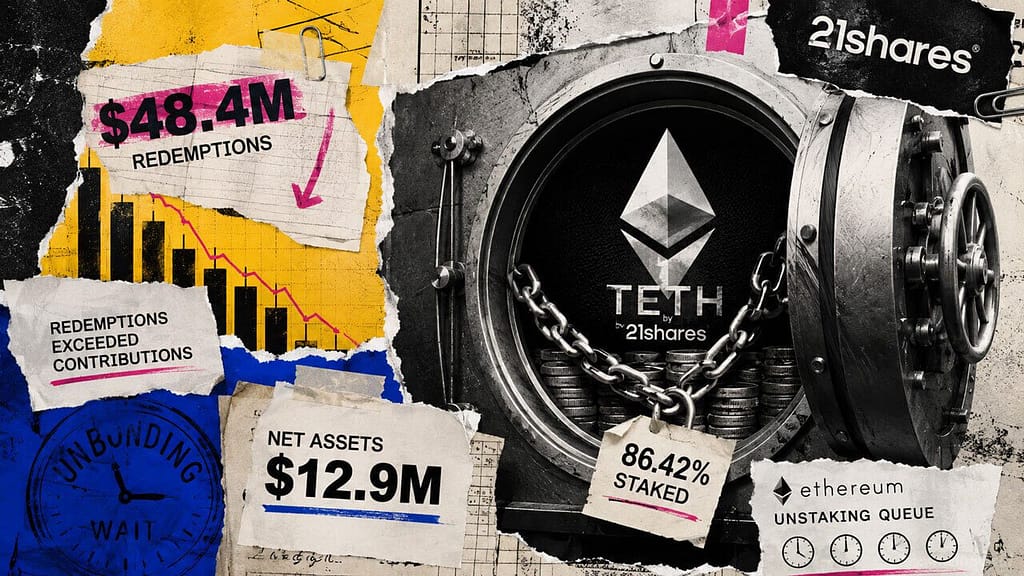
- TETH processed $48.4 million in redemptions in H1 2026, exceeding new contributions by $6.25 million
- Fund net assets collapsed 59% from $31.3 million in December to $12.9 million by June 30
- 86.42% of ETH holdings remain staked as of June 30, subject to variable unbonding delays on redemption
- $48.4M TETH redemptions processed versus $42.2 million in new contributions
- 86.42% ETH staked versus 31.64% average daily staking in Q2
- $12.9M net assets at June 30 versus $31.3 million at December 31
The 21Shares Ethereum ETF, trading under the ticker TETH, confronted a structural challenge that will intensify scrutiny of staking mechanics in spot crypto ETFs: nearly seven in eight of its ETH holdings are locked in stake, yet the fund must fulfill redemptions on demand.
According to an August 14 quarterly filing, TETH redeemed 21,125 ETH during the first half of 2026, generating $48.426 million in cash distributions to departing shareholders while accepting only $42.174 million in new contributions.
The net outflow of $6.25 million, combined with a 46.89% decline in Ethereum’s price over the six-month period, drained the fund’s total assets from $31.3 million to $12.9 million, a contraction of nearly 60% that signals both redemption pressure and market headwinds.
The filing’s most revealing detail appears in a single sentence buried in the technical disclosures: as of June 30, TETH held 86.42% of its ETH in staked form, locked under Ethereum’s proof-of-stake protocol. This poses a direct operational risk.
Staked ETH cannot be moved or transferred during Ethereum’s variable unbonding period, which the fund acknowledges may temporarily limit its ability to settle redemptions in the standard in-kind transfer.
That timing mismatch, between when an investor places a redemption order and when staked ETH becomes liquid, creates a gap that authorized participants and ordinary shareholders must navigate with uncertainty.
TETH’s staking ratio surges to 86% despite minimal H1 2026 staking activity
The 86.42% staking ratio at quarter-end stands in stark contrast to the fund’s average daily staking exposure during the reporting period.
In the second quarter alone, TETH maintained only a 31.64% daily average staking ratio, and across the full six months, the average fell to 27.32%. That sudden spike from a 27% rolling average to an 86% quarter-end concentration suggests a rapid deployment of capital into stake in the final days of June, precisely when Ethereum’s price and TETH’s assets were under pressure.
Based on the fund’s disclosed balances, the filing’s unrounded figures indicate approximately 7,074 ETH staked and 1,112 ETH unstaked as of June 30. The trust held 8,185 ETH in total, making the staked portion the dominant position.
This composition creates an operational dependency: any large redemption request from authorized participants, who trade in baskets of 10,000 shares, would require the fund to unstake ETH and wait for the unbonding period to elapse before settlement could complete.
During market volatility or elevated redemption demand, that delay exposes TETH to pricing risk, slippage, and potential cash-in-lieu settlements instead of the preferred in-kind redemption that most institutional investors expect from an ETF structure.
Fund assets halved in six months as redemptions outpaced inflows
The redemption volume itself reflects mounting investor skepticism about TETH’s product structure or pricing. The trust sold 21,125 ETH across H1 2026, converting it to $48.426 million in redemption cash.
Concurrently, the fund recorded a realized loss of $12.769 million on those ETH sales, indicating the fund liquidated holdings at prices below cost basis, a consequence of both market depreciation and the timing of outflows.
The combination of redemptions exceeding contributions by $6.25 million and the $12.77 million in realized losses accounted for most of the $18.4 million decline in net assets, separate from the mark-to-market loss on remaining holdings.
Net asset value per share dropped sharply from $14.83 in December to $7.88 by June 30. Shares outstanding contracted from 2.11 million to 1.64 million, reflecting both the redemption activity and market erosion.
For institutional investors, the shrinking fund size raises questions about whether TETH can maintain operational efficiency or competitive fee structures as assets under management decline. Smaller ETF pools typically face higher per-share expense burdens and reduced liquidity in secondary market trading, both conditions that can accelerate further redemptions in a negative feedback loop.
Broader Ethereum ETF outflows create competitive pressure on smaller issuers
TETH’s outflows sit within a broader pattern of redemptions across spot Ethereum ETF products. In June 2026 alone, the category recorded four consecutive weeks of withdrawals exceeding $870 million collectively, interrupted only by a single inflow day of $19.3 million, a 17-day stretch dominated by departing capital.
The broader market context underscores that TETH’s $48.4 million redemption is not an isolated event but part of sustained institutional skepticism toward Ethereum ETFs or a reallocation of holdings among competing products.
Larger competitors, particularly BlackRock’s ETHB, hold substantially more assets and operate under different fee and settlement frameworks. Those structural advantages, scale, brand recognition, and potentially more favorable staking yield arrangements, allow larger issuers to absorb redemption shocks and maintain liquidity buffers without forcing immediate cash-in-lieu settlements.
Smaller players like 21Shares face a dual pressure: they must compete on fees and yields, yet they cannot match the operational resilience of larger funds when redemptions spike or assets decline.
Unbonding delays pose unresolved settlement risks for future redemptions
The core unresolved question is whether TETH can meet large, sudden redemption requests without forcing cash-in-lieu settlements or suspending in-kind transfers. The filing records no failed, delayed, or suspended redemption orders during H1 2026, indicating that the fund successfully processed all requests.
However, the trust explicitly warns in its prospectus that temporary lockups or transfer restrictions imposed by Ethereum’s unbonding protocol could limit its ability to meet redemptions, a condition that becomes more likely if the fund’s staking ratio remains elevated and redemption demand accelerates.
Authorized participants who place orders in 10,000-share increments face the greatest exposure to this risk. If they place a large redemption basket and the fund cannot deliver in-kind ETH due to unbonding delays, they must either accept cash settlement (potentially at a disadvantageous price relative to in-kind transfer) or wait for the protocol to unlock the capital.
That operational friction is priced into TETH’s competitive position and may explain part of why redemptions have outpaced inflows over the past six months.
The critical watch point is whether 21Shares will either increase its unstaked ETH buffer, lower its staking ratio, or adjust its fee structure to remain competitive as assets continue to contract. The fund’s next quarterly filing, due in November 2026, will reveal whether the June 30 staking concentration was temporary or whether it persists. If TETH’s assets fall below $10 million or staking ratios climb further toward 90%+, pressure on the fund to suspend in-kind