
Michael Saylor wants SpaceX in the ‘Mag 8’ and says its Bitcoin holdings are why
SpaceX’s $2 trillion-plus IPO on June 12, 2026, has forced Wall Street to retire the “Magnificent Seven” label and expand its shorthand for market leadership, with Michael Saylor publicly advocating for SpaceX’s inclusion based partly on the rocket company’s Bitcoin holdings. The naming shift reflects how Bitcoin adoption and artificial intelligence are reshaping which companies institutional investors treat as systemic market drivers.
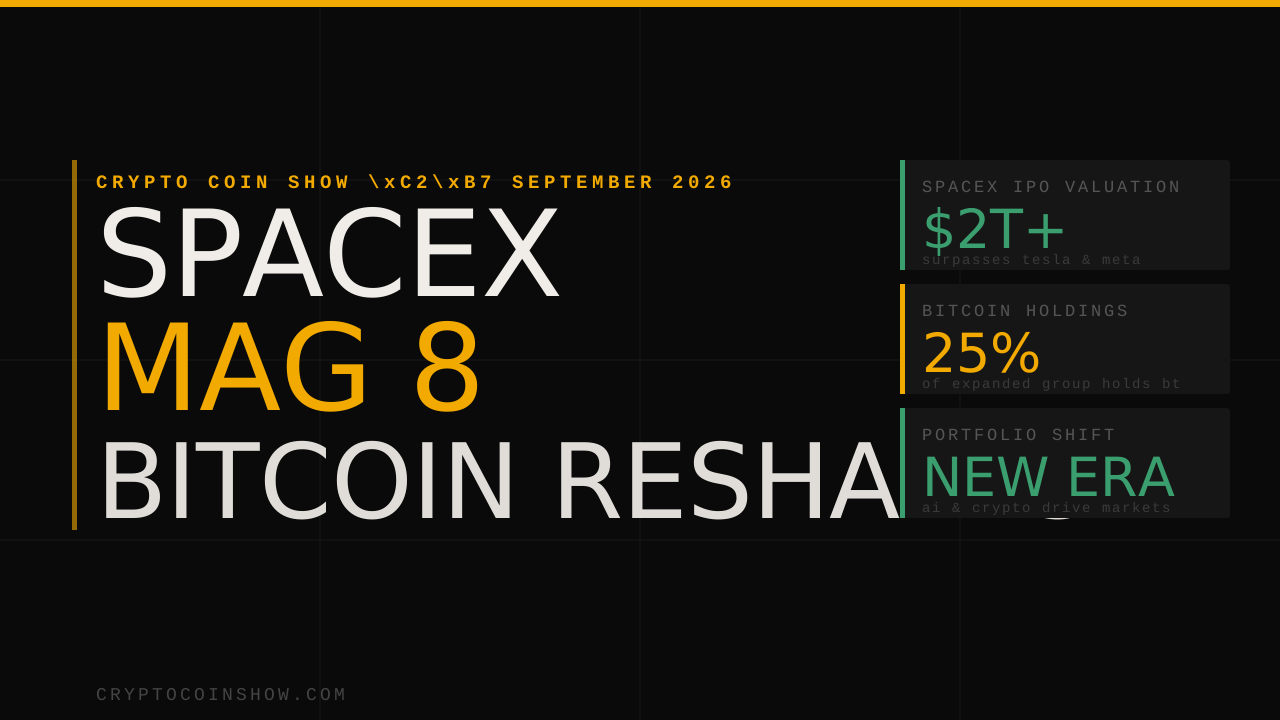
- SpaceX raised capital at a valuation exceeding $2 trillion, surpassing Tesla and Meta Platforms, both Magnificent Seven members.
- Michael Saylor noted that 25% of an expanded group now holds Bitcoin on the balance sheet, highlighting crypto as a strategic asset class.
- Multiple replacement labels including “MANGOS” and “Magna Atoms” are already circulating among Wall Street traders and asset managers.
- $2T+ SpaceX IPO valuation versus existing Magnificent Seven member market caps
- 25% of expanded tech group now carrying Bitcoin on corporate balance sheets
- June 12, 2026 SpaceX listing date marking largest U.S. IPO ever completed
SpaceX’s entry into public markets at a valuation surpassing $2 trillion has upended Wall Street’s decade-old framework for identifying the stocks that dominate market leadership and capital flows.
The company’s opening price placed it ahead of both Tesla and Meta Platforms, two cornerstone holdings in the Magnificent Seven index that investment banks and financial media have used since late 2023 to describe the handful of mega-cap technology stocks driving equity returns.
That structural problem, a company larger than two members of a supposedly elite group sitting outside the label, has triggered an immediate naming scramble among traders, strategists, and asset managers seeking language that reflects current market reality.
Michael Saylor, chairman of MicroStrategy (NASDAQ: MSTR), used the IPO announcement to publicly advocate for SpaceX’s inclusion while making an explicit case for Bitcoin’s role in reshaping corporate financial strategy.
In a post on X following the June 12 listing, Saylor wrote: “Congratulations @ElonMusk and $SPCX on a historic IPO. Thanks to you, 25% of the Mag8 now holds Bitcoin on the balance sheet.” That statement embedded two overlapping arguments: first, that SpaceX deserves recognition as a core institutional holding, and second, that cryptocurrency ownership has become material enough to influence how Wall Street categorizes systemic market leaders.
SpaceX valuation forces immediate reckoning with outdated market classification
The Magnificent Seven, created by Michael Hartnett at BofA Global Research in late 2023, was designed to capture the seven largest technology companies: Nvidia, Apple, Amazon, Alphabet, Meta, Tesla, and Microsoft.
Over the prior two years, these names had accumulated such dominant weight in major indices that their performance largely determined equity market direction, making the label a useful shorthand for both institutional traders and financial media describing market concentration.
By SpaceX’s IPO date, however, the group faced a credibility problem: it had become a closed set, incapable of reflecting new entrants that manifestly exceeded the size or strategic importance of existing members.
Shay Boloor, chief market strategist at Futurum Equities, articulated the mechanical problem. “It becomes very hard to keep using Mag 7 as the clean shorthand for market leadership because one of the most important companies in the world would immediately be outside the label,” he said. The issue was not merely semantic.
These informal names carry real institutional weight, they influence which stocks analysts track together, how portfolio managers construct benchmark-relative strategies, and which equities dominate financial media narratives during market dislocations. A classification system that excludes a $2 trillion company stops functioning as useful market intelligence.
Wall Street has a long history of retiring and reinventing such labels as market structure shifts. The “Nifty 50” described large-cap leadership during the 1960s and 1970s, while the “Four Horsemen” emerged during the late 1990s dot-com boom to identify the most influential technology stocks of that era.
Bitcoin holdings become criterion for inclusion in expanded tech leadership tier
Saylor’s public argument for SpaceX’s inclusion deliberately highlighted Bitcoin as a qualifying factor, not merely company size or revenue scale. By noting that 25% of an expanded group now holds Bitcoin on corporate balance sheets, he reframed the criteria for what makes a company “systemic” in modern financial markets.
This shift reflects a genuine institutional change: MicroStrategy itself pioneered large-scale corporate Bitcoin accumulation, holding over $20 billion in the asset as of early 2026. Tesla, under Elon Musk, purchased Bitcoin in early 2021 and has maintained a material position.
Both companies’ Bitcoin holdings have become recognized factors in how analysts model long-term enterprise value and cash management strategy.
SpaceX’s own Bitcoin position, while not yet public in detail, appears to have factored into Saylor’s calculation. The inclusion of cryptocurrency holdings as a marker of financial sophistication and forward-looking corporate strategy signals a broader shift in how institutional investors evaluate technology companies.
Bitcoin is no longer treated as a speculative experiment relegated to fringe balance sheets; it has become part of the financial toolkit for major corporations managing capital preservation and optionality in an inflationary environment.
This represents a material change in institutional perspective. A decade ago, corporate Bitcoin holdings were entirely absent from mainstream investment classification schemes.
Multiple replacement labels already circulating as industry settles on new shorthand
Wall Street has already begun testing replacement terminology, with several competing proposals gaining traction among traders and asset managers. One candidate spreading rapidly on X is “MANGOS,” an acronym built from Meta, Anthropic, Nvidia, Alphabet, OpenAI, and SpaceX. Some versions substitute Apple for Anthropic, given that Apple ranks as the third-largest U.S.-listed company by market value.
Another proposal, “Magna Atoms,” suggested by Dan Boardman-Weston, chief executive of BRI Wealth Management, would expand the original seven to include SpaceX, OpenAI, and Anthropic, essentially creating a ten-company umbrella.
Aga Kuplinska, senior vice president of product development at Tidal Financial Group, confirmed that these new labels are already embedded in industry workflow. “We are already referring to it internally and the industry is picking up on it as well,” she said.
Tidal advises asset managers developing exchange-traded funds, making it a key node in how new market taxonomy spreads into institutional practice. The fact that multiple competing terms have emerged simultaneously suggests no single consensus label will dominate the way “Magnificent Seven” did, at least not immediately.
Instead, investors may operate with several overlapping classifications depending on whether they emphasize artificial intelligence exposure, Bitcoin holdings, valuation thresholds, or other criteria.
The proliferation of alternatives reflects genuine disagreement about which companies belong in the core group. OpenAI and Anthropic remain privately held, though both are considered strong IPO candidates.
Their potential entry into public markets would further destabilize any fixed nomenclature, making it likely that Wall Street will cycle through multiple labels as the composition of mega-cap leadership continues to shift.
Bitcoin and AI reshape which companies define systemic market concentration
The underlying driver of this nomenclature crisis is not merely SpaceX’s size but the fundamental remapping of which industries and asset classes institutional capital now treats as systemic. The original Magnificent Seven was dominated by cloud computing, consumer internet platforms, and semiconductor manufacturing.
An expanded group incorporating SpaceX reflects the rising influence of aerospace, energy infrastructure, and artificial intelligence development. The inclusion of Bitcoin as a balance-sheet consideration further broadens the aperture, treating cryptocurrency and traditional corporate finance as no longer separate categories.
Saylor’s framing of Bitcoin ownership as a qualifying criterion for market leadership status is particularly significant because it represents a major shift from institutional skepticism toward integration. Five years ago, corporate Bitcoin holdings were treated as idiosyncratic CEO preferences. Today they signal participation in a recognized store-of-value strategy that institutional investors increasingly view as a legitimate capital allocation decision. This normalization carries real consequences for how asset managers construct indices, benchmark their performance, and communicate to limited partners about exposure to technology-sector concentration.</p