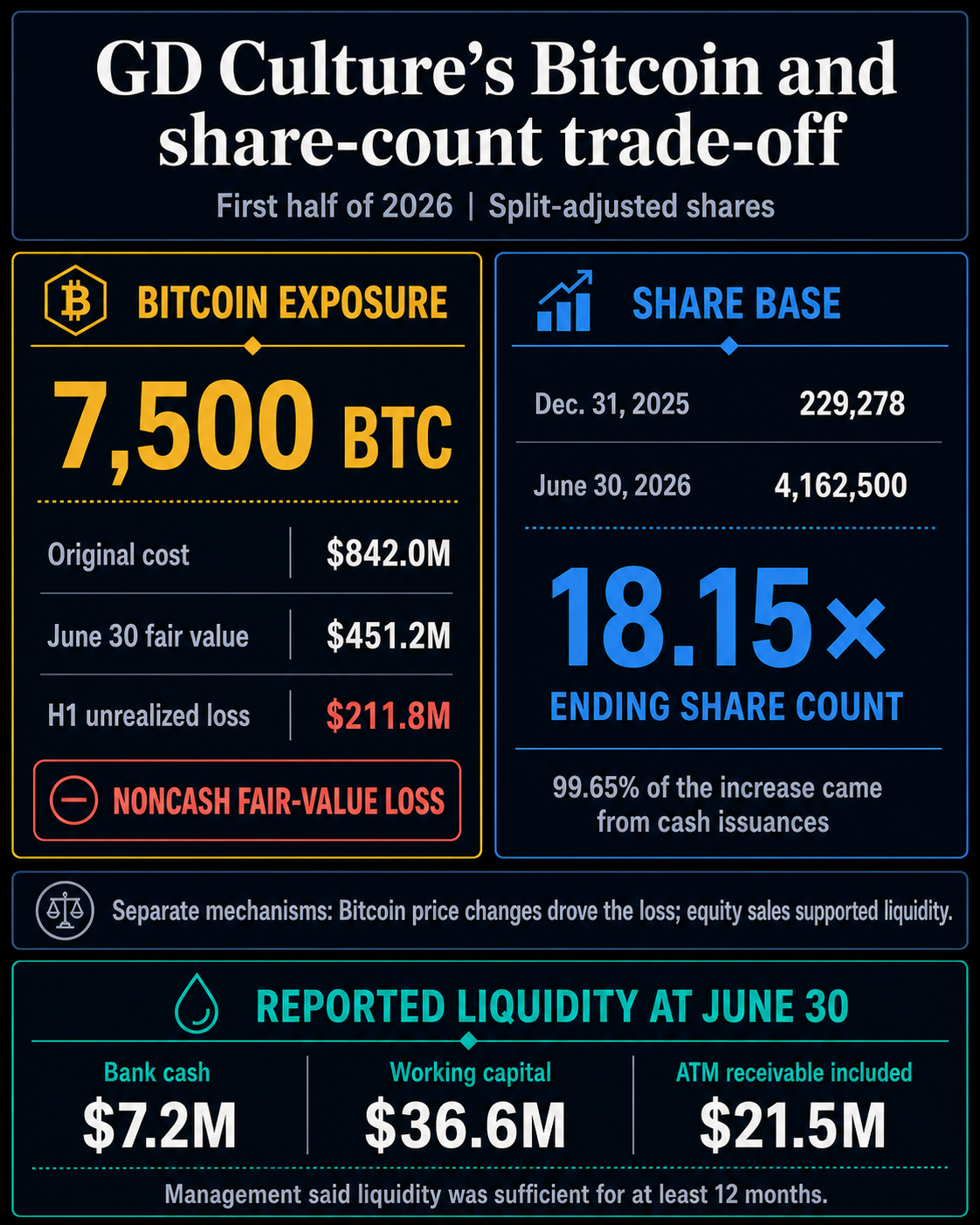
GD Culture Group reported a $211.8 million first-half unrealized Bitcoin loss on its holdings while its split-adjusted share count rose to more than 18 times its year-end level, exposing two distinct pressures behind the company’s crypto-treasury strategy.
The Nasdaq-listed digital media and technology company held 7,500 BTC with an original cost of $842 million and a June 30 fair value of $451.2 million, according to its Aug. 14 quarterly filing. The Bitcoin loss accounted for about 97.9% of GD Culture’s $216.2 million net loss for the first six months of 2026.
That charge reflected fair-value accounting as Bitcoin prices changed. It was not a cash outflow or a sale of the core reserve. GD Culture separately reported selling about 1.08 BTC purchased for short-term trading, receiving $71,201 and recording a $28,799 realized loss.
The 7,500-BTC reserve entered GD Culture through its September 2025 acquisition of Pallas Capital Holding, the company’s 2025 annual report shows. The company identified working capital and general corporate purposes as the intended uses for its 2026 offering proceeds.
Equity sales supported liquidity amid the Bitcoin loss
GD Culture ended 2025 with 229,278 shares outstanding and finished June with 4,162,500, after retroactively adjusting both figures for the June 29 one-for-250 reverse split. The increase of 3,933,222 shares left the ending count 18.15 times its year-end level.
Cash issuances accounted for 3,919,455 of those additional shares, or 99.65% of the increase. From May through June, the company sold 2,882,249 split-adjusted shares through its at-the-market program for about $42 million net. It also sold 1,037,206 split-adjusted shares in a June placement at an adjusted $5.25 each, raising about $5.45 million gross.
The company received $25.1 million of financing cash during the first half. Another $21.5 million in ATM proceeds remained in the underwriter’s brokerage account at quarter-end, so GD Culture recorded the amount as a receivable. The company said it received those funds immediately afterward.
At June 30, GD Culture reported $7.2 million in operating bank accounts and $36.6 million of working capital, which included that ATM receivable. The company used $12.3 million of cash in operations during the half. Management concluded it had enough liquidity to meet its obligations for at least 12 months after the interim financial statements were issued.
The filing therefore presents two distinct shareholder exposures. Bitcoin price volatility drove a large noncash accounting loss, while the rapid expansion of the share base made dilution the direct cost to shareholders. The stock sales did not cause the Bitcoin loss, but the filing shows equity issuance was a major source of near-term liquidity as GD Culture kept its 7,500-BTC reserve.
K Wave Media has become a useful reminder that the Bitcoin treasury trade is not one simple story. The company once presented Bitcoin as part of a larger balance-sheet strategy. Now, after selling its BTC and shifting attention toward artificial intelligence infrastructure, it has effectively shown the other side of the corporate accumulation narrative.
That matters because Bitcoin treasury companies have been one of the loudest themes of the cycle. The market loves the clean version: a public company raises capital, buys BTC, and lets shareholders gain leveraged exposure to Bitcoin. K Wave’s reversal is messier.
For more details, visit the official Sec platform.
TL;DR
K Wave Media disclosed in SEC filings that it sold Bitcoin tied to its treasury strategy and used proceeds to address debt obligations. The company has also discussed reallocating capital toward AI infrastructure. For the wider market, the story is not about the size of K Wave’s BTC stack. It is about what happens when smaller treasury plays meet debt, equity-market pressure, and changing investor appetite.
Bitcoin treasury strategies work best when capital is cheap, share prices are strong, and investors reward accumulation. They become much harder when financing conditions tighten or the company’s core business needs cash.
That is the lesson here.
A Treasury Strategy Needs More Than A Slogan
The corporate Bitcoin playbook is often associated with Strategy because Strategy built it at scale and stuck with it for years. Smaller companies have tried to borrow parts of that model, but not every balance sheet can carry the same risk.
Buying Bitcoin is easy to explain. Funding it sustainably is the hard part.
If a company relies on capital raises, convertible notes, preferred stock, or other financing tools to support a BTC strategy, the market has to keep believing in the premium. Once that premium disappears, the strategy can turn from accretive to stressful very quickly.
K Wave’s exit is therefore less about one company’s number of coins and more about the market’s willingness to keep funding copycat treasury models.
Why Bitcoin Traders Should Care
For BTC itself, K Wave is not large enough to move the market on its own. But the symbolism is bigger than the position.
Treasury-company demand has been part of Bitcoin’s institutional story. If investors start separating strong treasury operators from weaker ones, the market may become more selective. That is healthy in the long run, but it can create short-term pressure as weaker names unwind or pivot.
The bullish interpretation is that Bitcoin’s treasury theme is maturing. Not every company that announces a BTC plan deserves a premium. The bearish interpretation is that some corporate holders could become sellers if balance-sheet pressure rises.
Both can be true.
K Wave’s move does not kill the treasury trade. It does show that the trade is no longer automatic. Investors are now asking harder questions about debt, liquidity, business quality, and whether the Bitcoin strategy actually fits the company using it.
This report is based on information from K Wave Media SEC filings.
This article was written by the News Desk and edited by Samuel Rae.
MicroStrategy’s $64 billion Bitcoin (BTC) bet has become a stress test for everyone who funded it. BTC now trades below $60,000, and the renamed company, Strategy, sits at a discount to its own holdings.
The question dividing investors is no longer whether Strategy gets liquidated tomorrow. It is who absorbs the losses while the company keeps its coins and keeps paying to hold them.
How the Bitcoin Flywheel was Built
By June 22, Strategy held 847,363 BTC bought for $64.1 billion, an average of $75,651 each. That is the largest corporate Bitcoin position anywhere.
MicroStrategy Bitcoin Purchases in 2026. Source: Strategy
The model runs like a flywheel. The company sells stock and debt, buys more Bitcoin, and its shares climb when BTC rises. However, falling prices spin the machine in reverse.
BTC has fallen below $60,000 this week, its lowest level since 2024. The stock has slid with it, dropping under the value of the Bitcoin on its books.
A new accounting standard made the pain visible. Since 2025, FASB rule ASU 2023-08 forces firms to mark Bitcoin to fair value each quarter. As a result, Strategy booked a $14.46 billion unrealized loss in early 2026. That produced a $12.54 billion net loss, or $38.25 for every diluted share.
Michael Saylor’s Strategy currently has a $14 billion unrealized loss on bitcoin.
Tom Lee’s Bitmine currently has a $10.5 billion unrealized loss on ETH.
This is why it’s foolish to follow the smart money and not take profit.
They can survive a crypto winter, most of will not!
The bill does not fall on Strategy alone. As the flywheel slows, the cost spreads to five groups, in rough order of exposure.
Common shareholders
They stand first in line. When the stock trades below the value of its Bitcoin, the company still raises cash by selling new shares. Each sale buys less Bitcoin than it hands away.
“If we decide to sell $1 billion of MSTR stock and buy $1 billion of Bitcoin… when you do it at 1.0x MNAV… it is dilutive. It is a minus 48 basis point yield. It costs the shareholders $310 million,” Michael Saylor, Executive Chairman, Strategy, said during Q1 2026 earnings call.
Existing owners are left holding a smaller claim on the same coins, and that dilution is how the strategy gets funded.
Investors in other treasury companies
The copycats have fared worse than the original. Their shares once traded far above the Bitcoin they held, lifted by hype.
As that premium faded, many Bitcoin treasury company stocks fell much harder than Bitcoin itself, leaving late buyers deep underwater.
“If that’s not already a bubble burst, how would that bubble burst?” Tom Lee, Chairman of BitMine, said while many treasury stocks traded below net asset value.
Passive and index fund investors
This group never chose the bet. MSCI has proposed removing companies whose digital assets exceed half their total assets from its global indexes.
“Feedback from the consultation confirmed institutional investor concern that some DATCOs exhibit characteristics similar to investment funds, which are not eligible for inclusion in the MSCI Indexes,” MSCI said in its official announcement earlier this year.
Strategy clears that bar with ease. An exclusion would force index funds and pension trusts to sell automatically, whatever the price, just to keep tracking the benchmark.
Convertible bondholders and preferred shareholders
These investors lent on the assumption that MicroStrategy could always refinance. If Bitcoin stays depressed into 2027, that assumption breaks.
“Proceeds from the bitcoin sales are expected to be used to fund distributions on preferred stock,” Strategy indicated in the June 1 Form 8-K.
Bondholders can demand cash, and preferred holders still expect dividends, both drawing on a reserve of just $1.4 billion.
MicroStrategy itself
The company is the backstop of last resort. On its first quarter 2026 earnings call, Michael Saylor again framed Strategy as a net buyer that never sells.
“We will probably sell some Bitcoin to fund a dividend just to inoculate the market, just to send the message that we did it.”
Yet if financing freezes while debt and dividends come due, keeping that vow could become impossible.
“We will sell Bitcoin when it is advantageous to the company. We are not going to sit back and just say we will never sell the Bitcoin,” Strategy co-CEO Phong Le added.
The Real Test Arrives in 2027
MicroStrategy faces no margin call today. Its main debt is unsecured, so a falling price alone cannot trigger a forced sale. The threat is a date, not a level.
Holders of a $1.01 billion convertible note can demand repayment on September 15, 2027. If the shares sit below the conversion price, that claim becomes a cash bill the company must cover.
Strategy has neared this edge before. A 2022 Silvergate loan backed by Bitcoin carried a margin call near $21,000 before the firm repaid it. Moving to unsecured notes and preferred stock removed the automatic trigger, but not the obligation.
Microstrategy took a loan to buy more #bitcoin a few months ago using 19,000 $BTC as collateral.
For now, no forced sale looms. The pressure has simply moved from a price trigger to a calendar. The number that matters is no longer $60,000, but the September 2027 repayment date.
Strategy (formerly MicroStrategy) added another $100 million of Bitcoin to its balance sheet last week, extending a buying campaign that has made the company the world’s largest corporate holder of the digital asset while sharpening a debate over what its common shareholders actually own.
On June 15, Michael Saylor, the company’s chairman, said Strategy bought 1,587 BTC at an average price of $63,024 per token, which lifted its total holdings to 846,842 BTC.
That position is equal to more than 4% of Bitcoin’s fixed 21 million supply cap, a level that has turned Strategy from a software company into one of the market’s most closely watched Bitcoin financing vehicles.
However, the latest purchase landed at a more difficult moment for the company’s equity story. Bitcoin has fallen sharply from recent highs, Strategy’s stock has come under increased pressure, and the company’s preferred per-share metric for tracking Bitcoin ownership moved lower following the transaction.
That decline has reopened a question that has followed Strategy through several rounds of capital raising: Is the company still increasing value for common shareholders, or is it asking them to accept a smaller claim on its Bitcoin stack in exchange for a larger and more complex balance sheet?
Bitcoin stack grows, BTC yield falls
According to the SEC filing, Strategy financed the latest purchase through sales of its Class A common stock.
The company said it sold 1.7 million MSTR shares last week for about $209 million. It used roughly $100 million to buy Bitcoin and allocated another $100 million to its dollar reserve, lifting that reserve to about $1.1 billion.
The company still has $25.75 billion of MSTR shares available for sale under its at-the-market program. It has also expanded its capital markets platform to include up to another $21 billion of common stock, $21 billion of STRC preferred stock, and $2.1 billion of STRK preferred stock.
The scale of those programs has made each new transaction a test of how investors should measure dilution.
Strategy’s BTC Yield, which tracks the change in Bitcoin holdings per assumed diluted share, slipped from 13.0% on June 1 to 12.8% on June 8. It fell again to 12.5% after the latest purchase. The decline came even as Strategy’s Bitcoin holdings rose from 843,706 BTC to 846,842 BTC over the same period.
Strategy’s Bitcoin Per Share (Source: Strategy)
For critics, that is the core issue. Strategy bought more Bitcoin, but common shareholders appear to own less Bitcoin per share when measured using the company’s own Bitcoin-per-share framework.
Matthew Kratter, a Bitcoin advocate and frequent Strategy critic, argued that the drop in BTC Yield showed the transaction was dilutive. He wrote on X:
“Congratulations to Saylor and Strategy for diluting MSTR shareholders once again over the weekend! Bitcoin per share dropped yet again, and the Saylor simps are too st#pid to understand what’s happening to them.”
Saylor defends Strategy against dilution arguments
Saylor has rejected the view that the latest transaction should be judged only by BTC Yield, arguing that the metric captures Bitcoin per share but does not account for the cash Strategy added to its balance sheet.
His defense rests on a broader framework built around common equity Bitcoin exposure (CEBE).
Under that approach, investors distinguish between Bitcoin per share before senior claims and Bitcoin exposure available to common shareholders after accounting for debt, preferred stock, and cash reserves.
Saylor has described BPS as the growth metric for common equity, while CEBE BPS is the more conservative risk measure because it adjusts for senior claims. BTC Yield, in his view, measures execution on the BPS side of the equation but does not fully capture the company’s residual equity value.
That distinction matters more as Strategy’s capital structure becomes more layered. If obligations are short-dated or expensive, CEBE becomes more important because those claims can quickly weigh on common shareholders.
However, when liabilities are longer dated, and Bitcoin appreciates faster than the company’s financing costs, Saylor argues that BPS better reflects the upside available to common equity.
In view of this, he described the gap between BPS and CEBE BPS as “amplification.” Without debt or preferred stock, the two measures would be the same, and a Bitcoin treasury company would more closely track Bitcoin itself. As liabilities increase, the measures diverge, creating both the possibility of outperformance and the risk of underperformance.
For Saylor, that means Strategy’s liabilities should not be treated as a single risk category. Short-duration, high-cost obligations can turn leverage into a drag, while long-duration, low-cost financing can increase common equity upside if Bitcoin’s annual return exceeds the company’s cost of capital.
In that framework, the latest transaction can look dilutive under a Bitcoin-per-share measure while still appearing accretive when cash reserves and senior claims are included.
On this basis, Saylor argued that a well-capitalized Bitcoin treasury company can outperform Bitcoin over time, provided the asset appreciates faster than the cost of financing the structure.
Market analysts remain split over the balance sheet
Despite Saylor’s detailed defense of the capital structure, institutional analysts remain sharply divided on whether Strategy is creating or destroying value.
Quinn Thompson, chief investment officer at Lekker Capital, criticized the continued equity issuance, arguing that Strategy should strengthen its balance sheet rather than use new capital to buy more Bitcoin.
Thompson said MSTR common trades at about 0.8 times net asset value after accounting for debt and preferred equity liabilities.
He wrote:
“They’re selling MSTR shares that are worth 80 cents on the dollar to buy $1 bills.”
In his view, the issue is not whether common equity issuance can improve the capital structure for creditors. It is whether common shareholders benefit when a company with negative cash flow relies on capital markets to service debt and preferred equity obligations while continuing to buy Bitcoin.
Nic Puckrin, CEO of Coin Bureau, made a similar point, saying Strategy has few clean options left if its common stock trades below the value of its Bitcoin holdings.
According to him, issuing more stock can dilute Bitcoin per share, while issuing more preferred shares would add to future cash obligations. At the same time, selling Bitcoin could damage market confidence, while suspending dividends could drive preferred holders away.
However, Dylan LeClair, director of Bitcoin strategy at Metaplanet, pushed back on that view. He argued that once debt and preferred stock are deducted, the common equity can still trade at a premium because Strategy’s enterprise value exceeds its Bitcoin net asset value.
From that perspective, issuing common stock can be positive for the capital structure. LeClair said the move can increase US dollar net asset value per share and reduce leverage, even if it puts some pressure on Bitcoin per share.
Adam Livingston, an independent market analyst, also supported Saylor’s broader framework. He argued that the latest transaction was accretive once Strategy’s new Bitcoin and larger cash reserve were both included.
By Livingston’s calculation, the 1,587 BTC purchase and roughly $100 million reserve increase added about 3,146 BTC-equivalent to the common residual. That lifted common equity Bitcoin exposure from 145,142 satoshis per share to 145,319 satoshis per share.
He said:
“BTC-only looked dilutive. BTC plus cash was accretive.”
His argument mirrors Saylor’s broader case: Common shareholders do not own only the latest Bitcoin purchase. They own the residual claim on Strategy’s entire balance sheet after debt, preferred stock, and other senior claims are considered.
MSTR’s harder test is investor confidence
The dispute reflects a broader shift in how investors are judging Strategy. During Bitcoin rallies, the company’s model was easier to defend: raise capital, buy Bitcoin, and trade at a premium to the value of its holdings.
However, the current market has been less forgiving. Bitcoin’s decline has compressed that premium, while preferred dividends, debt, and future financing needs have become a larger part of the investment case.
That is why today’s $100 million purchase has drawn attention beyond its size. BTC Yield fell, reinforcing the dilution argument. Cash reserves rose, supporting Saylor’s claim that Strategy’s broader residual value improved.
The next test is whether investors continue to accept that framework. Strategy can keep buying Bitcoin as long as capital markets remain open. The harder question is whether common shareholders will continue to treat the strategy as accretive when their direct per-share Bitcoin claim is declining.
Strive (NASDAQ: STRV) purchased 2,500 Bitcoins between May 23 and June 1 for approximately $185.2 million, bringing the company’s treasury to 19,000 BTC
The 2,500 BTC purchase was funded almost entirely through the company’s Variable Rate Series A Perpetual Preferred Stock (SATA), with an average cost of about $74,092 per coin.
Is Strive still buying BTC?
An SEC 8-K filing confirmed that Strive raised most of the money used for its most recent Bitcoin purchase through its SATA stock. The company issued 1,754,188 new shares that generated approximately $175.4 million. The remaining $9.8 million came from selling Class A common stock (ASST).
The average price Strive paid per coin was $74,092, which is lower than its previous purchase when it bought 1,109 BTC at about $76,989 per coin. During the latest purchase window, Bitcoin traded below $71,000 at certain points, meaning the treasury firm bought during a price drop.
Strive’s holdings have risen from 16,500 BTC to 19,000 BTC, representing a 15.2% increase in total holdings over a single reporting period. The CEO, Matt Cole, disclosed the deal on X, adding that the company has a quarter-to-date BTC yield of 23.0%, a year-to-date yield of 36.7%, and an amplification ratio of 57.0%.
The 8-K filing also shows cash and equivalents rising from $93.3 million to $137.3 million, even after Strive spent $185 million on Bitcoin. Strive raised about $229 million total from both equity instruments, and the company stated that the higher cash balance helps it maintain an 18-month dividend reserve for SATA holders.
Strategy’s rare Bitcoin sale
Strategy (NASDAQ: MSTR), the largest corporate Bitcoin holder at 843,706 BTC, disclosed that around the same time as Strive’s purchase, it had sold 32 Bitcoins for $2.5 million to fund dividend payments on its own preferred stock, STRC. This is the second time Strategy has ever sold any of its Bitcoin holdings.
Michael Saylor, Strategy’s executive chairman, responded to Cole’s announcement regarding the Bitcoin purchase with a brief endorsement on X, posting “@Strive for Bitcoin.”
Cole previously announced that Strive expects to increase the size of its at-the-market programs by $2.1 billion each for Class A shares and SATA, which would bring total ATM capacity to approximately $5.15 billion. However, the expansion requires amended SEC filings and a certificate of amendment for SATA.
Strive plans to change SATA‘s current dividend payouts from a monthly to a daily basis beginning June 16, in order to smooth out the concentrated buying pressure that currently builds ahead of each monthly ex-dividend date, and potentially reduce the periodic pauses in Bitcoin accumulation that observers have noticed.
Don’t just read crypto news. Understand it. Subscribe to our newsletter. It’s free.