
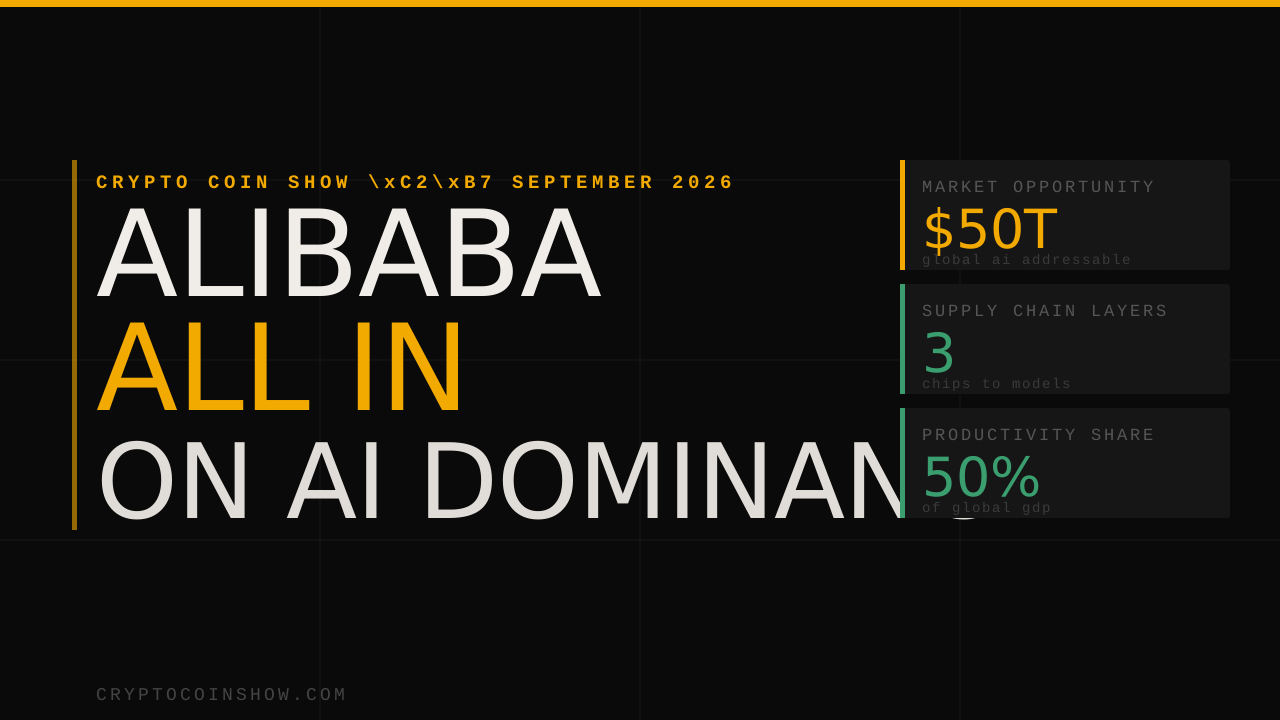
Alibaba goes all in on AI, with Joe Tsai calling it a US$50 trillion market
Alibaba Group is committing investment across the entire AI supply chain, from semiconductor chips to cloud infrastructure to foundational models, rather than betting on any single layer, with Chairman Joe Tsai framing a $50 trillion addressable market opportunity based on global human productivity. For institutional investors, this signals a strategic pivot away from model-only competition toward infrastructure dominance, even as Beijing simultaneously mobilizes state resources to embed AI across consumer devices and retail networks.
- Tsai estimates AI market opportunity at $50 trillion, derived from half of global GDP tied to human productivity and intelligence
- Alibaba launching Accio Work, autonomous AI agents performing market research, sourcing, and store management for SMBs in Malaysia
- China’s ministries issue 17-stage “AI Plus Consumption” strategy to integrate AI into smart devices, robotics, and retail by state mandate
- $50T Total addressable market for AI based on human productivity portion of global GDP
- 17 Additional stages in China’s coordinated ministry strategy for AI consumer integration
- 3 European cloud regions for Alibaba after France launch, enabling agentic AI services rollout
Alibaba Group announced its most expansive AI investment thesis this week, moving beyond incremental model releases to declare a full-stack commitment spanning semiconductors, cloud platforms, large language models, and consumer-facing applications.
At the Viva Technology conference in Paris, Chairman Joe Tsai articulated a $50 trillion total addressable market for AI, derived from the roughly $100 trillion in annual global GDP, with at least half representing human productivity and intelligence work susceptible to automation.
The framing matters strategically: rather than chase near-term wins in a single AI layer, Tsai signaled Alibaba is positioning itself as essential infrastructure across the entire value chain, from chip design through end-user applications in e-commerce, logistics, and consumer services.
This posture directly contests the assumption that dominance in large language models guarantees market leadership. Tsai explicitly warned that today’s leading AI model companies may lose their positions, reasoning that competitive advantage will shift as the technology matures and commoditizes.
If you look at global GDP, over US$100 trillion of GDP, at least half of that, US$50 trillion, is about human productivity and human intelligence. And that is the TAM of AI. And that’s why we’re all in on AI.
Joe Tsai, Chairman, Alibaba Group
Alibaba’s Qwen models reach top-tier adoption as company spreads infrastructure bets
Alibaba’s AI strategy explicitly encompasses four layers: proprietary chip design, cloud computing infrastructure, core generative models under the Qwen brand, and applications embedded into operational services.
The Qwen model family, open-source and commercially available, has grown into one of the world’s most popular foundation models by adoption metrics, with the latest version, Qwen 3.7-Plus, released earlier this month.
This positioning allows Alibaba to compete with OpenAI and Anthropic on model quality while simultaneously selling cloud compute, infrastructure services, and enterprise tools to customers locked into its ecosystem.
The multi-layer approach mirrors infrastructure plays by larger cloud providers but with a distinctly Chinese strategic orientation: state-aligned development, vertical integration across supply chains, and integration into existing consumer commerce platforms that already operate at massive scale.
Unlike pure-play AI companies or cloud providers betting heavily on third-party model adoption, Alibaba controls more of its own destiny across the stack.
Accio Work deploys autonomous agents into SMB operations across Southeast Asia
Alibaba.com this week launched Accio Work in Malaysia, a suite of AI agents engineered to operate autonomously within small and medium-sized business workflows. The tool performs market research, product development, supplier sourcing, product listing creation, marketing campaign design, and online store operations without continuous human intervention at each step.
This represents a material escalation beyond chatbot or copilot-style tools that generate answers to queries; Accio Work accepts high-level instructions and executes multi-step business processes, effectively functioning as a team member.
Shawn Yang, General Manager for Alibaba.com’s APAC region, framed AI as “essential infrastructure that is changing how businesses operate worldwide” rather than an experimental feature. The deployment targets a market segment, SMBs in developing economies, where wage costs and access to specialized talent create acute ROI for automation tools.
Alibaba plans to expand agentic AI services into European markets later this year, following cloud infrastructure buildouts in France, Germany, and the UK.
Beijing coordinates AI-plus-consumer rollout across robotics, smart devices, and retail
Parallel to Alibaba’s corporate strategy, China’s Ministry of Commerce and seven co-signing ministries issued a coordinated 17-stage framework for integrating AI into consumer products, retail services, and household devices.
The “AI Plus Consumption” initiative explicitly targets deployment across smart robotics, AI-powered assistants, autonomous vehicles, and AI-native smartphones, with stated objectives to create new growth sources, enhance consumer experience, and increase overall spending capacity. The policy framework includes infrastructure standards, subsidy mechanisms, and hardware development targets.
This state-level mobilization creates tailwinds for domestic AI companies including Alibaba: coordinated procurement standards, infrastructure subsidies, and regulatory clarity around consumer AI deployment. It also signals that Chinese policymakers view AI adoption in consumer retail as a demand-side economic stimulus tool, comparable to industrial policy in prior decades.
The timing aligns with slowing growth in traditional e-commerce and reflects Beijing’s pivot toward AI-driven productivity gains as a counter to demographic headwinds.
The combination of Alibaba’s full-stack infrastructure commitment and Beijing’s consumer AI integration roadmap creates a test case for whether vertically integrated, state-aligned AI strategies can compete with distributed, open-source models developed by Silicon Valley incumbents.
Institutional investors should track three specific developments: Qwen’s adoption rates and pricing power compared to OpenAI’s GPT and Anthropic’s Claude; whether Accio Work achieves measurable productivity gains and retention rates among SMB users in Malaysia and Southeast Asia; and whether China’s “AI Plus Consumption” subsidies and standards drive material revenue uplift for Alibaba Cloud services in 2025.
Alibaba’s Infrastructure Play Against OpenAI-Style Model Concentration
Alibaba’s full-stack approach directly challenges the venture-backed model-centric strategy exemplified by OpenAI and Anthropic, where valuations and competitive advantage cluster around frontier large language models.
By contrast, Tsai’s thesis treats models as one component within a larger productivity ecosystem, a shift that mirrors how Nvidia became more valuable than any individual AI software company by controlling the enabling layer.
This architectural choice carries institutional implications: infrastructure vendors typically command higher margins and longer customer lock-in than application layers, though they also face geopolitical scrutiny around export controls and data sovereignty.
The timing aligns with a documented slowdown in pure model performance gains; incremental improvements in LLM capabilities now require exponentially higher compute investments, with some researchers questioning whether scaling laws remain valid at frontier.
Alibaba’s diversification into autonomous agents, semiconductor design, and edge inference suggests management believes the next wave of AI value creation will accrue to implementers who can deploy models cost-effectively at scale rather than to labs that can increment benchmark scores by fractions of a percentage point.
This represents a recalibration of risk within Alibaba’s $220+ billion market capitalization away from R&D intensity and toward operational deployment.
Institutional investors should monitor whether Alibaba’s semiconductor roadmap, currently targeting inference chips competitive with Nvidia’s H100 by 2025, actually closes the performance gap or remains three to five generations behind. The credibility of Tsai’s $50 trillion TAM thesis depends on Alibaba demonstrating it can deliver AI infrastructure at 40-50% lower total cost of ownership than Western equivalents, a claim that will be tested when Alibaba Cloud autonomous agent services launch across the three new European regions this quarter.