
Originality.ai flags 1,272 of 2,034 Amazon religious titles as machine-written
An AI detection firm has identified 1,272 of 2,034 religious books on Amazon, roughly 63 percent, as likely machine-written, with Eastern religion categories showing the highest concentration of automated content. For institutional crypto and blockchain investors watching AI governance, content authenticity, and marketplace integrity, this finding underscores a critical gap in Amazon’s ability to police generative AI at scale, raising questions about the baseline trust and oversight mechanisms that digital platforms now require.
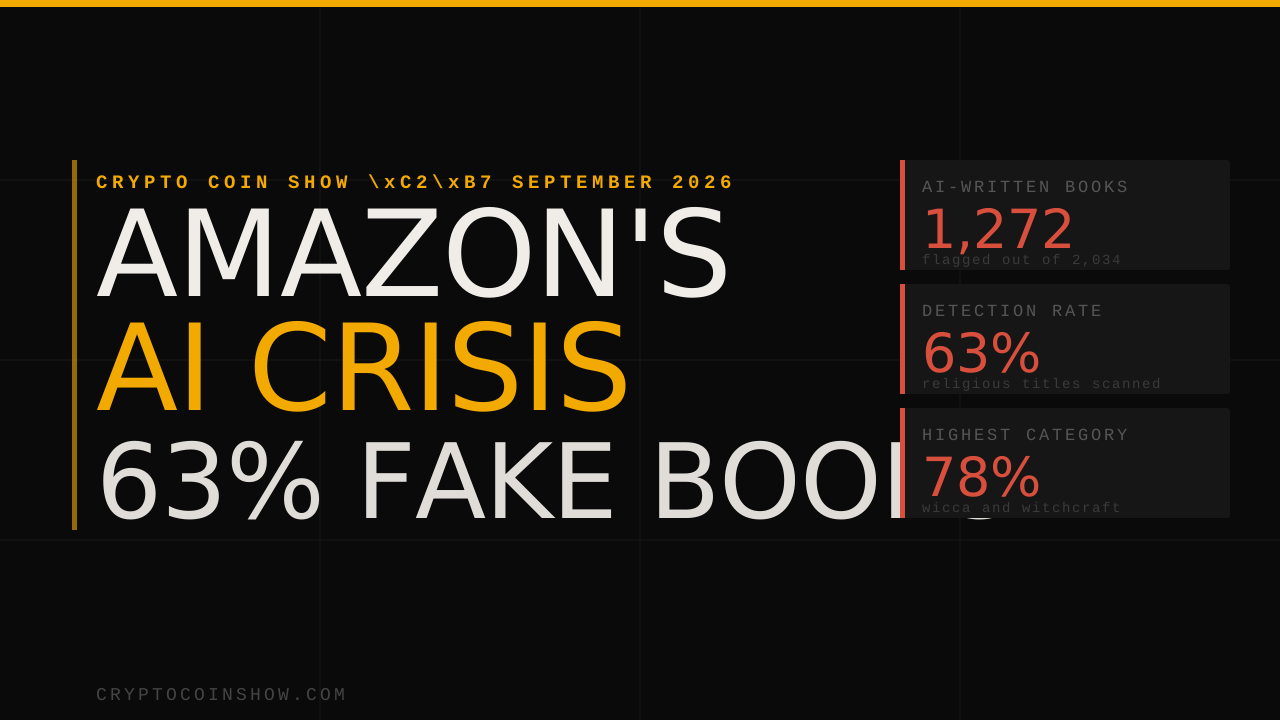
- Originality.ai flagged 1,272 of 2,034 religious books scanned across 14 faith categories as likely AI-written, representing 63 percent of the sample.
- Wicca and witchcraft titles showed the highest AI concentration at 78 percent, followed by Hinduism at 76 percent and Taoism at 74 percent.
- AI-generated religious books averaged $16.84 and 170 pages versus $18.96 and 208 pages for human-written titles, with fact-checkable claims in witchcraft titles showing 53 percent potential falsehoods.
- 63% Share of 2,034 religious books flagged as likely AI-written versus human-written baseline
- 78% Percentage of Wicca and witchcraft category titles identified as machine-generated content
- $2.12 Average price difference between AI books and human-written religious titles on Amazon
Originality.ai, a detection firm specializing in machine-written content identification, completed a systematic scan of 2,034 English-language religious and spiritual paperbacks published on Amazon during the first six months of 2026.
The firm analyzed titles across 14 faith categories, ranging from major traditions to niche belief systems, and applied a machine-learning model to the book summary, author biography, and interior sample text to assign each a likelihood score for AI authorship.
Titles scoring 50 or higher on the firm’s scale were classified as “Likely AI.” The result: 1,272 books met that threshold, indicating that nearly two-thirds of the religious titles in Amazon’s catalog during this period appear to have been generated or substantially composed by language models rather than human authors.
The scale of the finding matters to institutional investors because it reveals a fundamental weakness in Amazon’s content governance infrastructure at precisely the moment when AI-generated material is flooding digital marketplaces faster than human review processes can handle.
For blockchain and decentralized finance stakeholders, this case study demonstrates why transparent, immutable, and algorithmically auditable content attribution may become a market requirement, not a nice-to-have feature.
Eastern religion categories show highest AI saturation, signaling market targeting by cost-optimizing publishers
The geographic and categorical breakdown of AI-written titles exposes a deliberate targeting pattern. Wicca, witchcraft, and paganism, the single category most amenable to claims about healing crystals, herbal remedies, and energy cleansing that require no scientific validation, registered the highest AI saturation at 78 percent. Hinduism followed at 76 percent, and Taoism at 74 percent.
By contrast, Satanism registered only 22 percent AI content, Atheism 40 percent, and Mormonism 42 percent, though the Originality.ai report notes that these lower-traffic categories drew from smaller sample sizes and thus carry less statistical weight.
Michael Fraiman, the lead author of the study, offered a market-driven explanation for the Eastern religion skew: publishers using AI systems appear to be targeting high-demand, lower-scrutiny niches where readers make purchasing decisions based on category appeal and star ratings rather than author reputation or content verification.
The Wicca and witchcraft market, in particular, attracts buyers seeking wellness solutions, mental health improvement, chemical detoxification, stress relief, without requiring the title to meet any external scientific standard.
Fraiman noted that AI book authors “chase the busiest categories,” suggesting that low-traffic faith traditions experience less AI penetration simply because they lack the volume incentives.
The report also points to a secondary pattern: non-native English speakers may be using AI writing tools as a low-friction entry point into the English-language religious publishing market, explaining part of the Eastern religion concentration.
AI religious books undercut human-authored titles by $2 and average 38 pages shorter
The economic profile of the AI-generated religious books reinforces the cost-driven motivation behind their production. Books flagged as likely AI-written averaged $16.84 and 170 pages, compared to $18.96 and 208 pages for those identified as human-written, a two-dollar price discount and a roughly 18 percent reduction in page count.
This pricing structure allows publishers to undercut legitimate religious authors while maintaining retail margins, creating a perverse incentive for continued AI content production as long as reader demand and Amazon’s content review capacity remain asymmetrical.
The Originality.ai report characterizes this dynamic as exploitative, arguing that AI-generated religious books “pull at the heart of a religious person’s beliefs” while charging readers for unverified claims and potentially false information.
The damage extends beyond consumer deception: readers purchasing these titles sight unseen, a common behavior in faith and spirituality categories where buyers rely on category, rating, and price cues rather than author verification, may make life or wellness decisions based on false claims presented as factual guidance.
Fact-checking reveals 53-58 percent false claim rates in witchcraft, atheism, and satanism categories
When Originality.ai applied fact-checking analysis to testable claims within the flagged AI books, the results grew more troubling. In witchcraft titles, 53 percent of fact-checkable claims were flagged as potentially false. Atheism reached 58 percent false claims, agnosticism 53 percent, Satanism 52 percent, and Buddhism 52 percent.
These figures suggest that AI language models, when tasked with generating religious and spiritual advice, are producing plausible-sounding but demonstrably inaccurate information at rates far exceeding acceptable margins for published content.
The high false claim density in atheism and agnosticism categories is particularly significant because these texts often frame themselves as educational or philosophical frameworks rather than emotional wellness guides. Readers approaching an atheism or philosophy book expect factual rigor and logical consistency, not marketing-grade persuasion.
That more than half of testable claims in these categories fail verification indicates that the AI systems are not simply paraphrasing existing sources, they are generating novel, confident-sounding claims without grounding them in factual accuracy.
The Buddhist category also exceeded the 50 percent false claim threshold at 52 percent, suggesting that religious texts across multiple traditions are being compromised.
Amazon acknowledges AI content problem but declines explicit prohibition or disclosure requirement
When pressed on the findings, Amazon did not dispute them.
A company spokesperson confirmed that the retailer has “content guidelines” and takes “proactive and reactive measures to prevent, detect, and remove content that violates those guidelines, whether AI-generated or not.” Notably, the spokesperson framed the issue as a content quality problem rather than an AI-generation problem, a distinction that allows Amazon to avoid committing to AI-specific detection, labeling, or author verification requirements.
Amazon does not prohibit AI-written books outright, nor does it require authors to disclose whether their work was generated, composed, or substantially edited using language models.
The retailer’s approach treats AI content as one category within a broader content moderation challenge, which functionally means that individual title review depends on whether Amazon’s human or algorithmic systems flag specific policy violations, a reactive rather than proactive posture.
This governance gap is directly relevant to institutional investors in two ways. First, it demonstrates how rapidly AI-generated content can saturate a digital marketplace when distribution platforms lack both transparency requirements and cost-effective detection at scale.
Second, it reveals that incumbent tech platforms, even those with enormous resources and established content moderation operations, have chosen not to implement the structural changes (author verification, AI disclosure requirements, content provenance tracking) that would prevent the problem in the first place.
Blockchain and verifiable content attribution emerge as potential market solutions to authenticity crisis
The Originality.ai findings arrive
Original reporting: cryptopolitan.com