Hackers Expose How AI Music App Suno Stole Decades Worth of Copyrighted Music
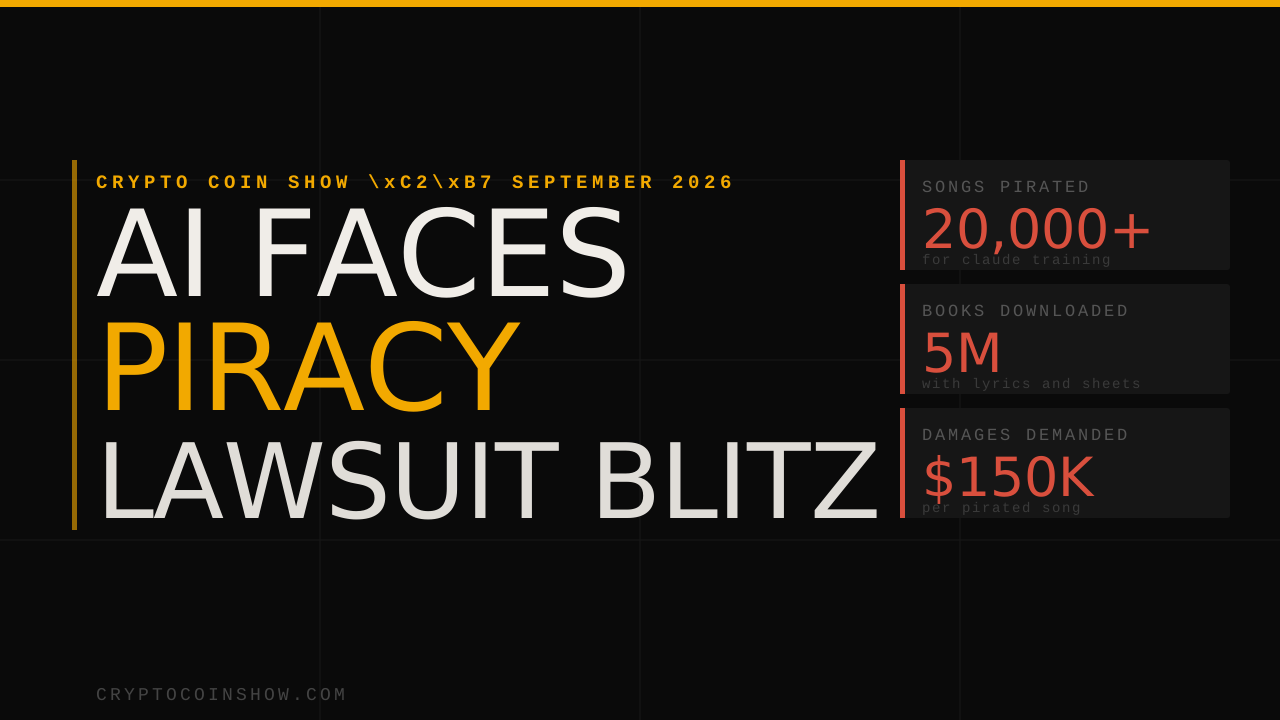
A security breach at AI music generation startup Suno has exposed the company’s systematic harvesting of millions of copyrighted songs to train its models, raising acute questions about data governance and legal liability as the firm faces multiple copyright lawsuits. For institutional investors in AI infrastructure and music-adjacent crypto projects, the incident signals both the technical and regulatory risks inherent in large-scale machine learning training on unlicensed content.

- Suno’s datasets contained 2,013,545 YouTube Music clips and 113,879 hours of YouTube Music alone, representing decades of copyrighted material.
- The hack exposed source code documenting Suno’s scraping of YouTube Music, Genius, Deezer, Jamendo, Freesound, Pond5, and IMSLP without licensing agreements.
- The breach also revealed access to sensitive user payment data via Stripe, compounding security and compliance exposure beyond copyright infringement claims.
- 2,013,545 YouTube Music clips ingested into Suno datasets per exposed source code file
- 113,879 hours of YouTube Music content in training data, equivalent to over 13 years of continuous audio
- Multiple ongoing copyright lawsuits against Suno from major record labels and rights holders
A security researcher operating under the pseudonym ellie.191 obtained Suno’s source code and documented in granular detail how the AI music generation platform scraped millions of songs from public websites to build its machine learning models, according to reporting by 404 Media.
The exposed files reveal that Suno systematically harvested music and metadata from YouTube Music, Genius lyrics, Deezer, and smaller libraries including Jamendo, Freesound, Pond5, and the International Music Score Library Project, consolidating them into training datasets of staggering scale.
The hack confirms what Suno had already conceded in court filings: that it used “essentially all music files of reasonable quality that are accessible on the open internet” without negotiating licenses or securing rights holder consent.
The breach carries immediate consequences beyond copyright exposure, as the hacker also demonstrated access to Stripe payment information tied to Suno user accounts.
Suno’s Admitted Scraping Strategy Confirmed by Leaked Training Data Architecture
Suno had previously disclosed its training methodology in legal documents filed in response to copyright infringement suits, but the leaked source code provides the first technical granularity on execution scale.
One repository file labeled “youtube_music” contained metadata for more than 2 million discrete music clips, while a corresponding database record documented 113,879 hours of YouTube Music content alone, roughly 13 years of uninterrupted audio.
That single source represents only a fraction of Suno’s total training corpus, which appears to span hundreds of thousands of hours when all scraped libraries are combined.
The scale is material to institutional investors evaluating AI infrastructure ventures because it exposes the operational model underlying Suno’s product: rather than licensing music catalogs or generating synthetic training data, the company built its competitive position on unauthorized ingestion of the entire publicly accessible internet music archive.
This approach has cost advantages during development but creates asymmetric legal and reputational risk once the company seeks institutional capital or profitability.
Suno has raised venture funding at a reported valuation exceeding $500 million, yet now faces cumulative copyright claims from Universal Music Group, Sony Music, and RIAA member labels, suits that could impose damages, training data deletion orders, or injunctions against model deployment.
Hacker Access to Payment Systems Reveals Layered Data Security Gaps
Beyond the copyright exposure, the breach demonstrates that Suno’s security architecture failed to compartmentalize sensitive user data from source code repositories.
The hacker obtained access not only to training data infrastructure but also to Stripe API integration and associated payment records, suggesting insufficient access controls and possibly hardcoded credentials within the codebase itself.
This pattern mirrors earlier breaches at AI startups where rapid scaling and product-focused engineering teams deprioritize security hygiene in favor of feature velocity.
For institutional investors conducting due diligence on Suno or comparable AI music ventures, the incident raises material governance questions: Does the company employ third-party security audits or bug bounty programs? Are API credentials rotated and stored separately from application code? Does the organization maintain insurance coverage for data breach liability?
Suno has not yet disclosed whether it has notified affected users or regulators under applicable data protection rules, nor has it published a detailed incident response. The silence itself is notable, as it suggests either ongoing remediation or regulatory consultation that prevents immediate disclosure.
Suno’s Legal Response Maintains Training Defense Despite Mounting Evidence
In a statement to 404 Media, Suno reaffirmed that its “AI models have been trained on publicly available music files and related metadata accessible on third-party websites on the open Internet,” and that the company’s “goal has always been to help people create original new music, not replicate someone else’s.” The statement is technically accurate on the sourcing claim, the files were publicly accessible, but ignores the distinction between legal access and authorized use that underpins copyright law in most jurisdictions.
Under U.S. copyright doctrine and the Digital Millennium Copyright Act, mere public availability does not confer a right to scrape, reproduce, and retrain on protected content without a license, fair use defense, or explicit opt-in consent.
The Copyright Office has indicated skepticism toward blanket fair use arguments in generative AI training, and the European Union’s AI Act requires explicit licensing for certain copyrighted training data.
Suno’s reliance on the “publicly available” framing is a legal posture, not a substantive defense, and the company’s own internal documentation now stands as evidence of willful, at-scale infringement rather than incidental use.
The company has also claimed that independent tests showing Suno’s ability to replicate published songs do not represent the model’s actual design intent, but rather edge cases or user misuse.
Yet the leaked datasets include artist-specific metadata and categorical organization, suggesting that the training process was structured to preserve artist identity and style, increasing the technical likelihood that the model could reproduce recognizable work.
Institutional Capital at Risk as Copyright Exposure Approaches Trial Threshold
The timing of the breach is significant because Suno’s copyright cases are advancing toward summary judgment or trial. Universal Music Group’s suit, filed in June 2024, names Suno and OpenAI (which invested in Suno) as co-defendants and alleges direct infringement and violations of the DMCA. Sony Music and the RIAA have brought parallel suits.
Discovery in these cases will now pit the leaked source code and training data architecture against Suno’s legal arguments, and the hacker’s documentation may be introduced as evidence of scienter, the company’s knowledge that its actions implicated copyright law.
Venture investors who backed Suno at high valuations now face dilution or loss scenarios if settlement costs or licensing requirements materially reduce the company’s financial runway or raise its cost of capital.
Institutional investors considering later-stage rounds will demand escrow for contingent liabilities and may require that Suno obtain representations and warranties insurance against copyright claims, a costly hedge that reflects market assessment of legal risk.
Suno has not announced any plan to license the music in its training datasets retroactively, nor has it stated whether it will modify its training methodology going forward. The next concrete step will be the courts’ response to discovery motions filed by Universal and Sony, likely within the next two to three months, which will determine whether Suno must produce the full technical documentation of its training process and whether the leaked source code is admissible as authentic evidence of the company’s data practices.
Original reporting: futurism.com