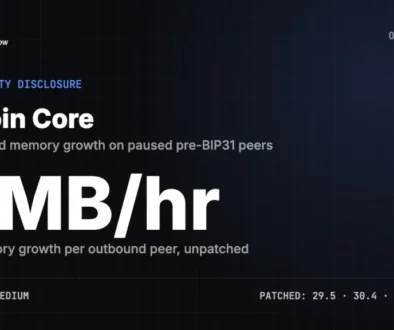
Bitcoin Core patches orphan transaction denial-of-service flaw
A vulnerability in Bitcoin Core’s orphan transaction handling allowed attackers to stall nodes by flooding them with duplicate transaction announcements, halting block processing. Core Lightning disclosed a separate denial-of-service flaw that crashed nodes through channel ID collisions, now patched in version 26.06.8.

- Bitcoin Core 29.x, 30.x before 30.5, and 31.x before 31.3 all affected
- Orphan transaction check repeated up to 50,000 times per inv message without deduplication
- Each malicious message stalled a node for over 12 seconds, blocking messages from all peers
- 29.x End of life; no fix available, users must upgrade immediately
- 50,000 Maximum announcements per inv message that attacker could duplicate
- 12 sec Minimum stall time per malicious message, blocking all peer communication
Greg Sanders posted a Bitcoin Core security advisory to the Bitcoin-Dev mailing list disclosing a medium-severity vulnerability in the node software’s handling of orphan transactions. The flaw, discovered in July by Project Loupe and responsibly reported by stutxo in August, affected all 29.x releases, 30.x versions before 30.5, and 31.x versions before 31.3. Version 32.1 and later already include the fix via Bitcoin Core #35878. The 29.x series has reached end of life and will not receive a patch.
How the orphan transaction flaw worked
Bitcoin Core stores transactions whose parent transactions it has not yet received, called orphans. Since version 29.0, each time a peer announced the wtxid (witness transaction ID) of a stored orphan, the node checked every parent of that orphan against its mempool and filters of recently seen transactions. The check ran every time, even for duplicate announcements.
An inv message can contain up to 50,000 announcements, and the vulnerable code skipped no duplicates. An attacker could send an orphan with thousands of missing parents, then send inv messages repeating its wtxid 50,000 times. According to the advisory, each such message stalled the node for over a dozen seconds during which it processed no messages from other peers, including blocks.
Who must upgrade and what to do
Full node operators running Bitcoin Core 29.x, 30.x before version 30.5, or 31.x before version 31.3 should upgrade immediately. Users of 29.x, which is no longer maintained, have no choice but to move to a supported release. Operators running 30.5 or later, or 31.3 or later, already have the fix.
The vulnerability was classified as easily exploitable, so attackers likely attempted to weaponize it. The fix deduplicates announced transactions within each inv message, so each orphan parent is now processed only once per announcement batch.
Core Lightning channel ID collision denial of service
Nishant Bansal disclosed a separate denial-of-service vulnerability in Core Lightning 26.06.7, released in August, that allowed attackers to repeatedly crash a node. The bug gave attackers no direct access to funds but could put channel reserves at risk through continuous crashes. Users are advised to upgrade to the latest version immediately. The flaw was fixed in CLN version 26.06.8.
The vulnerability stemmed from multiple v1 Lightning channels sharing the same channel_id. A malicious peer could open a channel by providing another channel’s funding outpoint, causing channel IDs to collide since channel_id is derived from that outpoint. CLN runs a channeld subdaemon for each channel and routes messages based on channel_id, assuming uniqueness.
Collisions caused the connectd daemon to crash.
Two attack vectors for the channel ID flaw
An attacker had two ways to crash a Core Lightning node. During reconnection, when lightningd starts channeld subdaemons, the first channel_id lookup would work fine. On the second request, an assertion verifying the connection was not already active would abort connectd, taking down the node.
Since both channels remained in the database after restart, repeated reconnections caused persistent crashes.
The second vector exploited CLN’s retention of previously closed channels in a hash table keyed by channel_id. An attacker closing a channel with a matching channel_id would trigger an assertion preventing duplicates, crashing the node.
This variant affected only versions 26.06.7 through 26.07.3, and unlike the first attack, the node crashed on every restart without further action from the attacker, persisting until upgrade.
BIP editor team refresh discussions
Mark “Murch” Erhardt posted to the Bitcoin-Dev mailing list to revive his April proposal to refresh the Bitcoin Improvement Proposal editor team, citing a backlog of submissions awaiting review. He presented two options: adding active editors or lowering standards so editors check only format compliance. He strongly preferred refreshing to three regularly contributing editors.
Erhardt noted that volunteers reluctant to commit long-term could serve limited terms of 12 to 24 months. Following the post, several people volunteered and current editor Olaoluwa Osuntokun announced plans to step down at year’s end. Discussion was ongoing at publication.
The CCS read. These vulnerabilities expose a sharp divide in Bitcoin infrastructure maturity. Bitcoin Core’s orphan-handling flaw is a process problem: easy exploitation of a code path running since version 29.0 that survived code review and fuzzing. Core Lightning’s channel ID collision is worse, a logic error that breaks fundamental assumptions in the daemon architecture. Neither reflects recent negligence; both were in production months before disclosure. The real lesson is that Lightning node operators, who run smaller deployments than Bitcoin Core node runners, depend on a narrower security review funnel. CLN’s immediate requirement to upgrade (versions 26.06.7 through 26.07.3 crash on restart post-attack) is a harsher penalty than Bitcoin Core’s 12-second stalls.
Bitcoin Core 32.1 is live; version 30.5 and 31.3 containing the fix are available now. Core Lightning users should verify they are running 26.06.8 or later. The BIP editor team decision awaits community consensus as Osuntokun’s departure nears year-end.
Lead image: Crypto Coin Show. Source: Bitcoin Optech newsletter