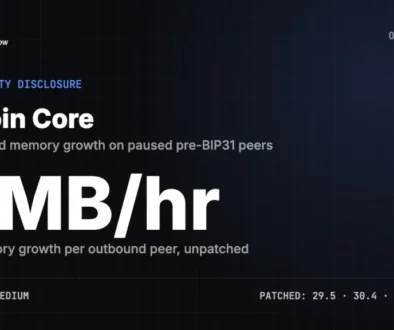
Bitcoin Core patches orphan announcement node stall
Bitcoin Core released security patches on November 20, 2026 (today) to fix a vulnerability that allowed attackers to temporarily stall nodes by flooding them with duplicate announcements of orphan transactions. Node operators running versions 29.0 to 31.2 must upgrade immediately to versions 30.5, 31.3 or 32.1.

- Attacker could send 50,000 duplicate orphan announcements in a single message
- Each malicious message stalled a node for over a dozen seconds, blocking all peer communication
- Fix deduplicates transactions in announcement messages to process each only once
- Medium severity classification; easily discoverable through automated tools
- 50,000 duplicate entries allowed per inv message before deduplication fix
- 12+ sec node stall duration per malicious inv message received
Bitcoin Core, the reference implementation that most full nodes run to validate the blockchain, disclosed CVE-2026-117348 today, a vulnerability in how it handles orphan transactions, transactions whose parent transactions the node has not yet received. The flaw let an attacker send crafted network messages that froze a node’s block and transaction processing, though only temporarily.
How the attack worked
When a Bitcoin node receives an announcement of an orphan transaction, it asks peers for the missing parent transactions. The network protocol allows up to 50,000 transaction announcements in a single message. The document states: “An attacker could send a node an orphan with thousands of missing parents, then send inv messages repeating its wtxid 50,000 times.”
Because Bitcoin Core versions 29.0 through 31.2 did not skip duplicate announcements in the same message, the node would process the same orphan 50,000 times. Each pass through the deorphaning logic, checking the mempool and recently-seen filters for each missing parent, took over a dozen seconds, during which the node stopped responding to other peers and could not process incoming blocks.
Fix and affected versions
The fix is simple: process each transaction announced in an inv message only once. Bitcoin Core version 32.1 included the patch when released on October 27, 2026. The fix was backported to the 31.x and 30.x branches on November 17, 2026, and released in versions 31.3 and 30.5 today.
The 29.x series reached end of life and will not receive a fix. Affected versions are 29.0 to 29.5, 30.0 to 30.4 and 31.0 to 31.2. All users on these versions should upgrade to patched releases immediately to restore resilience against this stall attack.
Discovery and disclosure timeline
Project Loupe, an automated security scanner run by Elias Rohrer at Spiral, identified the vulnerability on July 8, 2026. Gregory Sanders validated the finding and reported it to the Bitcoin Core security team, opening PR #35878 on August 4, 2026 with a fix that merged two days later. A second report from Stutxo arrived the same day.
The document does not disclose whether the attacker who exploited this vulnerability on the network before the fix was released, or whether any nodes were successfully stalled in the wild. The severity classification as “easily discoverable” suggests automated tooling could have been weaponized to find it independently.
The CCS read. This is a low-barrier DoS that freezes consensus-critical infrastructure for the duration of the attack. The fix is trivial and should have caught this in code review. That it did not, and that an LLM scanner found it first, reflects the resource constraints on Bitcoin Core volunteers and raises the standard for security review depth on the reference implementation.
Node operators should upgrade to Bitcoin Core 30.5, 31.3 or 32.1 by end of November 2026. The document does not specify a date after which the vulnerability details will be published for public study or whether the Bitcoin Core security advisory will be updated with additional context on exploitation in the wild.
Lead image: Crypto Coin Show. Source: Bitcoin Core release notes