Binance to require cross-border transfer disclosures from Brazil users starting November 2026
Binance will begin holding back certain crypto deposits and blocking withdrawals for Brazilian users starting November 1, 2026, unless customers disclose the purpose of a cross-border transfer and the identity of the counterparty. The move folds crypto flows into Brazil’s foreign-exchange surveillance system and signals that exchanges operating in Latin America’s largest digital-asset market will face bank-grade reporting obligations going forward.
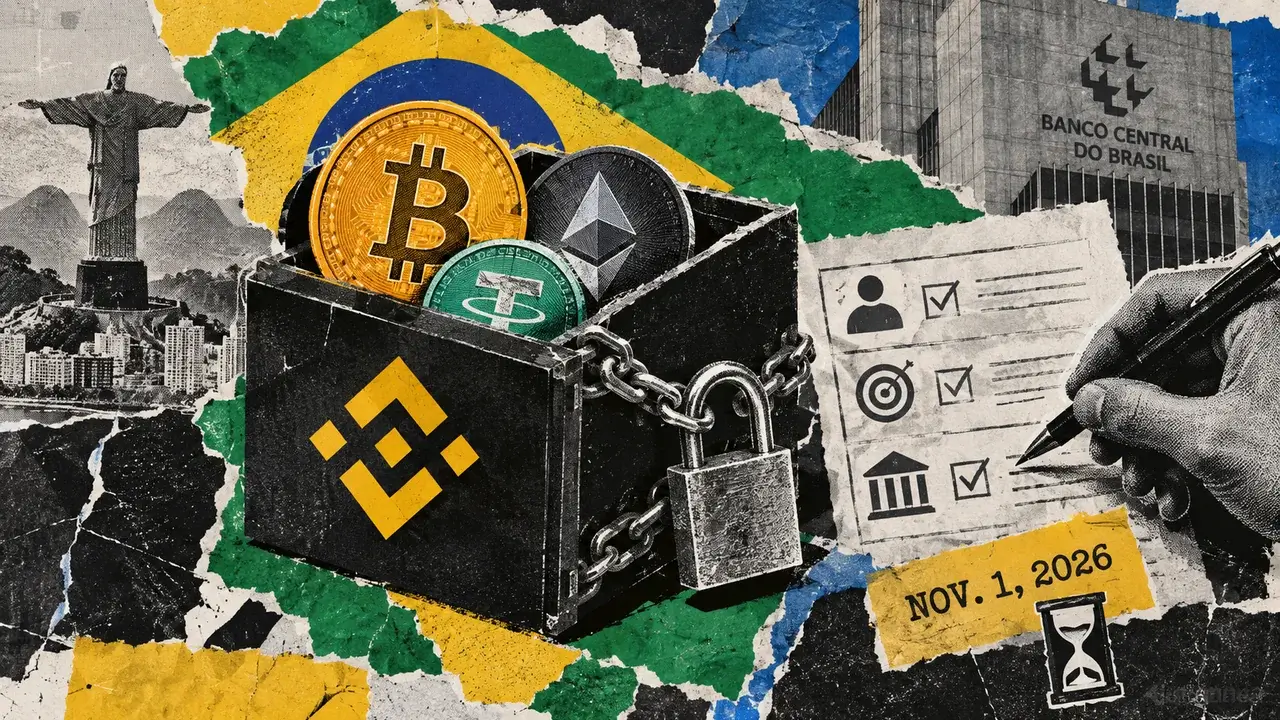
- Binance will require purpose-of-transfer and counterparty disclosures for cross-border crypto transactions starting Nov. 1, 2026.
- Chainalysis estimated Brazil’s crypto market handled $252.5 billion between July 2025 and June 2026, ranking first globally in its adoption index.
- Brazilian tax filings show R$1.13 trillion in declared stablecoin transactions since 2019, about 72% of all declared crypto activity.
- $252.5B Brazil’s 12-month crypto transaction volume tracked by Chainalysis
- $10,000 threshold that triggers mandatory self-custody wallet reporting to Coaf
- 96 purpose classifications required for the largest cross-border transfers
Binance notified Brazilian customers that transfers sent abroad or received from nonresidents must now carry a stated purpose and a declared counterparty type, with corporate accounts additionally required to flag whether the other party belongs to the same economic group, according to the exchange’s published guidance. The exchange will report those transactions monthly to Brazil’s central bank under Resolution BCB No. 521/2025, which pulls international virtual-asset transfers into the country’s existing foreign-exchange reporting regime. The change was first detailed by CryptoSlate, which reported that transfers between Brazilian residents are unaffected.
Binance Will Freeze Withdrawals Until Users Answer a Questionnaire
Withdrawals cannot be submitted at all until the required questionnaire is completed.
Incoming deposits face a softer but still consequential process: funds can sit pending, and in some cases get returned, if a user fails to supply the requested information. The rules apply broadly, covering individuals and companies moving assets to or from nonresidents, including Brazilians transferring crypto to their own accounts on foreign exchanges.
Binance has built tiered disclosure requirements around transfer size. Transactions up to $50,000 use a simplified menu of 10 purpose codes, compared with 96 classifications required for anything larger.
Certain international transfers are capped outright at $100,000 when the counterparty is not authorized to operate in Brazil’s foreign-exchange market, and customers sending funds to their own account on a foreign exchange will have purpose and counterparty fields pre-filled for confirmation rather than manual entry.
Brazil’s $252.5 Billion Crypto Market Tops Chainalysis Adoption Index Despite 1.6% Dip
The tightening lands on a market Chainalysis ranked first overall in its 2026 global adoption index and second for cross-border flows, even though transaction activity contracted 1.6% over the twelve-month window ending June 2026.
Binance’s questionnaire is one piece of a wider regulatory push that already includes a separate $10,000 reporting threshold for transfers tied to self-custody wallets, which regulated institutions must report to Brazil’s Financial Activities Control Council, or Coaf, by the next business day even absent any suspicious-activity flag.
Stablecoins sit at the center of that surveillance expansion. Brazilian tax data put declared stablecoin transactions at R$1.13 trillion between August 2019 and December 2025, roughly 72% of all declared crypto activity in the period, a concentration that mirrors global regulators’ growing focus on dollar-pegged tokens.
Brazil has separately restricted stablecoin use inside aggregated cross-border payment structures run by foreign-exchange providers, now requiring settlement through licensed FX transactions or qualifying nonresident real accounts.
Resolution BCB 584 Adds Precautionary Holds Starting January 1, 2027
Brazil’s rollout does not stop with Binance’s November changes.
Resolution BCB 584 takes effect January 1, 2027, introducing precautionary holding procedures that can delay outbound virtual-asset transfers pending additional checks. That sits alongside Brazil’s Travel Rule, which Binance said is a separate framework scheduled to phase in for domestic transactions in 2027 and international transfers in 2028.
The CCS read. Institutional desks routing capital through Brazilian exchanges should treat the Nov. 1 checkpoint as a liquidity-timing risk, not just a compliance update. Withdrawal freezes tied to incomplete purpose codes can strand funds mid-settlement, and the 96-category schema for larger transfers invites processing delays that smaller, faster rivals outside Binance’s reporting scope will not face.
Binance said it will release further operational details before the November 1 deadline, leaving open exactly how the exchange will handle disputed or ambiguous purpose declarations once Resolution BCB 584’s precautionary holds arrive on January 1, 2027.