Revealing the moment crypto started reshaping American elections
The crypto industry has transformed from a regulatory target into a major political force in less than two years, deploying $139 million across the 2024 election cycle and assembling a $220 million war chest for 2026, a shift that signals institutional investors the sector now sees political influence as essential to long-term viability. For asset managers and institutional buyers, this represents a structural change in how crypto regulation will be determined, moving away from agency enforcement and toward legislative and electoral channels.
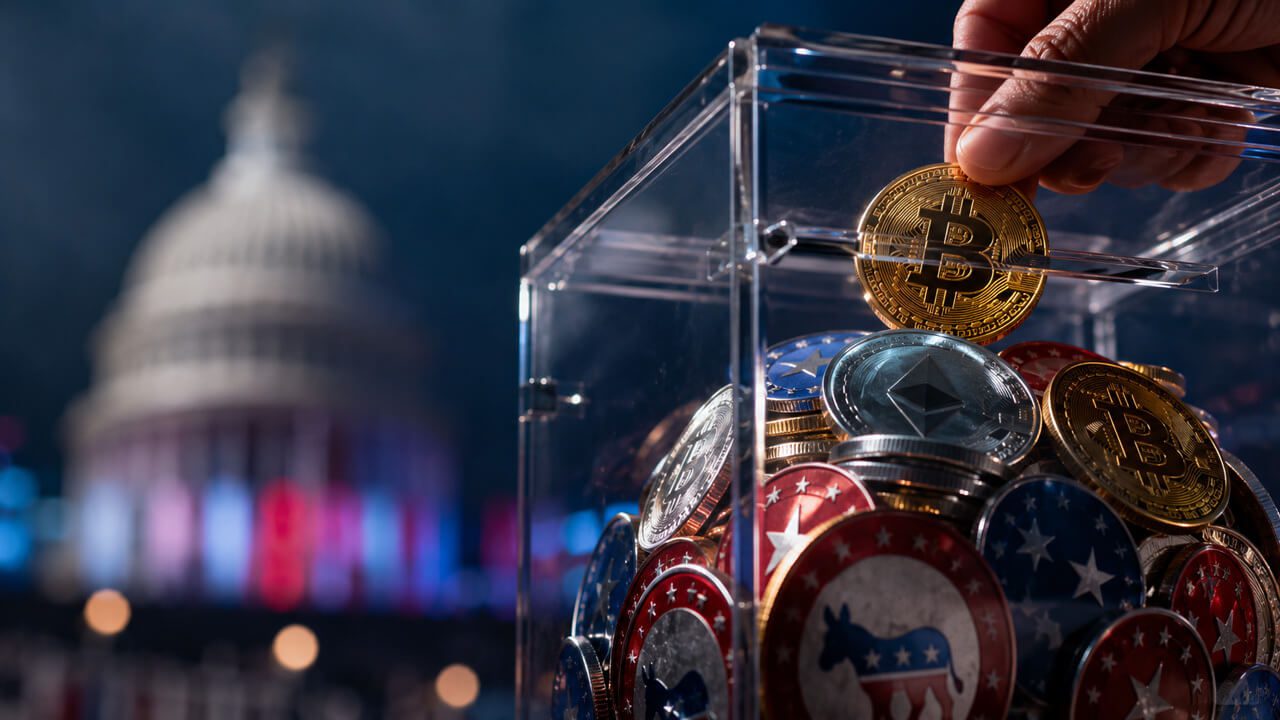
- Crypto companies spent $139 million shaping 2024 elections through super PACs and related networks.
- The sector has assembled $220 million in political spending for the 2026 midterm elections.
- The SEC issued 46 crypto-related enforcement actions in 2023, triggering industry shift to political organizing.
- $139M crypto political spending in 2024 elections versus near-zero after FTX collapse.
- 46 SEC enforcement actions in 2023 alone, marking peak regulatory pressure on sector.
- $220M war chest assembled for 2026 midterms, exceeding prior cycle by $81 million.
The crypto industry’s pivot from regulatory defense to organized political mobilization marks a critical inflection point for institutional investors evaluating long-term exposure to digital assets.
Between the FTX collapse in November 2022 and the November 2024 elections, the sector executed a coordinated strategy to shift control over its regulatory destiny from enforcement agencies to electoral politics and Congress. This transformation has profound implications for how crypto assets will be regulated, taxed, and integrated into mainstream finance over the next decade.
The speed and scale of the industry’s political build-out accelerated sharply in 2023 and 2024, driven by a specific calculus: after the SEC issued 46 enforcement actions in 2023 alone and pursued major cases against Coinbase, Binance, and Ripple, companies concluded that regulatory outcomes were fundamentally political rather than technical or legal.
Gary Gensler’s SEC treated most digital assets as unregistered securities subject to the same rules governing stocks and bonds, leaving little room for industry input. The more enforcement pressure accumulated, the clearer it became that survival required political tools deployed at scale.
SEC Enforcement Wave Triggers $139 Million 2024 Political Spending Campaign
The catalyst for the industry’s political mobilization was the SEC’s aggressive enforcement posture that intensified throughout 2023. The agency brought landmark cases against Coinbase and Binance, pursued enforcement actions against Ripple, and signaled its intent to define digital asset regulation unilaterally, without meaningful industry participation.
For Coinbase specifically, the regulatory pressure became existential: the company found itself simultaneously suing the SEC and being sued in return, crystallizing the reality that judicial and regulatory channels alone could not determine the sector’s future.
This enforcement wave coincided with a broader industry realization that regulatory outcomes flow from political power, not from technical merit or legal argument. Andreessen Horowitz, one of the largest venture investors in crypto, pioneered an aggressive lobbying operation designed explicitly to exclude crypto from SEC jurisdiction and shift regulatory authority toward more favorable channels.
That template spread through the sector during 2023, reshaping how major crypto companies and their investors approached Washington. By 2024, the message was clear: companies that survived the next decade would be those that deployed capital in Washington with the same discipline applied to market competition.
The result was Fairshake, a super PAC backed by Coinbase, Andreessen Horowitz, Ripple, and a consortium of other crypto companies, which emerged as the primary vehicle for coordinated political spending in 2024.
Fairshake Super PAC Deploys $139 Million to Reshape Electoral Landscape
Fairshake operated at a scale that positioned crypto spending among the top political forces in the 2024 cycle. The $139 million deployed across elections and related activities placed crypto financial influence on par with sectors like oil and banking, industries that have shaped American regulation for decades through sustained political investment.
This spending was distributed strategically across congressional races, Senate contests, and presidential-adjacent efforts designed to elect crypto-friendly candidates and remove crypto-hostile incumbents.
The political strategy reflected a clear theory of change: if the SEC’s enforcement-first approach had made regulation hostile, then electoral leverage could elect a Congress and presidency willing to legislate favorable rules directly, bypassing agency discretion entirely.
Fairshake and allied spending sought to ensure that candidates who opposed heavy-handed crypto regulation won contested races, particularly in swing districts and states. The super PAC also backed ballot measures and state-level initiatives that attempted to establish crypto-friendly policy frameworks before federal rules could harden.
By November 2024, the political spending had demonstrably shifted the landscape. Multiple crypto-skeptical incumbents lost reelection, while pro-crypto candidates won key races. The incoming Congress signaled a markedly different posture toward digital assets than the 2023-2024 Congress, which had been dominated by calls for strict regulation following FTX’s collapse.
The election results suggested that the industry’s capital deployment had successfully reframed crypto from a regulatory disaster to a viable policy question worthy of competing viewpoints.
Post-Election Pivot: Industry Assembles $220 Million for 2026 Midterms
Rather than treat the 2024 victory as a terminal outcome, the crypto industry immediately began organizing for sustained political competition. Fairshake and allied funds announced plans to raise $220 million for the 2026 midterm elections, representing an $81 million increase from 2024 spending and signaling that political mobilization is now permanent industry infrastructure.
This war chest indicates that major crypto companies and investors view ongoing electoral engagement as a core business function, not a one-time defensive measure.
The $220 million projection also reflects confidence that the 2024 electoral strategy succeeded in reshaping the regulatory environment. With a new administration taking office and Congress tilted more favorably toward crypto-friendly policy, the industry sees an opportunity to consolidate gains by maintaining political pressure through 2026.
The midterms will determine whether the pro-crypto congressional majority holds, and whether state-level ballot initiatives can lock in favorable policies before a potential shift in electoral winds.
For institutional investors, the $220 million 2026 commitment signals that the crypto industry now views political spending as a permanent cost of doing business, comparable to regulatory compliance and legal defense.
Structural Shift in Regulatory Authority From Agencies to Legislative Bodies
The industry’s political strategy reflects a fundamental shift in how crypto regulation will be determined over the next decade. Rather than accept the SEC’s enforcement-driven approach, the sector has chosen to compete for regulatory authority in Congress, where legislative authority ultimately resides.
This represents a major constraint on Gary Gensler’s ability to unilaterally define digital asset rules, and a corresponding expansion of the crypto industry’s ability to shape favorable outcomes through elected representatives.
The implications for institutional investors are substantial. If crypto regulation moves from agency rulemaking to Congressional legislation, outcomes become more predictable and potentially more favorable to industry preferences. Congress has historically been more receptive to industry input on technical regulatory details than agencies conducting enforcement campaigns.
Additionally, legislative rules tend to be more stable and harder to reverse than agency positions, offering greater regulatory certainty for long-term institutional positioning in digital assets.
However, the crypto industry’s political success also creates new vulnerabilities. As the sector accumulates political power comparable to traditional finance, it becomes a larger political target. Anti-crypto advocacy organizations, consumer protection groups, and hostile politicians have strong incentives to challenge crypto’s growing influence.
The 2026 midterms will test whether the industry’s electoral coalition is durable or whether political momentum can shift as rapidly as it has in the past two years.
The critical next test will come in the 2026 midterm elections, when voters will determine whether the pro-crypto Congress elected in 2024 expands or contracts. Industry insiders are already signaling that the $220 million 2026 spending plan is a minimum, not a ceiling, suggesting further expansion if midterm races tighten, a dynamic institutional investors should monitor closely, as it will determine whether legislative crypto-friendly rules actually pass or whether regulatory authority reverts to the SEC under adverse political conditions.
Original reporting: cryptoslate.com