
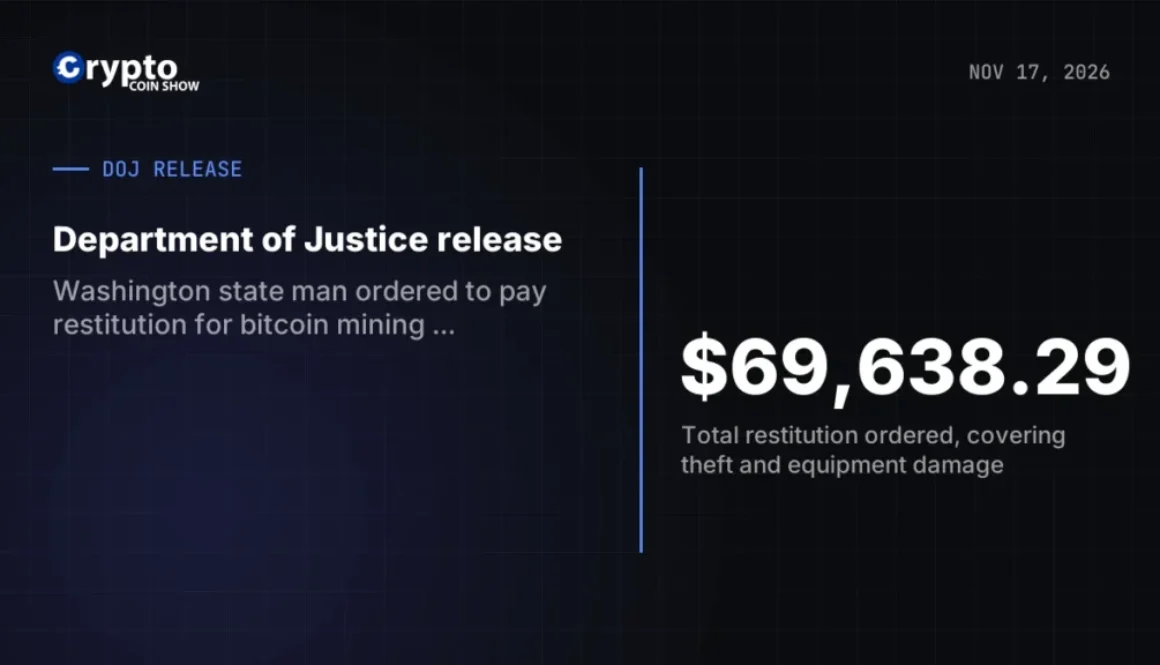
Washington state man ordered to pay restitution for bitcoin mining theft
Christopher Rankin, a 40-year-old from Washington state, has been ordered by federal court to pay $69,638.29 in restitution for stealing bitcoin and damaging computers at a Niagara Falls mining company where he worked. The case tests how courts value and penalize theft from infrastructure operators now common in Bitcoin’s proof-of-work security model.
- Rankin accessed 100 computers without authorization at the mining company.
- He redirected mining power to pools he controlled, stealing 1.06683386 BTC ($53,315.75 at offense date).
- Operating computers in “high-performance” mode damaged hardware and shortened lifespan.
- $69,638.29 Total restitution ordered, covering theft and equipment damage
- 1.06683386 BTC Bitcoin stolen from the company’s mining operations
- 100 Company computers accessed and redirected without authorization
U.S. Attorney Michael DiGiacomo announced the sentence today, following conviction for transmitting a program, information, code or command to a protected computer and causing damage. Rankin was hired by the Niagara Falls mining company in July 2021, but after gaining access to the mining infrastructure, he manually reset 100 computers and directed them to mining pools of his own creation instead of the company’s authorized pools.
Redirecting mining power and equipment damage
Mining pools combine computing power from multiple machines to validate transactions and earn block rewards more reliably than solo mining. Rankin’s diversion of the company’s machines to his own pools violated both employment and computer fraud law.
The restitution figure breaks into two components: the $53,315.75 worth of bitcoin stolen and additional damages from running the hardware in “high-performance” mode, which severely limited computer lifespan and compromised system integrity and data availability.
The company detected the unauthorized redirection and hardware degradation, though the document does not specify how long Rankin’s scheme ran before discovery or what additional operational disruptions resulted from the compromised computers.
Computer fraud charges in infrastructure theft
Rankin’s conviction rested on transmitting commands to protected computers and causing damage, a charge under federal computer fraud statute. The case demonstrates that theft in Bitcoin mining does not require stealing coins directly from exchange wallets or custodians; it can occur by hijacking the hardware operators control, a vulnerability unique to proof-of-work infrastructure.
The sentencing resolves the matter without public statement from Rankin or disclosure of whether he contested the charges.
The investigation was conducted by the United States Secret Service, Buffalo Field Office, and prosecuted by Assistant U.S. Attorney Charles M. Kruly.
What the sentence does not address
The restitution order covers only direct financial loss to the mining company and equipment damage. The document does not disclose whether Rankin received prison time, probation terms, or asset forfeiture beyond restitution, nor does it state whether he retained custody of the bitcoin he redirected to his wallets or whether any such funds were recovered.
The CCS read. This case shows that federal courts now treat mining pool operator theft with computer fraud penalties, even when no exchange account or private keys are compromised. For mining operators and pool providers, it underscores the insider-threat surface: employees with machine access can redirect hash rate and hardware in ways that inflict both theft and equipment degradation. Custody of mining infrastructure and access control now carry the same compliance and liability weight as exchange hosting.
The sentencing is final; Rankin’s restitution payment deadline and any appeal rights are not specified in the release.