
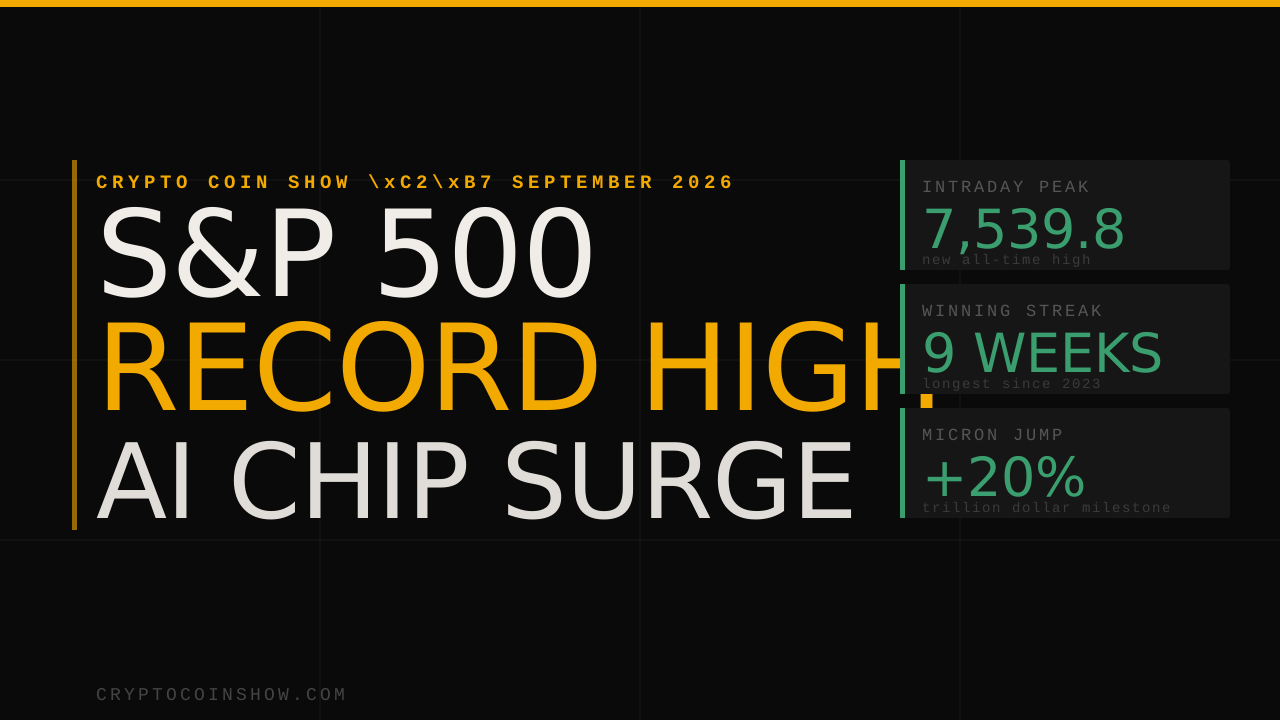
S&P 500 hit a new intraday record at 7,539.8
The S&P 500 broke to a new intraday record of 7,539.8 on Tuesday, extending a nine-week winning streak, its longest since 2023, as technology stocks and memory chip makers surged on structural AI demand. For institutional investors, the rally signals renewed conviction that chip-dependent artificial intelligence capex will sustain equity valuations, despite geopolitical tension over Iran that could yet disrupt sentiment.
- S&P 500 hit intraday record of 7,539.8 Tuesday, up 0.5%, entering ninth consecutive week of gains since late 2023
- Micron Technology jumped 20% and crossed $1 trillion market cap after UBS raised price target above 100% upside potential
- Nvidia trades at 21x forward earnings after datacentre revenue accelerated to $300 billion annualized run rate with 92% year-over-year growth
- 7,539.8 S&P 500 intraday record versus prior all-time closing high baseline
- $300bn Nvidia datacentre annualized revenue run rate with 92% YoY growth
- 20% Micron Technology single-day jump after analyst upgrade to $1 trillion market value
U.S. equities extended their post-Memorial Day momentum Tuesday as the S&P 500 reached 7,539.8 during intraday trading, putting the benchmark on track for its longest weekly winning streak in more than eighteen months. The index rose 0.5% on the session, while the Nasdaq Composite, driven by semiconductor and artificial intelligence-adjacent names, added 0.9% to also set a new intraday record.
The Dow Jones Industrial Average bucked the trend, falling 216 points or 0.4%, reflecting sector rotation away from traditional industrials and toward technology. This marks the ninth consecutive week of gains for the S&P 500, a rhythm last seen in late 2023 when the initial wave of AI enthusiasm began reshaping capital allocation across financial markets.
The rally underscores institutional conviction that artificial intelligence capex cycles will remain durable despite headline macroeconomic uncertainty and geopolitical risk.
Micron crosses $1 trillion valuation after UBS projects 100% upside on AI memory deals
Micron Technology surged 20% Tuesday to cross the $1 trillion market capitalization threshold, making it one of the few semiconductor companies to reach that scale alongside Intel and Nvidia. The move followed a bullish research note from UBS, which raised its price target and flagged more than 100% upside potential from current levels.
UBS attributed the upgrade to Micron’s long-term contracts with hyperscale data center operators, the same cloud infrastructure companies driving demand for Nvidia’s graphics processing units.
The analyst note emphasized that the “structural changes AI has driven to the entire memory complex” will force the market to assign a higher multiple to memory chip makers as visibility into their revenue streams improves.
We believe the market will start to put a more ‘normal’ multiple on the stock and MU will continue to re-rate higher as more details emerge about the structural changes AI has driven to the entire memory complex.
UBS
Micron’s trajectory reflects a broader rotation within semiconductor equities away from pure-play foundry exposure and toward companies benefiting from memory demand tied directly to AI training and inference infrastructure. Seagate Technology climbed 5% Tuesday while Western Digital rose 8%, as investors repriced risk across the memory supply chain.
The Roundhill Memory ETF, which tracks DRAM and NAND flash producers, jumped 15% to reach its own record, signaling that professional asset managers are treating memory chips as a structural beneficiary of multi-year AI capex cycles.
The shift matters because it suggests institutional conviction has moved beyond Nvidia’s dominance and is now pricing in sustained spending on complementary infrastructure, processors, memory, and storage, required to operate large language models at scale.
Memory chip valuations had fallen sharply the prior week but reversed with conviction, indicating institutional investors view weakness as a buying opportunity rather than a fundamental crack in AI demand.
Nvidia datacentre revenue accelerates to $300 billion annualized rate with 92% year-over-year growth
Nvidia, the semiconductor company most directly exposed to AI capex, also moved higher Tuesday after Rothschild & Co Redburn raised its price target to $300 from $280, implying nearly 40% upside from Friday’s close.
The upgrade was anchored in the chipmaker’s first-quarter results, where analyst Timm Schulze-Melander called datacentre performance “near-immaculate.” Nvidia’s datacentre business reached an annualized revenue run rate of $300 billion in the first quarter of fiscal 2025, up from $250 billion in the prior quarter, with year-over-year growth accelerating to 92% from 75% in the fourth quarter.
Sales to hyperscale customers, Amazon, Google, Meta, and Microsoft, grew 115% year-over-year, reflecting a structural shift in corporate capex away from real estate and traditional infrastructure toward silicon and AI-specific hardware.
The acceleration is material because it demonstrates that artificial intelligence demand has not plateaued and that customer willingness to spend on compute capacity remains intact even as prices for Nvidia’s flagship H100 and newer Blackwell processors have begun moderating.
Schulze-Melander’s note argued that rivals would need to grow faster than Nvidia for an extended period to prove they are capturing meaningful market share, a threshold few competitors have demonstrated. Nvidia currently trades at just over 21 times forward earnings, a valuation that has compressed from peaks near 70x in mid-2023 but remains elevated relative to the broader market.
This multiple reflects a consensus view that Nvidia’s earnings growth will persist at double-digit rates for the next several years, a bet contingent on continued hyperscaler capex and the absence of disruptive competitive alternatives.
Nvidia’s ability to maintain 90%+ year-over-year datacentre growth while trading at a reasonable forward multiple suggests the market is pricing in both scale and competition, not speculative exuberance.
Iran tensions resurface as Pentagon conducts self-defense strikes while Trump signals ongoing diplomatic talks
Geopolitical risk briefly surfaced as a market factor Tuesday when the U.S. military conducted what it characterized as “self-defense” strikes in southern Iran. U.S. Central Command spokesman Tim Hawkins confirmed that the strikes targeted missile launch sites and Iranian vessels allegedly attempting to place naval mines.
Hawkins stated the U.S. exercised “restraint during the ongoing ceasefire” between the nations, signaling that Washington intended the strikes as a measured response rather than an escalation.
Separately, President Donald Trump said Monday that diplomatic talks with Iran to end regional conflict were “proceeding nicely,” though he added that military action remained an option should negotiations fail.
The Iran situation remains a latent tail risk for equity markets because any sustained escalation could disrupt oil prices, energy sector stability, and broader risk appetite.
However, equity markets have broadly shrugged off the tensions Tuesday, suggesting institutional investors believe the diplomatic track and demonstrated U.S. restraint will continue to dominate geopolitical outcomes over the near term.
Oil futures and major indices did not show signs of distress, indicating that traders are pricing in a baseline scenario of ongoing talks rather than a conflict spiral. This risk tolerance appears anchored in the strength of earnings growth in technology and the conviction that AI capex will override other macro concerns for equity investors.
The pending catalyst to watch is whether Trump’s stated diplomatic process with Iran yields concrete progress or whether military tensions escalate further; simultaneously, investors should monitor whether Nvidia and the memory chip complex can sustain current growth rates when new quarterly results arrive, as any slowdown in hyperscaler capex would likely trigger a sharp repricing of semiconductor valuations that have now reached record intraday levels.