
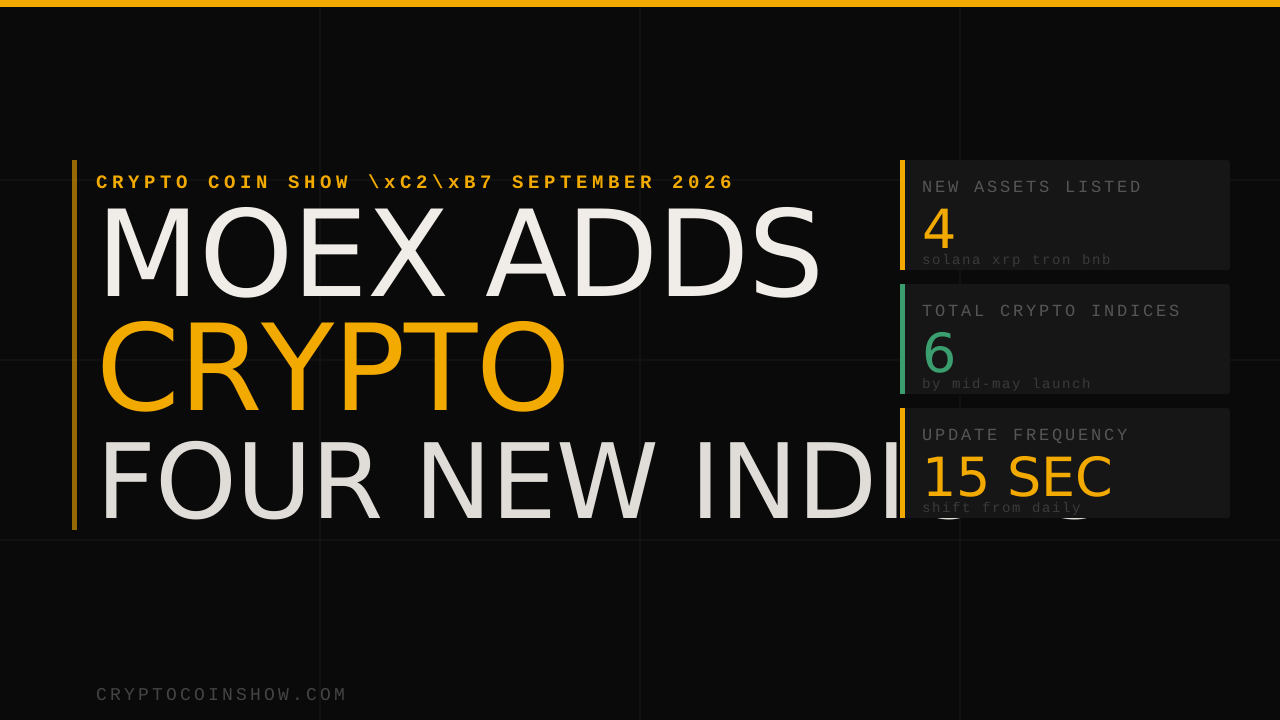
Moscow Exchange to add indices for another four cryptocurrencies
Russia’s Moscow Exchange is expanding its cryptocurrency index offerings to six digital assets by mid-May, positioning itself as the primary venue for institutional crypto derivatives trading in a market set to legalize digital assets by summer. The move signals confidence that regulated crypto trading will become a standard offering alongside traditional equities and derivatives at major exchanges in jurisdictions moving toward formal asset frameworks.
- MOEX will launch indices for Solana, XRP, Tron, and BNB on May 13, joining existing Bitcoin and Ethereum indices
- Index calculations will shift from daily to every 15 seconds during trading and weekend sessions, beginning May 13
- MOEX intends to expand to at least 10 cryptocurrency indices, with Dogecoin and Cardano under consideration for addition
- 6 Total cryptocurrency indices MOEX will offer after May 13 launch
- 10 Minimum number of crypto indices MOEX ultimately plans to support
- 15 seconds New calculation frequency for all indices, versus once daily currently
The Moscow Exchange announced Monday that it will introduce indices tracking Solana (SOL), Ripple’s XRP, Tron (TRX), and Binance’s BNB effective May 13, 2025.
The new indices will carry tickers MOEXSOL, MOEXXRP, MOEXTRX, and MOEXBNB, and will use price data aggregated from four major global exchanges: Binance at 50% weighting, Bybit at 20%, OKX at 15%, and Bitget at 15%. These indices serve as the underlying reference for crypto derivatives that MOEX issues to qualified institutional investors, extending the exchange’s existing framework that already covers Bitcoin and Ethereum indices launched in June and October 2025 respectively.
The expansion reflects MOEX’s confidence that regulated cryptocurrency trading will become embedded in Russia’s mainstream financial infrastructure. Under legislation based on the Bank of Russia’s regulatory framework released in December, traditional licensed exchanges like MOEX can offer digital asset products without requiring separate authorization.
This legal pathway removes a critical barrier that has constrained crypto adoption at institutional venues in other markets.
MOEX Shifts from Daily to Real-Time Index Calculations Starting May 13
One of the most operationally significant changes announced is the move from daily index calculation to continuous updates every 15 seconds throughout the trading day and during additional weekend sessions. Currently, MOEX publishes its Bitcoin and Ethereum indices once per day at or before 6:00 pm Moscow time.
Beginning May 13, all six cryptocurrency indices will be calculated with quarter-minute frequency, bringing calculation speed into line with spot market behavior and enabling derivatives traders to hedge positions with minimal lag.
This operational upgrade matters substantially for derivatives traders. Continuous recalculation reduces basis risk, the gap between the index price and the actual price traders can execute at when opening or closing positions.
For institutional investors hedging crypto exposure or building directional strategies, a 15-second update cycle at MOEX will compete with real-time pricing available on major global spot exchanges.
The weekend session inclusion is particularly notable, as it signals MOEX’s intent to operate crypto indices across the full seven-day week, matching market behavior rather than adhering to traditional equity market calendars.
The speed upgrade also creates competitive pressure on other regulated exchanges globally to match real-time calculation standards or risk losing institutional flow to faster venues.
MOEX Strategy to Reach 10 Indices Reflects Confidence in Russia’s Crypto Legalization Timeline
MOEX publicly stated in February 2025 that it intended to launch indices and futures on SOL, XRP, and TRX, with consideration of perpetual futures on Bitcoin and Ethereum alongside the monthly index futures already traded. The current announcement confirms the first tranche of that plan and adds BNB to the lineup.
Critically, MOEX indicated that it plans to expand the index count to at least 10, with Dogecoin, Cardano, Hyperliquid, and Chainlink named as candidates for future inclusion.
This staged expansion strategy serves two purposes. First, it allows MOEX to validate operational infrastructure and risk management protocols on liquid, established assets before scaling to lower-liquidity tokens. Second, and more importantly for institutional investors, it signals that MOEX expects Russia’s crypto market legalization to remain on track for completion by summer 2025.
Regulatory timelines slip routinely, but the exchange’s willingness to commit to a specific near-term expansion roadmap suggests internal confidence based on direct engagement with the Bank of Russia and other authorities.
The inclusion of assets like Hyperliquid, a decentralized perpetual futures protocol launched in late 2024 and not traditionally held at regulated exchanges, indicates MOEX’s willingness to pursue emerging segments of the crypto market.
This contrasts with more conservative regulatory approaches in other jurisdictions and suggests the Bank of Russia’s framework may be designed to accommodate innovation within supervised channels rather than push trading underground.
Russia’s Qualified Investor Framework Creates New Derivatives Market Without Physical Settlement
Russia’s central bank authorized financial firms including MOEX to offer cryptocurrency derivatives to qualified investors in spring 2024, establishing a critical boundary: derivatives contracts must not involve actual delivery of the underlying digital assets.
This cash-settlement-only requirement isolates MOEX’s crypto business from the operational and custody complexities that have constrained derivatives offerings at traditional finance venues, while preserving regulatory control over who participates.
For institutional investors, the qualified-investor restriction is a familiar compliance framework. The Bank of Russia defines qualified investors using criteria similar to those in EU and U.S. regulations, typically requiring a minimum net worth, professional experience, or institutional status.
By restricting access to this cohort, MOEX avoids retail market safeguarding requirements and can move faster on product launches. The cash-settlement model also means MOEX does not need to operate cryptocurrency custody services or manage private key security, reducing both operational risk and regulatory scrutiny on that dimension.
MOEX’s existing monthly index futures on Bitcoin and Ethereum, already traded under this framework, establish the operational precedent for the new instruments launching May 13.
Global Exchange Price Data Underpins MOEX Indices, Reducing Geographic Arbitrage Risk
The decision to weight MOEX indices using data from Binance (50%), Bybit (20%), OKX (15%), and Bitget (15%) reflects a pragmatic approach to pricing integrity in a market where Russian traders would otherwise trade on global spot exchanges and hedge on MOEX. By using global benchmarks rather than domestic-only pricing, MOEX avoids creating persistent arbitrage opportunities that would lure flow away from the exchange.
Binance’s 50% weighting is particularly significant given the exchange’s global market share and regulatory footprint. Bybit, OKX, and Bitget collectively represent major liquidity pools in the Asia-Pacific region, where price discovery for XRP, SOL, TRX, and BNB often leads global markets.
This geographic diversification in the index construction reduces the risk that a single exchange’s outage, price manipulation, or regulatory disruption could corrupt MOEX’s indices and trigger basis widening in derivatives contracts.
For institutional traders, this pricing framework creates a clean hedging relationship: if a Russian fund manager holds spot positions on global exchanges and hedges short on MOEX futures using the same global price data, the hedge will track the underlying position with high fidelity.
The alternative, an index based solely on Russian domestic prices or smaller exchanges, would create persistent basis risk and reduce MOEX’s appeal as a hedging venue.
MOEX’s plan to reach 10 cryptocurrency indices by an unspecified future date, combined with the Bank of Russia’s stated summer 2025 target for crypto market legalization, will test whether regulatory timelines hold firm as May 13 approaches; institutional market participants should monitor whether any delays occur in either the index launch or broader legislative progress, as either signal could indicate friction between traditional finance incumbents and crypto policy advocates within Russian financial authorities.