
The EU’s war on Big Tech just got a second front
TikTok is mounting its first legal challenge to the European Union’s Digital Markets Act gatekeeper designation before the bloc’s highest court, with the outcome potentially determining whether Brussels can enforce strict regulations on dominant tech platforms. The case will test whether the EU’s definition of market power holds up to judicial scrutiny and shapes the enforceability of fines reaching 10% of annual revenue.
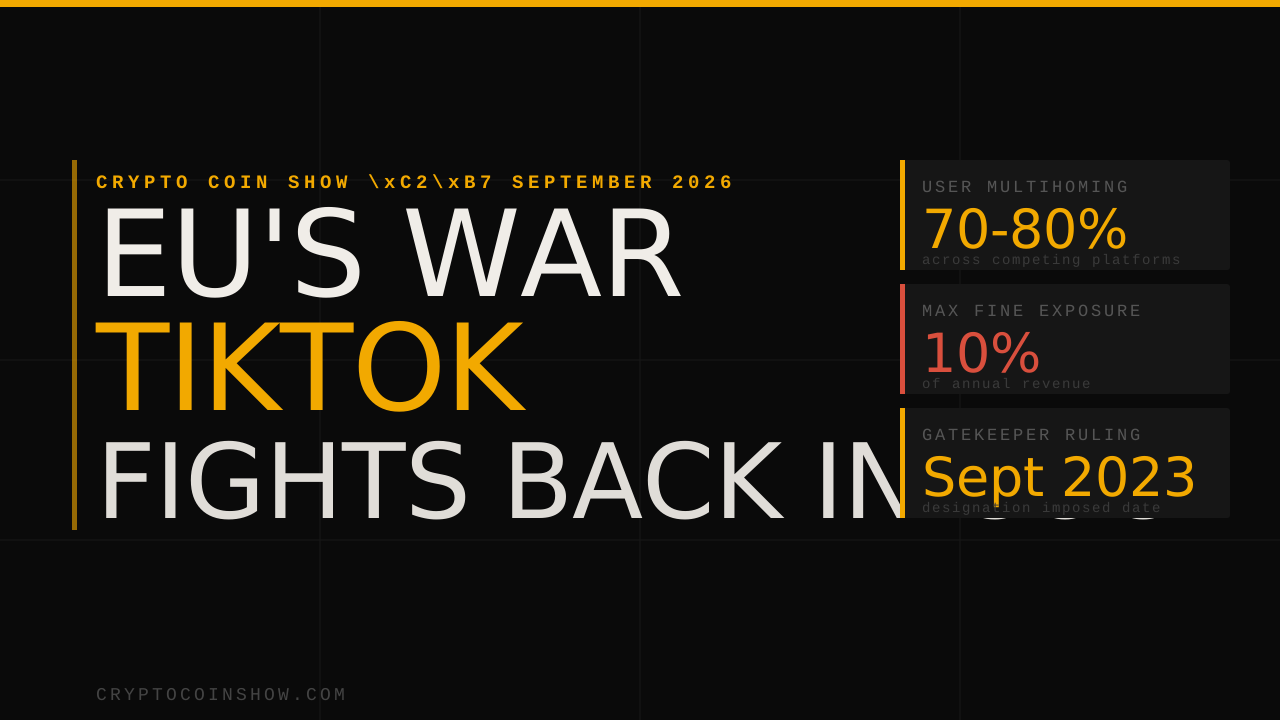
- TikTok argued at EU Court of Justice that 70-80% of its users multihome across Meta, Snap, and X platforms, disputing gatekeeper classification imposed September 2023
- EU Commission countered that lock-in effects can occur despite multihoming, citing specific user groups dependent on individual platforms as justification
- Court ruling expected within months will set precedent for how strictly Brussels can regulate social media giants and whether other platforms succeed in similar challenges
- 10% Maximum annual revenue fine imposed on companies violating Digital Markets Act gatekeeper obligations
- 70-80% Percentage of TikTok users who simultaneously use competing platforms including Meta and Snap
- 45M+ Monthly active users threshold used to designate companies as gatekeepers under EU regulation
ByteDance’s TikTok faced the EU Court of Justice on Tuesday in a landmark challenge to its September 2023 designation as a gatekeeper under the bloc’s Digital Markets Act, marking the first major court test of Brussels’ authority to classify and regulate dominant digital platforms.
The hearing matters for institutional investors because it will clarify whether European regulators can enforce the DMA’s most severe penalties, which reach 10% of annual global revenue, and whether the gatekeeper framework itself survives judicial review.
If TikTok prevails, it could undermine the EU’s broader antitrust strategy; if the court upholds the Commission’s decision, it signals confidence in the regulatory regime that already applies to Google, Meta, Apple, Amazon, Microsoft, and Booking.com.
TikTok’s multihoming argument challenges EU’s market concentration theory
TikTok’s legal team argued that the lower court tribunal made factual errors in finding the platform met all three gatekeeper tests, particularly the requirement that a company serve as an essential channel for businesses to reach customers while maintaining a dominant position difficult to challenge.
Bill Batchelor, representing TikTok, emphasized that ByteDance’s market capitalization derives overwhelmingly from Asian operations, not Europe, and that the company faces distinct competitive dynamics, regulatory frameworks, and cultural environments across regions.
This geographic separation, TikTok contended, should disqualify it from gatekeeper status when European market power alone is the measure.
The core of TikTok’s defense rested on user behavior data showing that 70% to 80% of its European users simultaneously maintain active accounts on competing platforms including Facebook and Instagram, Snap, and X. Batchelor termed this widespread behavior “multihoming” and argued it proves users are not locked into TikTok and that businesses retain meaningful alternatives to reach target audiences.
If users and businesses have genuine substitutes, TikTok’s legal team reasoned, the platform cannot be deemed essential or dominant in the gatekeeper sense, regardless of its absolute user count.
This argument directly challenges the EU Commission’s underlying theory of digital market power. Brussels has long held that even dominant platforms can be gatekeepers if they control access to user bases that specific business segments depend on, regardless of whether individual users maintain multiple accounts.
TikTok’s focus on average user behavior rather than dependency among discrete customer groups represented a fundamental disagreement over how to measure lock-in effects in social media markets.
EU Commission argues lock-in persists despite user multihoming patterns
Mislav Mataija, the lawyer arguing for the European Commission, rejected TikTok’s multihoming evidence as insufficient to disprove gatekeeper status.
He told the 15-judge panel that lock-in effects can persist even when users maintain accounts across multiple platforms, because certain user demographics or business segments may depend on TikTok specifically to reach their audiences or build communities.
This position reflects Brussels’ stance that gatekeeper classification is not negated by the existence of alternatives, but rather by evidence that specific high-value user groups or business categories face genuine switching costs.
The Commission’s argument has practical force because TikTok’s algorithm and user base skew heavily toward younger demographics, particularly Gen Z consumers aged 13 to 24. Content creators, e-commerce vendors, and advertisers targeting that cohort may lack equally effective alternatives on older platforms like Facebook or Instagram, regardless of those platforms’ total user bases.
If the court finds merit in this reasoning, it would validate the EU’s approach of defining gatekeepers by the indispensability of their reach to specific market segments rather than by average user overlap.
The factual dispute also has implications for how the EU will regulate TikTok’s design choices going forward. European officials have signaled plans to scrutinize features that “hook” young users, and a gatekeeper ruling allows them to impose interoperability requirements, limit algorithmic ranking, and mandate data transparency on TikTok at a scale that non-gatekeeper platforms avoid.
Conversely, if TikTok succeeds, the company would shed obligations that currently apply to the other six designated gatekeepers, creating competitive asymmetry within Europe’s social media and content markets.
Lower court already rejected TikTok’s first challenge a year ago
This appeal to the EU Court of Justice arrives after a lower tribunal rejected TikTok’s initial complaint in 2024, ruling that the platform clearly satisfied the gatekeeper criteria. That prior decision had upheld the September 2023 Commission designation, giving the higher court a record of judicial reasoning to either affirm or overturn.
By choosing to challenge again, ByteDance’s legal team signaled it views the stakes as high enough to justify escalation, particularly given the 10% revenue fine exposure and the precedent value of a loss for other platforms.
Meta Platforms is also pursuing a separate gatekeeper challenge focused on its Messenger and Marketplace services, meaning the court will handle multiple such cases concurrently. If the judges side with the platforms and narrow the gatekeeper definition, the cumulative impact could weaken the DMA across multiple companies and delay or block the Commission’s enforcement agenda.
If they uphold the Commission’s theory, the precedent will embolden regulators to defend gatekeeper classifications against future corporate litigation.
Court decision expected within months will define DMA’s enforceability
The EU Court of Justice has not announced a specific ruling date, but observers anticipate a decision within the next few months, creating a near-term catalyst for European digital regulation strategy.
The timing matters for institutional investors holding positions in any of the seven designated gatekeepers, as a TikTok victory could create legal precedent that weakens Commission enforcement authority across the board, while a TikTok loss would clarify that the DMA framework survives the highest judicial standard.
A narrow ruling focused solely on TikTok’s geographic market share could allow the company to escape gatekeeper obligations while leaving the other six platforms bound. A broader decision addressing the multihoming doctrine would establish a durable legal standard for how European regulators quantify lock-in effects and dependency, shaping DMA enforcement for years.
The judges will also signal whether they view the DMA itself as a permissible regulatory tool or as an overreach that lacks sufficient competitive justification.
The outcome will directly determine whether TikTok can operate in Europe under a lighter compliance regime than Google, Meta, Apple, Amazon, Microsoft, and Booking.com, and whether the Commission’s authority to impose billion-dollar fines and interoperability mandates survives judicial review. Watch for the court’s published decision on whether user multihoming defeats gatekeeper status and whether the Commission must prove lock-in effects among specific business segments rather than broad user populations.