
AscendEX pushes for insolvency and rescue deals as claim portal to launch September 5
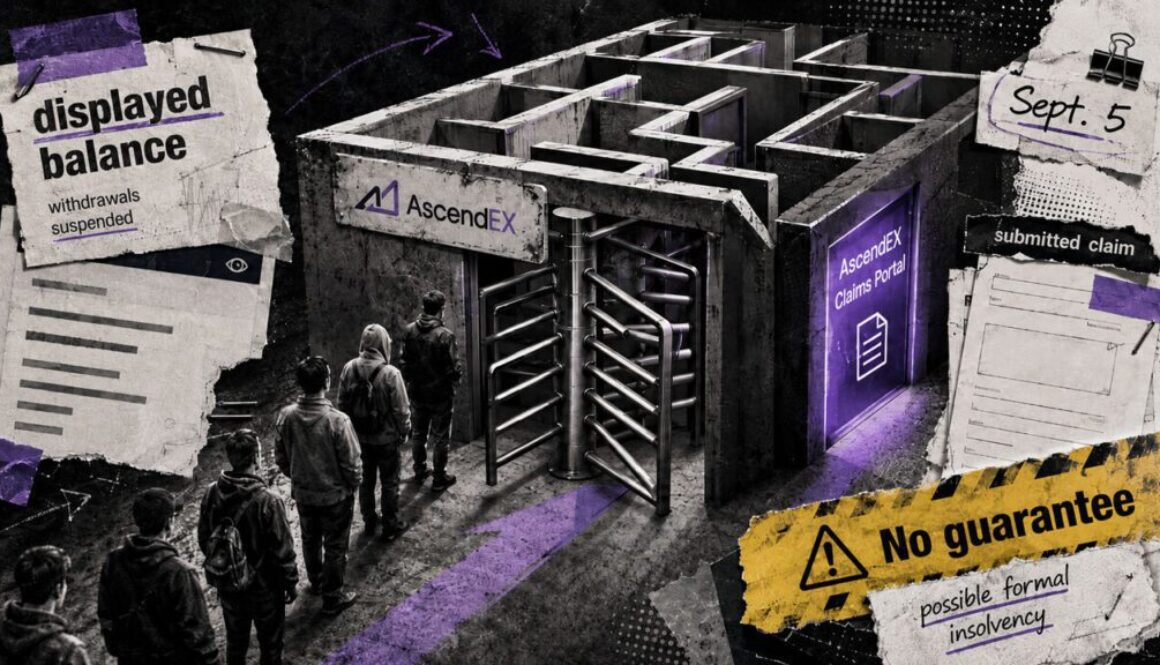
AscendEX launched a claims portal on September 5 to let suspended customers record account balances and submit recovery claims, but explicitly stated the portal offers no guarantee of repayment, timeline for withdrawal resumals, or clarification of claim priority. For institutional investors holding assets on the exchange since its July 1 shutdown, the portal represents a critical procedural step toward potential recovery, but leaves fundamental questions about the exchange’s solvency path, asset pool size, and governing insolvency jurisdiction entirely unanswered.
- Claims portal launched September 5 allowing users to review balances and submit claims with supporting documents
- Portal explicitly does not restore trading, deposits, or withdrawals, nor guarantee recovery amounts or timing
- AscendEX exploring rescue and recapitalization while simultaneously preparing formal insolvency filing with no disclosed timeline
- July 1 Date normal operations and all customer withdrawals suspended indefinitely
- Sept. 5 Targeted launch date for claims portal, with possible delays for technical or legal work
- Dec. 2021 Security incident AscendEX cited as contributing to current financial distress alongside failed recapitalization
AscendEX announced in an August 22 customer update that its long-awaited claims portal would go live on September 5, offering suspended users their first formal mechanism to document holdings and submit recovery demands since the exchange halted all withdrawals and trading on July 1.
The portal will allow eligible customers to view recorded account balances, register account details, and upload supporting documentation, but the exchange made clear in the same announcement that none of these steps guarantees recovery, establishes legal claim status, or provides any timeline for repayment. The portal functions primarily as a record-keeping system, not as a resolution mechanism.
The exchange provided no recovery estimate, no asset pool figure, and no stated deadline for when withdrawals might resume. AscendEX also declined to name the legal entity that would enter a formal insolvency process, the jurisdiction governing that process, or any claims administrator or court-appointed office-holder.
Those omissions reflect the fluid state of the exchange’s restructuring efforts and leave customers without the basic procedural information typically available in bankruptcy or insolvency proceedings.
AscendEX Portal Accepts Claims Without Admitting Liability or Recovery Probability
The claims portal occupies an unusual middle ground between normal service and formal insolvency. Users logging in will see balances recorded in AscendEX’s internal systems as of the July 1 suspension date, but acceptance of a claim submission carries no legal weight.
The exchange explicitly stated that a balance appearing on the portal or an accepted claim would not constitute admission of the claim’s validity, establish its priority relative to other customer claims, or guarantee any amount or timing of recovery.
This structure protects AscendEX from accepting liability while allowing it to gather and organize customer demands for use in a future insolvency process or settlement negotiation. For customers, the portal is a procedural necessity, failure to submit claims by any future deadline could forfeit recovery rights, but filing provides no assurance of repayment.
The exchange also warned users to access the portal only by typing ascendex.com directly into a browser, and said it would never request passwords, private keys, or fees to access the system, flagging the risk of phishing schemes targeting distressed customers.
Rescue Negotiations Parallel Formal Insolvency Preparations With No Defined Endpoint
Alongside the claims portal launch, AscendEX said it is “exploring rescue, recapitalization and restructuring options” while simultaneously preparing for a formal insolvency filing. The dual track suggests the exchange is pursuing a negotiated sale, recapitalization by a new investor, or restructuring arrangement, but has given no assurance any of those paths will succeed.
The company made no announcement of a prospective buyer, investor, or timeline for a rescue transaction.
AscendEX attributed its financial distress to a failed prior recapitalization attempt and to losses stemming from a December 2021 security incident. That December breach, which was publicly disclosed at the time, appears to have created losses the exchange could not absorb, leading to the July 1 shutdown.
However, the exchange has never provided a comprehensive accounting of the total impact of that incident or of the subsequent trading losses or market conditions that triggered the liquidity crisis.
The absence of a named insolvency forum or jurisdiction is material for creditors.
Different legal regimes offer different protections and recovery rates, and customers have no way to model likely outcomes without knowing whether AscendEX will file under U.S. bankruptcy law, Singapore law (where the exchange is incorporated), another jurisdiction, or whether it will pursue an out-of-court restructuring instead.
Each choice carries distinct implications for claim priority, timeline, and recovery percentage.
Customers Face an Extended Waiting Period With No Clear Recovery Pathway or Deadline
The portal launch does not restore service; it creates an administrative checkpoint. Customers can now formally register their claims, but cannot trade, deposit, or withdraw. AscendEX provided no date for when normal operations might resume or when the exchange might begin processing redemptions.
For institutional investors who moved assets to AscendEX before July 1, the portal represents the start of a documentation process, not the beginning of a recovery timeline.
The September 5 launch date itself is stated as an estimate. AscendEX reserved the right to delay the portal launch if “more technical, security or legal work is required,” offering no alternative target date if the initial launch slips.
That ambiguity reflects the complexity of organizing systems for a suspended exchange, but it also underscores that the company does not have a clear operational roadmap or set timeline for the next phase.
The critical next step is whether AscendEX will file for formal insolvency within weeks or months, and if so, under which jurisdiction and with which office-holder or administrator. Until the exchange announces a named insolvency court, filing date, and governing law, customers will lack the procedural certainty and statutory protections available in formal bankruptcy processes.
The portal launch is procedural; the real test of recovery will come when AscendEX either announces a rescue transaction, files a formal insolvency petition, or announces that no buyer or recapitalization can be achieved.
Recovery Pool Visibility Gap Complicates Institutional Planning
AscendEX has not disclosed the total value of customer assets held at the time of the July 1 shutdown, nor has it published a preliminary accounting of seized or recovered funds available for distribution.
This absence of asset pool transparency is unusual in major exchange failures; by comparison, FTX’s Chapter 11 filing in November 2022 included detailed schedules of asset categories and recovery estimates within weeks, allowing creditors to model potential recovery rates.
Without comparable disclosure, institutional investors cannot calculate expected recovery percentages or adjust balance-sheet provisions for potential losses.
Industry precedent suggests that exchanges in formal insolvency typically segregate customer assets from operational capital and prioritize customer recovery claims over equity holders.
AscendEX’s concurrent pursuit of recapitalization and insolvency filing raises questions about whether any recovered or recapitalized funds will flow to the claims pool or be earmarked for restructuring costs and management compensation.
A July 2023 Chainalysis report on exchange failures found that cases without clear asset ringfencing saw average customer recoveries below 30 percent, compared to 60+ percent in jurisdictions with mandatory segregation rules.
The exchange’s pending formal insolvency filing, described as “simultaneous” to recapitalization efforts but with no disclosed target date, will likely trigger court-ordered asset valuation and creditor hierarchy rules that supersede the claims portal process. Institutional investors should monitor filings in the jurisdiction where AscendEX incorporates for the first legally binding asset pool estimate.