
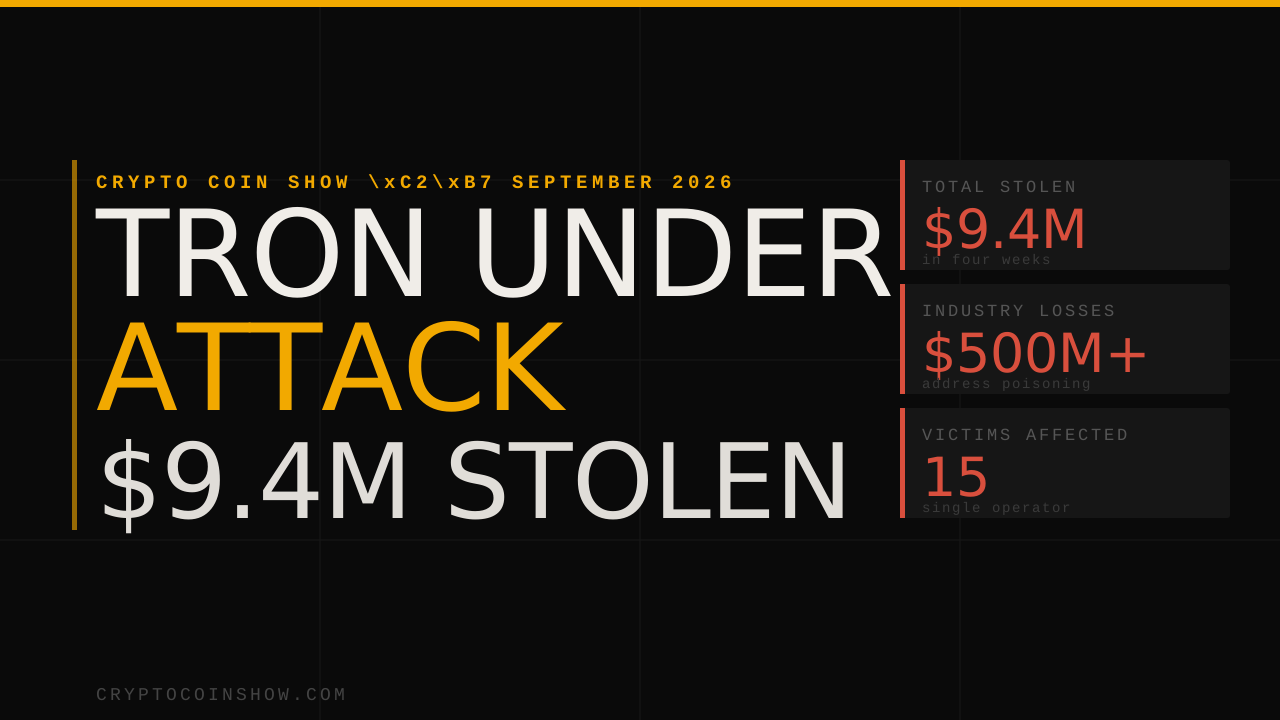
Tron wallet providers get called out as address poisoning attacks spread
A single operator has stolen $9.4 million from 15 Tron network users in four weeks using address poisoning, a low-tech attack that exploits wallet display defaults and wallet providers’ uneven security coverage across blockchains. The attack pattern reveals a critical gap in institutional crypto infrastructure: while Ethereum and EVM-compatible chains now have built-in defenses, Tron and other networks remain largely unprotected despite documented losses exceeding $500 million industry-wide.
- Single operator drained $9.4 million from 15 victims over four weeks on Tron network via address poisoning
- Two largest victims each lost $2.5 million; stolen funds swapped to USDD stablecoin and consolidated
- MetaMask and Trust Wallet protections work only on EVM chains, leaving Tron users exposed despite $500 million documented stolen
- $9.4M Total stolen from 15 Tron victims in four weeks by single operator
- $500M+ Confirmed stolen industry-wide through address poisoning attacks across all chains
- 34,000 Address poisoning attacks detected per hour across networks globally
Address poisoning attacks are accelerating across blockchain networks, but institutional investors and crypto firms remain exposed on non-EVM blockchains where wallet providers have not implemented defenses.
On-chain investigator Specter reported on August 27 that a single attacker operating on the Tron network had successfully stolen $9.4 million from 15 users within a four-week window using a technique that requires no sophisticated hacking tools, only transaction history manipulation and user inattention. The two largest individual losses each totaled $2.5 million.
After draining victim wallets, the attacker swapped the stolen funds into USDD, Tron’s native stablecoin, and funneled everything to a single consolidation wallet, a standard money-laundering pattern that buys time before withdrawal.
Bofur Capital’s $2 million loss exposes the mechanics of address poisoning on institutional wallets
The attack works because blockchain addresses are 42-character alphanumeric strings that are impractical for humans to verify character-by-character. Most wallet interfaces display only the first and last four characters, conditioning users to recognize addresses by these visible fragments alone.
An attacker exploits this by sending tiny amounts of cryptocurrency, called dust transactions, from a fake address that appears nearly identical to a real address the victim has previously transacted with, differing only in the middle characters users never see.
On August 22, investment firm Bofur Capital became a textbook victim. The attacker sent 0.0002 USDC from a spoofed address approximately 20 hours before Bofur intended to withdraw $2 million from the lending platform Compound. When Bofur’s team copied what they believed was Compound’s address from their recent transaction history, they instead selected the attacker’s fake address.
The thief received $2 million in USDC and immediately swapped it into DAI stablecoin to reduce the risk of the stolen funds being frozen or flagged by exchanges monitoring USDC transfers.
This pattern, dust first, then the real transfer 12 to 24 hours later, has become the standard playbook precisely because it maximizes the window for the victim to mistake the fake address for legitimate activity.
Analyst Stacy Muur documented this mechanism on August 26, explaining the cognitive vulnerability that makes the attack effective. Most cryptocurrency users, institutional and retail alike, have developed a habitual security shortcut: they verify addresses by checking the visible first and last segments rather than the full string.
This heuristic works fine for normal transactions but fails catastrophically against address poisoning because the attacker’s address passes the visual test.
MetaMask and Trust Wallet deployed EVM-only defenses, leaving Tron and other non-EVM chains unprotected
Wallet providers have begun deploying technical safeguards, but their protection is fragmented across blockchain ecosystems. MetaMask, owned by Consensys, now displays a warning when a user attempts to send funds to an address whose first and last four characters match a previous recipient but the middle differs substantially.
Trust Wallet went further in March by launching “Address Poisoning Protection,” which cross-references every destination address against a database of known scam addresses and shows a side-by-side character comparison if a match is detected.
However, both protections work exclusively on EVM-compatible chains: Ethereum, BNB Smart Chain, Polygon, and others that run the same virtual machine architecture. Tron, which operates on its own consensus mechanism and virtual machine, receives no such protection from either provider.
Trust Wallet has detected over 225 million poisoning attempts across its user base and confirmed that more than $500 million has been stolen through these attacks, averaging 34,000 attacks per hour across all networks. Despite this scale, the security infrastructure remains unevenly distributed, leaving users of non-EVM blockchains vulnerable regardless of which wallet they use.
The economic incentive structure accelerates attacks on cheaper blockchains. Lower gas fees on networks like Ethereum and Tron make mass dust transactions economically viable; an attacker can spray thousands of spoofed addresses at minimal cost and wait for statistically inevitable user errors.
These bulk dust campaigns also artificially inflate daily transaction counts on affected networks, a problem Ethereum has documented as increasing network analytics noise.
Industry calls for mandatory wallet protections remain unmet across multi-chain infrastructure
The scale of documented theft has prompted regulatory and industry pressure. In December, following a $50 million address poisoning theft, Binance founder Changpeng Zhao publicly called on all wallet providers to implement address poisoning detection and blocking across their supported networks. That call has not resulted in universal compliance or standardized defense mechanisms.
Wallet providers have been selective, prioritizing major EVM chains where their user bases concentrate while deprioritizing lower-volume networks like Tron, where institutional adoption remains smaller despite active use by hedge funds and trading desks.
For institutional investors managing multi-chain treasuries, this fragmentation creates operational risk. A firm that holds assets across Ethereum, BNB Smart Chain, and Tron receives best-in-class warnings on two of the three networks but zero protection on the third. The same internal process that works safely on Ethereum, copying an address from transaction history, becomes dangerous on Tron.
This inconsistency forces institutions to implement manual verification procedures at the human level rather than relying on wallet-layer automation.
The gap also reflects the broader challenge of blockchain security infrastructure development: wallet providers prioritize chains based on user concentration and revenue, not exhaustively across all networks their interfaces support.
Tron’s user base and transaction volume rank it among the top five blockchains globally, yet its address poisoning defense status lags significantly behind Ethereum and BNB Smart Chain. This lag creates a vector for sophisticated attackers to target institutional users they know are less protected.
Institutional treasurers must implement character-by-character address verification until multi-chain defenses reach parity
Until wallet providers implement poisoning defenses uniformly across all supported networks, institutional crypto holders operating on Tron, Solana, or other non-EVM chains must fall back on procedural safeguards.
The most reliable defense remains manual verification: checking every character of every destination address against the intended recipient’s official channels, not against transaction history alone.
Some institutional participants now require a second party to verify addresses independently before signing transactions involving high-value transfers, particularly on networks where wallet-layer protections do not exist.
The Bofur Capital incident and the broader pattern of $9.4 million stolen in four weeks on Tron suggest that the attack is not slowing despite growing awareness.
The combination of low economic barriers to attack and high user error rates means address poisoning will remain viable until either wallet providers achieve comprehensive protection across all chains or institutional practices universally adopt manual verification. The fact that major wallets have not yet extended their EVM protections to Tron indicates that change is not imminent.
The critical next step is whether MetaMask, Trust Wallet, and other institutional-grade providers will commit to shipping address poisoning defenses on Tron and Solana before the end of 2024, or whether treasurers will be forced to adopt