
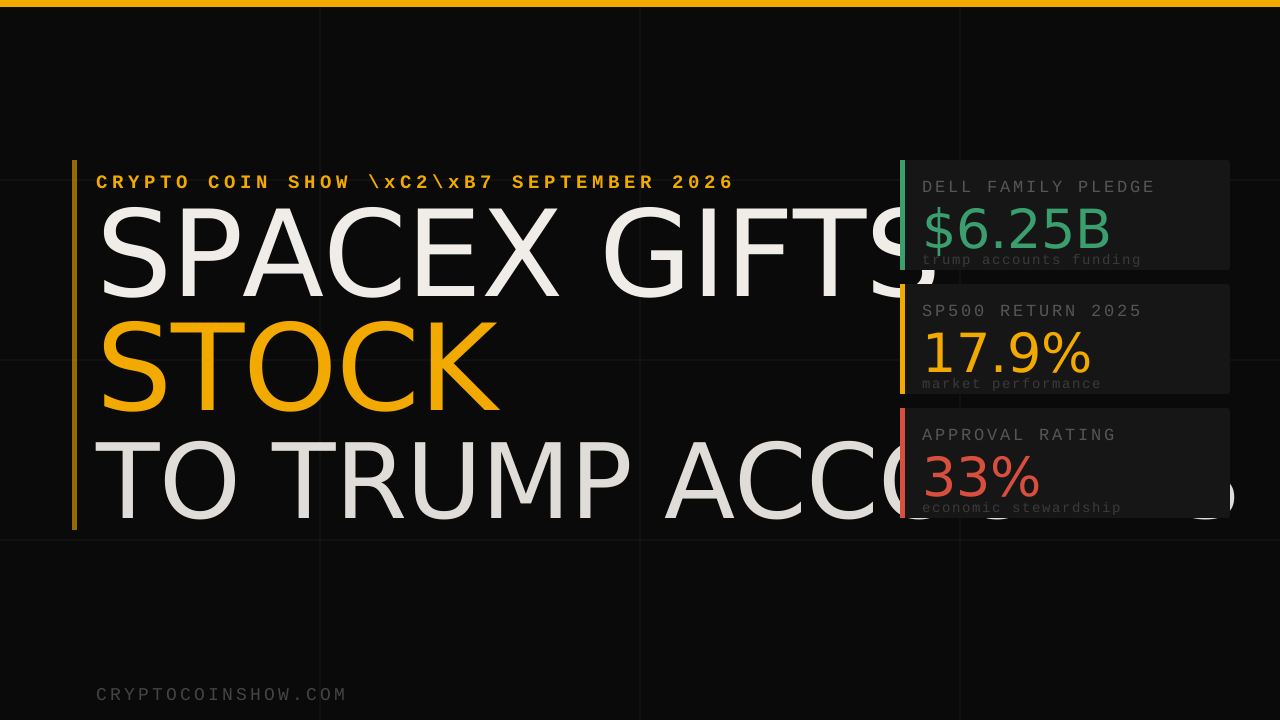
SpaceX gifts stock to Trump Accounts while Trump doubles down on the stock market
SpaceX president Gwynne Shotwell has pledged company stock to fund the Trump Accounts program, a new children’s savings initiative backed by multiple Fortune 500 companies and billionaire donors. The move signals corporate alignment with an administration heavily focused on equity market performance as a political metric heading into the 2026 midterm elections.
- Shotwell will distribute SpaceX stock across nearly 2 million Trump Accounts, with proceeds directed to children in central Texas.
- Micron committed $250 million, Dell family pledged $6.25 billion, and Intel and Robinhood joined the program before SpaceX.
- S&P 500 returned 17.9% in 2025, yet only 33% of Americans approve of Trump’s economic stewardship according to June polling.
- $2.4B Value of Shotwell’s SpaceX stake following the company’s record IPO last month
- 17.9% S&P 500 total return in 2025, following 25% gain in 2024
- 33% American adults approving Trump’s economic handling versus broader market strength
Gwynne Shotwell, president and chief operating officer of SpaceX, announced Monday that she will donate stock from her personal holdings to seed the Trump Accounts program, a federally-backed children’s savings vehicle launched July 4th that allocates $1,000 from the U.S. Treasury to each account for children born between 2025 and 2028.
The gift, shared between Shotwell and her husband, will be divided among close to 2 million accounts, with a focus on benefiting children in her home region of central Texas.
Shotwell’s pledge adds SpaceX to a growing roster of major corporations and ultra-high-net-worth individuals making public commitments to the initiative, a pattern that underscores the political salience of equity markets within the current administration.
Shotwell’s personal stake in SpaceX was valued at approximately $2.4 billion following the company’s record-breaking initial public offering last month.
Shotwell’s donation follows Trump’s prediction that Musk would join the program
Just days before Shotwell’s announcement, President Trump told CNBC’s Joe Kernen that he expected SpaceX chief Elon Musk to contribute stock to the accounts as well. Trump’s confidence in securing corporate participation reflects the political importance the administration has attached to the program and, more broadly, to sustained stock market gains as a policy achievement.
The timing of Shotwell’s pledge, coupled with Trump’s prior comments about Musk’s likely involvement, suggests a coordinated effort to demonstrate private-sector buy-in for the savings initiative.
Shotwell framed her donation in terms of intergenerational opportunity and gratitude for personal success.
“We have been fortunate in our careers and hope this gift encourages the next generation to continue the journey of enabling humanity to live and fly amongst the stars,” she wrote on X. The statement echoes language used by other wealthy donors, linking corporate philanthropy to narrative themes of American achievement and innovation that the Trump administration has emphasized.
Dell family pledges $6.25 billion while Micron commits $250 million one-time payment
The Trump Accounts program has attracted substantial commitments from Fortune 500 companies and billionaire families. Micron announced a one-time $250 million distribution to be divided among all children’s accounts in regions where the company operates.
Michael and Susan Dell stood beside Trump on Monday to announce their combined $6.25 billion pledge to the program, making it the largest single commitment to date by a significant margin.
Intel and Robinhood had previously announced their participation before SpaceX joined. Investor Ray Dalio made a separate personal pledge outside the formal program structure. The clustering of these announcements suggests that corporate participation has become a visible signal of alignment with the administration’s economic agenda, particularly as the 2026 midterm elections approach.
Trump joked that children had foregone gains simply because the accounts took time to launch, underscoring his focus on market performance as a tangible policy outcome.
Trump rings NYSE and Nasdaq opening bells from Oval Office to emphasize market gains
On the day the Trump Accounts program was highlighted, Trump rang the opening bells for both the New York Stock Exchange and the Nasdaq from the Oval Office, a ceremonial act that visibly linked his administration to market performance.
The S&P 500 climbed 17.9% in 2025, following gains of 25% in 2024 and 26.3% in 2023, a three-year run that forms the backdrop for Trump’s emphasis on stock performance as a measure of presidential success. Trump stated during trading that “it’s going to go up, I think the market’s going to go through the roof,” positioning continued gains as an inevitable outcome of his policies.
The administration’s strategy of tying political messaging to equity market performance reflects a deliberate effort to make stock gains a central component of his midterm campaign narrative. By creating the Trump Accounts program and securing corporate donations, the White House has constructed a visible, ongoing reminder of wealth creation under his administration.
The symbolic act of ringing the bell from the Oval Office amplified this connection, making the market’s performance a direct reflection of presidential authority rather than a distributed outcome of monetary policy, corporate earnings, and global conditions.
Yet only 33% of American adults approve of Trump’s handling of the economy, according to a June survey from The Associated Press-NORC Center for Public Affairs Research.
The disconnect between record equity gains and lukewarm public approval presents an unresolved strategic challenge for the administration’s midterm messaging.
While corporate participation in the Trump Accounts program demonstrates business-world alignment with administration priorities, the gap between 17.9% market returns and a 33% approval rating on economic stewardship suggests that stock performance alone may not translate into voter approval heading into November 2026.
Whether additional corporate commitments or sustained market momentum can narrow this approval gap remains an open question that will likely shape midterm campaign strategy in the coming months.
Corporate Donations Signal Bet on Sustained Market Rally Through 2026
The scale of pledges to Trump Accounts, totaling at least $6.5 billion across Micron, Dell, Intel, Robinhood, and SpaceX, represents an implicit wager by institutional leadership that equity valuations will remain elevated through the 2026 midterm cycle.
Unlike charitable giving tied to tax incentives or philanthropic missions, these commitments are explicitly structured around a federal savings program designed to demonstrate broad-based prosperity ahead of elections. This represents a shift in how Fortune 500 capital allocation intersects with political messaging.
The timing of these pledges mirrors a broader pattern: the S&P 500 gained 17.9% in 2025 after a 25% gain in 2024, yet only 33% of American adults approved of Trump’s economic handling as of June polling. This gap between market performance and public sentiment creates political pressure to demonstrate that growth benefits households beyond institutional investors.
Trump Accounts, by depositing $1,000 directly into savings vehicles for newborns, attempt to close that perception gap before the midterm electorate votes.
If the S&P 500 corrects by more than 10% before November 2026, the program’s messaging value could erode rapidly, potentially prompting either accelerated payouts to beneficiaries or reduced participation from future corporate donors weighing reputational risk against market volatility.