
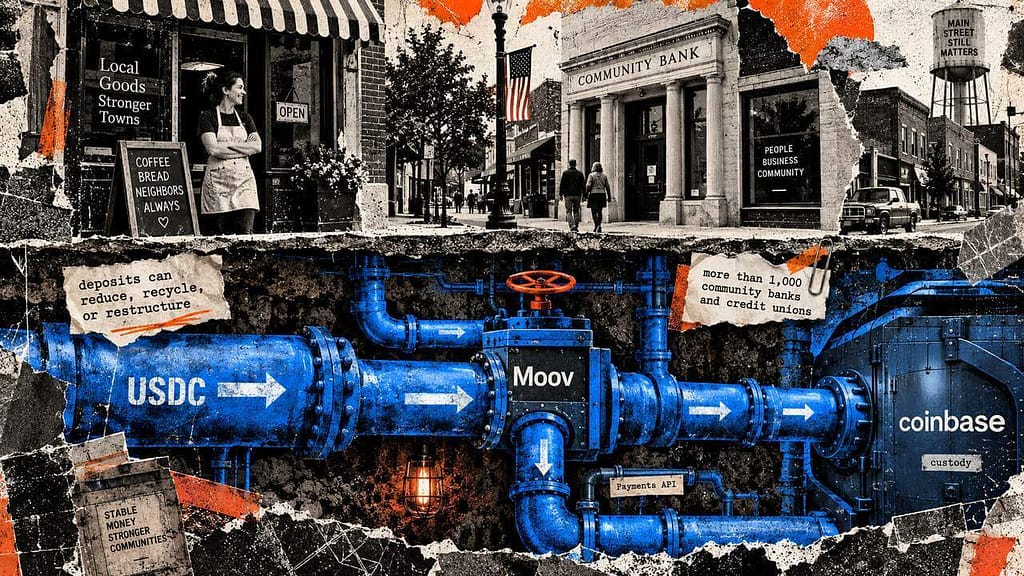
Moov embeds Coinbase stablecoin rails across 1000 plus community banks
Coinbase and Moov are embedding stablecoin payments directly into community banks’ existing platforms, letting local institutions retain customer relationships while outsourcing custody and transaction rails to Coinbase. The arrangement tests whether banks can stay economically relevant in crypto payments or whether they become mere distribution channels for larger crypto infrastructure providers.
- Moov integrates Coinbase’s custodial wallets and Payments API into its platform serving over 1,000 community banks and credit unions.
- Custody and stablecoin movement flow through Coinbase; the bank remains the customer-facing institution while Moov bridges the two.
- The partnership leaves unresolved who controls pricing, settlement destinations, customer data, revenue sharing and operational risk.
- 1,000+ Community banks and credit unions in Moov’s distribution footprint
- Sept. 10 Date the partnership was announced by the companies
- 3 Parties between a business customer and the stablecoin rail under the structure
Coinbase and Moov announced a partnership on September 10 designed to let community banks offer stablecoin payment services without building their own crypto infrastructure. Moov, a payments platform serving regional lenders, will embed Coinbase’s custodial wallet and stablecoin movement tooling into the systems that banks already use. The aim is straightforward: business customers currently leave their primary bank to access stablecoins. Under this model, they stay inside the bank’s payments experience while the institution outsources the technical heavy lifting to Coinbase. Banks are increasingly entering blockchain-based payment flows, and this arrangement lets community lenders compete without massive capital investment in crypto operations.
Moov places Coinbase infrastructure between bank and customer, creating a three-layer split
The partnership divides control across three entities. The bank or credit union owns the customer relationship and front-end interface. Moov supplies the payments-platform integration that connects those institutions to Coinbase. Coinbase provides custodial wallet accounts and Payments API orchestration for stablecoin movement and settlement. To the business customer, the service appears as a single bank offering, even though the underlying stack spans multiple providers.
The partnership announcement included no details on live deployments, implementation timeline or the number of Moov customer banks already signed on. The arrangement preserves the bank’s primary customer interaction but leaves unresolved the critical commercial terms: who sets prices, where balances are held, how revenue is split, who accesses transaction data and who bears operational risk when systems fail. Moov CEO Wade Arnold framed the demand plainly, businesses currently go outside their primary bank to buy stablecoins because their local institution cannot offer the service. This product keeps that conversation inside the bank’s existing channel.
Federal rules treat stablecoins and tokenized deposits differently, creating competing incentives
The regulatory landscape complicates the economics. An April 2026 proposed FDIC rule clarifies that if a bank holds deposits as reserves backing a payment stablecoin, those reserves receive corporate-deposit insurance under the stablecoin issuer’s account, not pass-through protection for stablecoin holders. A true tokenized deposit, one meeting statutory bank-deposit criteria, remains the issuing bank’s liability and can offer automatic FDIC protection regardless of how it is recorded on a ledger. The two instruments create different customer-protection profiles and different balance-sheet effects.
A Federal Reserve analysis published in December 2025 found that stablecoins can reduce, recycle or restructure bank deposits depending on who issues them and where they hold reserves. If a stablecoin issuer keeps reserves outside the banking system, deposits migrate away from retail banks. If reserves stay inside banks, deposits may flow toward large custodial institutions instead of returning to the community lender. For a regional bank, the risk is clear: stablecoin access can remove deposits from the institution even while the bank supplies customer distribution.
The Fed also identified partnerships and white-label infrastructure as tools to keep banks connected to digital payment flows, yet warned that stablecoins may sever the link between payment relationships and deposit-funded lending that has historically defined community banking.
Early deployments will reveal whether banks retain economics or become distribution-only channels
The real test comes in implementation. The announcement contains no numbers on committed institutions, pilot programs or expected launch dates, leaving the growth path opaque.
Adoption counts will show whether Moov’s 1,000-plus bank relationships convert into actual stablecoin volume. The choice of supported assets, the ownership of custodial balances and the settlement destination will reveal whether stablecoin activity benefits the originating bank or routes value to Coinbase and larger settlement institutions.
Commercial disclosures will matter equally: pricing structures determine whether the bank earns material revenue or mainly supplies distribution at thin margins, while data access and compliance allocation determine who deepens the customer relationship and who absorbs monitoring and regulatory burden.
Coinbase has given community banks a visible entry point into stablecoin payments with its infrastructure underneath. The unanswered question is whether banks will retain meaningful control over pricing, settlement, customer data and revenue sharing once live deployments begin, or whether they will function primarily as branded distribution channels for Coinbase’s custody and payment rails. Early adoption patterns and the commercial terms disclosed in pilot-bank agreements will answer that question.