
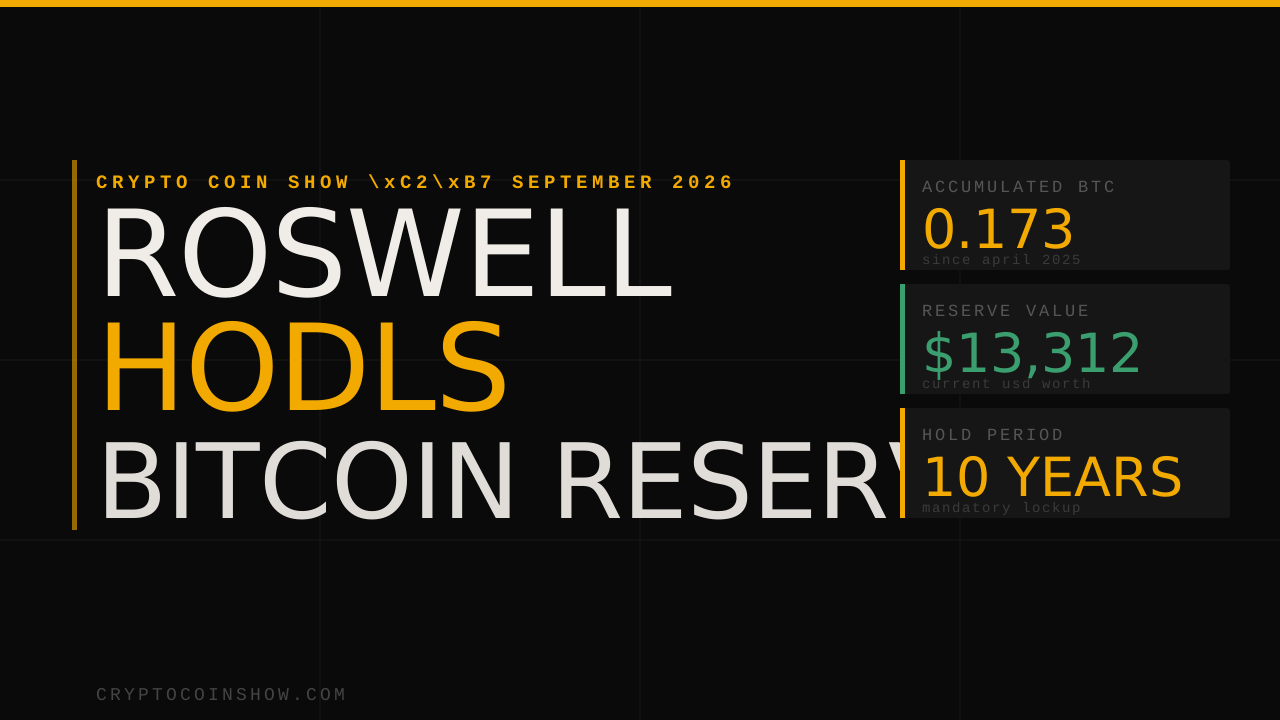
Aliens are buying Bitcoin as Roswell enacts a 10-year HODL ordinance
Roswell, New Mexico has become the first U.S. municipality to officially establish a Strategic Bitcoin Reserve, having accumulated 0.173 BTC worth approximately $13,312 through public donations since April 2025. The city has simultaneously enacted a 10-year holding ordinance that locks all Bitcoin donations and caps annual spending at 21 percent once the reserve exceeds $1 million in value, a framework that signals municipal governments are beginning to treat cryptocurrency as a long-term strategic asset rather than speculative holdings.
- Roswell’s Strategic Bitcoin Reserve received its first seed deposit of 0.0305 BTC (3,050,323 satoshis) valued at approximately $2,906 on April 29, 2025
- A 10-year mandatory holding period applies to all Bitcoin donations, with annual spending capped at 21 percent once reserves exceed $1 million in market value
- The reserve has grown to 0.173 BTC through subsequent anonymous donations from retail wallets and services including Robinhood, with no withdrawals to date
- 0.173 BTC Current balance of Roswell’s municipal reserve as of late May 2026
- 10 years Mandatory holding period for all Bitcoin donations under city ordinance
- 21% Maximum annual spending rate once reserve value exceeds $1 million threshold
Roswell, New Mexico has entered the institutional cryptocurrency landscape not through traditional finance channels but through grassroots Bitcoin donations, becoming the first U.S. municipality to formalize a Strategic Bitcoin Reserve backed by municipal ordinance.
The city’s reserve currently holds 0.173 BTC, equivalent to roughly $13,312 at prevailing market rates, accumulated through voluntary contributions since mid-April 2025. The first documented deposit, 3,050,323 satoshis valued at approximately $2,906, arrived on April 29, 2025, signed by Mayor Pro Tem Juliana Halvorson and Bitcoin advocate Guy Malone.
Since that initial contribution, the reserve has grown through deposits from diverse Bitcoin sources, including retail wallets and established exchanges like Robinhood, tracked and verified on-chain by analytics firm Arkham Intelligence.
Roswell Enacts 10-Year HODL Ordinance Restricting Municipal Bitcoin Sales
The Roswell municipal ordinance governing the Bitcoin Reserve imposes one of the most stringent holding requirements in American municipal governance: all Bitcoin donations must be held for a minimum of 10 years, prohibiting the city from liquidating holdings ahead of that deadline regardless of market conditions.
This framework directly addresses the volatility concern that has historically deterred institutional adoption of cryptocurrency by municipal governments.
By legally binding the city to a decade-long holding period, Roswell removes the temptation to sell during downturns or capitalize on short-term rallies, a structural commitment that mirrors the risk management strategies employed by sovereign wealth funds and endowments.
Once the reserve’s market value exceeds $1 million, annual spending is capped at 21 percent of total holdings, a withdrawal rate designed to preserve capital while generating sustainable revenue for municipal operations.
The 21 percent threshold is notably aggressive compared to traditional endowment spending policies, which typically withdraw 3 to 5 percent annually to maintain purchasing power.
This suggests Roswell’s ordinance prioritizes near-term municipal benefit over perpetual capital preservation, an approach that reflects the city’s positioning of Bitcoin as a complementary revenue source rather than permanent reserve.
The spending cap only triggers after the reserve reaches $1 million in total value, meaning the city will accept continued accumulation at current donation rates without pressure to monetize holdings in the near term.
Roswell’s UFO Legacy and Bitcoin Marketing Converge on Arkham Platform
Roswell’s identity as ground zero for American UFO folklore has intersected with its Bitcoin initiative in unexpected ways.
The city’s Arkham Intelligence profile, the on-chain analytics dashboard tracking the reserve’s holdings, features a customized avatar that blends extraterrestrial imagery with the Roswell Cosmicon logo, creating a visual narrative that links the 1947 UFO incident to contemporary Bitcoin adoption.
This symbolic branding may appear whimsical, but it serves a concrete function: it anchors Bitcoin donations to Roswell’s unique cultural identity and makes the reserve visible to cryptocurrency communities that overlap with UFO interest and alternative-culture audiences.
The 1947 U.S. Army Air Force announcement of a “flying disc” discovery near Roswell, later retracted as a weather balloon, created decades of conspiracy theories that transformed the city into a tourism and cultural hub.
That 1947 incident, despite official denials, created a lasting brand association with extraterrestrial mystery that few American municipalities possess.
By embracing rather than downplaying that association in its Bitcoin Reserve marketing, Roswell has effectively monetized its cultural capital, turning a historical accident into a differentiation strategy in the emerging municipal cryptocurrency space.
The city’s logo and public identity explicitly reference its UFO legacy, and extending that visual language to the Bitcoin Reserve signals that Roswell is not reluctant about cryptocurrency adoption but rather positions it as an extension of the city’s existing cultural narrative.
Donation Sources Span Retail and Institutional Wallets Without Centralized Funding Drive
The composition of Roswell’s Bitcoin donations reveals a decentralized funding model: contributions have arrived from multiple sources including retail wallets, exchange accounts, and what Arkham Intelligence has identified as various Bitcoin addresses spanning different custody models.
The first major donation involved explicit public acknowledgment by named officials, but subsequent contributions appear to have originated from anonymous donors who discovered the reserve through on-chain tracking or Bitcoin community channels.
This grassroots funding pattern contrasts sharply with traditional municipal bond issuance or grant-based revenue models, where a city would typically launch a formal fundraising campaign with identified sponsors and clear contribution schedules.
The inclusion of transfers from Robinhood, the retail-focused brokerage platform, suggests that individual investors, not institutional accumulators, are the primary donors at this stage. Arkham’s on-chain dashboard shows no outflows since the reserve’s inception, confirming that no Bitcoin has been sold or moved to cold storage independent of the tracking system.
The continuous balance increase shown in Arkham’s charts reflects two factors: organic donation growth and the appreciation of Bitcoin’s market price since mid-2025. Distinguishing between the two is crucial for institutional investors evaluating whether Roswell’s reserve represents genuine accumulation momentum or merely passive price appreciation of a small, static holding.
The fact that no withdrawals have occurred despite price volatility since April 2025 demonstrates that the 10-year ordinance functions as intended, locking in a commitment to holding regardless of short-term market conditions.
First Municipal Bitcoin Reserve Sets Precedent for Local Government Cryptocurrency Adoption
Roswell’s formalized Bitcoin Reserve represents a governance first in American municipal cryptocurrency policy.
Previous cities and states have expressed interest in Bitcoin, El Salvador adopted it as legal tender, and various U.S. jurisdictions have explored blockchain technology for land registries and permitting systems, but Roswell appears to be the first to establish a municipally authorized, legally binding reserve fund denominated in Bitcoin with explicit holding and spending constraints.
This precedent carries implications for institutional investors monitoring municipal government adoption of alternative assets, particularly as local governments face budget constraints and seek diversification beyond traditional Treasury bonds and municipal bonds.
The ordinance’s structural design, a decade-long lockup with capped annual spending above a $1 million threshold, creates a template that other municipalities could adopt and modify. If Roswell’s reserve reaches $1 million in value and demonstrates positive municipal benefit over the 10-year period, the model becomes politically defensible and potentially replicable in other jurisdictions.
Conversely, if the reserve stalls or Bitcoin experiences sustained depreciation, the political cost of defending a decade-long commitment to a volatile asset could discourage other municipalities from adopting similar frameworks.
The precedential weight of Roswell’s experiment will likely influence whether state governments authorize municipalities to hold Bitcoin as part of their treasury operations.
No other U.S. municipality has formalized a Bitcoin reserve through municipal ordinance, making Roswell an isolated test case rather than a broader trend, yet.
<p class="ccs-watch