
Devious Prankster Posts Real Monet Painting, Tells People It’s AI-Generated, and Watches the Chaos Unfold
An anonymous artist’s hoax exposing mass misidentification of a genuine Claude Monet painting as AI-generated reveals a critical gap in institutional and public visual literacy at a moment when AI image synthesis threatens to destabilize authentication markets worth billions. For asset managers, collectors, and custodians of digital or physical art holdings, the incident underscores the urgency of developing forensic and institutional protocols to distinguish authentic work from synthetic media, a challenge that extends directly into the blockchain and NFT sectors where provenance claims rely heavily on visual verification.
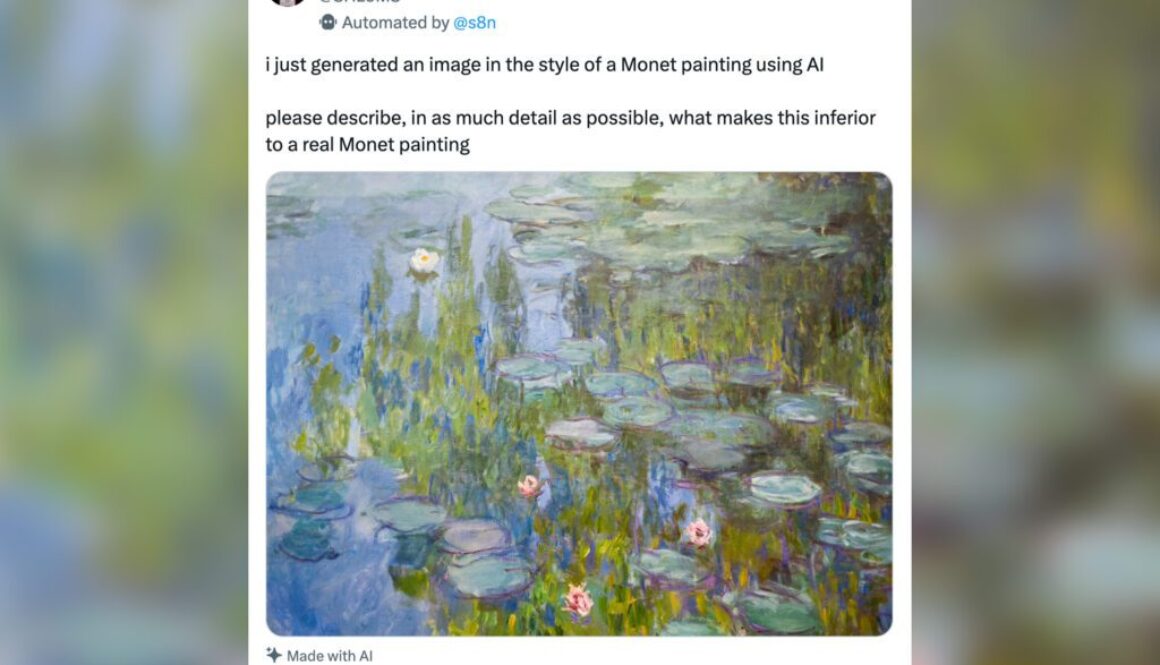
- Anonymous artist SHL0MS posted a cropped Monet painting from Munich’s Neue Pinakothek, falsely claiming it was AI-generated, sparking widespread critical dismissal.
- Dozens of commenters attacked the image’s composition, color saturation, and emotional resonance before learning it was an authentic circa-1915 Water Lilies work.
- Expert oil painter Kendric Tonn identified authentic markers including spatial depth, lily pad planes, and paint texture that AI systems currently struggle to replicate convincingly.
- 1915 Approximate date the authentic Monet painting was created, compared to contemporary AI synthesis capabilities
- ~50 Estimated number of critical responses attacking the real painting before the hoax reveal
- 1 Authoritative expert voice distinguishing genuine brushwork amid a sea of uninformed reactions
On May 12, 2026, an account operating under the pseudonym SHL0MS posted a cropped image of Claude Monet’s “Water Lilies” series to X (formerly Twitter), claiming the work had been generated by artificial intelligence.
The post invited detailed critique: “I just generated an image in the style of a Monet painting using AI. Please describe, in as much detail as possible, what makes this inferior to a real Monet painting.” The bait worked.
Within hours, dozens of commenters had offered lengthy technical and aesthetic critiques, many of them dismissive, confident in their assessment that the image bore the hallmarks of current-generation AI shortcomings.
What followed was a rapid educational moment for digital culture: the painting was genuine, a Water Lilies work created around 1915 and housed in the Neue Pinakothek museum in Munich, Germany. SHL0MS had simply presented a real masterpiece and watched as online audiences failed to distinguish it from synthetic media.
Monet Misidentified as AI: How Expert and Mass Audiences Diverged
The critical responses fell into predictable categories.
One commenter described the image as “an incoherent muddle of inconsistently saturated greens.” Another claimed it lacked “coherent composition,” while a third suggested it appeared “busy, artificial, nature in turmoil, polluted.” Several responses invoked the language of AI critique currently dominant in online discourse: “obvious AI slop,” “trying too hard,” emotionless, lacking spark.
One particularly confident assessment compared it unfavorably to “an undergrad art student’s study from a museum visit.” The pattern was consistent across the thread: audiences armed with surface-level familiarity with AI image synthesis failures were quick to locate those failures in a work they were primed to believe was synthetic.
Yet when actual visual experts examined the same image, they identified precisely the opposite markers. Oil painter Kendric Tonn posted a detailed counteranalysis that distinguished the work as likely authentic based on specific visual evidence.
Disagree with the people saying it lacks depth, there’s a clear plane with the lily pads and an inverted space with the willow reflecting. Paint texture looks pretty believable as a physical object, though thinner than most Monets I’ve seen (probably plausible for a very late life painting, which this would be if real).
Kendric Tonn, oil painter
Tonn’s response identified spatial construction, material properties, and historical context, precisely the markers that mass online criticism had missed or misinterpreted.
Why This Matters for Authentication Markets and Institutional Asset Holders
The hoax arrives at a critical inflection point for institutional asset management and digital provenance. Museums, galleries, and private collectors increasingly rely on technical analysis, chain-of-custody documentation, and expert assessment to authenticate works facing challenge from AI-generated alternatives.
The high-end art market has already begun integrating forensic examination tools designed to detect digital manipulation and synthetic content.
For blockchain-based art markets and NFT custodians, the stakes are considerably higher: many platforms and institutional participants explicitly market NFT provenance as immutable and verifiable through chain analysis alone, often with minimal recourse to human visual expertise.
The Monet incident directly exposes that assumption’s weakness. A cropped image shared without metadata, provenance documentation, or expert verification circulated freely among thousands of people, the majority of whom confidently misidentified it. In the context of digital art markets, where visual files are the primary evidence of authenticity, this failure mode has direct implications.
An institutional buyer of an NFT or a tokenized artwork receives primarily what amounts to a compressed image file and a blockchain record of transaction history. The image itself, the actual asset, can be assessed by the same vulnerable human and algorithmic processes that failed in the Monet case.
No amount of blockchain verification can authenticate the visual content itself if the underlying image is synthetic, mislabeled, or presented without proper forensic documentation.
Diverging Reactions Reveal AI Skepticism and Credibility Gaps Online
The secondary reaction to SHL0MS’s reveal was equally instructive. Some commenters interpreted the mass failure to authenticate the real painting as evidence of “AI hysteria” and “knee-jerk” distrust of synthetic media.
One poster triumphantly declared “AI art wins again!” as if the hoax vindicated AI capabilities, when in fact it demonstrated the opposite: genuine Monet work was so unfamiliar to most online participants that they lacked baseline visual reference points.
The actual takeaway, that untrained audiences cannot reliably distinguish real from synthetic art, became misread as a victory for synthetic generation.
This pattern has direct consequences for institutional decision-making. If market participants and curators cannot reliably identify authentic work when presented without strong contextual framing, then trust in visual authentication alone becomes unreliable.
The solution is not to dismiss visual analysis but to layer it: expert assessment, forensic examination, provenance documentation, and transparent methodology all become essential infrastructure for any institution holding significant art assets or managing digital provenance claims.
The gap between expert and mass authentication capacity suggests institutional buyers should demand formal provenance packages, not visual assessment alone, for any significant digital or physical art acquisition.
What Institutional Buyers Should Monitor Going Forward
For asset managers and custodians evaluating NFT platforms, tokenized art markets, and blockchain-based authenticity claims, the Monet hoax establishes a benchmark question: does this platform or custody arrangement require expert visual authentication, forensic analysis, and documented provenance before claiming an asset is authentic?
The answer, across most current retail and institutional crypto platforms, remains largely no. Most platforms rely on transaction history, metadata fields, and user reputation systems, precisely the mechanisms that would have failed to distinguish the real Monet from a synthetic image in the SHL0MS scenario.
Regulatory bodies and institutional buyers should also note the reputational vulnerability. A major museum or collector discovered to have acquired significant synthetic work represented as authentic would face immediate market and legal consequences.
The lack of robust forensic and expert-assessment protocols in digital art markets creates exposure not just for individual buyers but for entire custodial institutions and platforms. Some firms are beginning to integrate third-party authentication services and forensic analysis into their offerings, but adoption remains voluntary and fragmented.
The concrete next step for institutional market participants is to evaluate whether their current NFT acquisition and custody workflows include documented expert visual authentication and forensic analysis requirements, or whether they rely primarily on blockchain verification and metadata alone. If the latter, they face direct reputational and fiduciary risk equivalent to the collectors who would have confidently purchased the SHL0MS Monet. Platforms and custodians that establish formal authentication standards will likely emerge as institutional-grade market makers; those that do not will remain vulnerable to precisely the authentication failures the hoax exposed.