
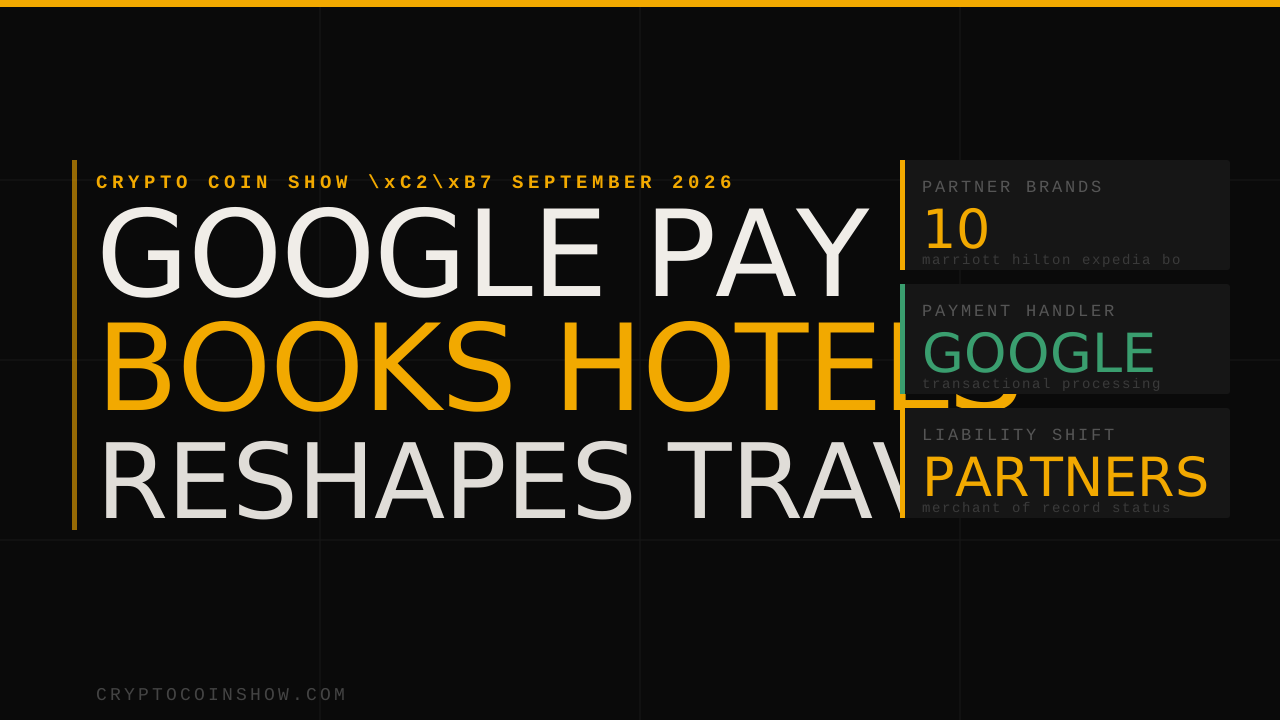
Google Pay closes the hotel booking while the partner keeps the support desk
Google has launched transactional hotel booking within its AI Mode search interface, allowing US users to complete reservations through Google Pay while partner chains retain merchant-of-record status and customer service responsibility. This move signals how major tech platforms are embedding commerce directly into search and AI experiences, a shift institutional investors should track as it reshapes the travel vertical and sets a template for fintech integration across verticals.
- Google Pay now processes hotel bookings for ten travel brands including Marriott, Hilton, Expedia, and Booking.com, with payment handled inside Google’s interface.
- Hotel partners retain merchant-of-record status and handle all customer service, keeping Google’s liability isolated to the checkout layer.
- Flight price tracking is live in 180+ countries; loyalty points pricing debuts with six airline and hotel brands, expanding in coming weeks.
- 10 hotel and booking partners launching hotel checkout in US rollout this week.
- 180+ countries and territories where flight price tracking now operates globally.
- 6 loyalty programs supporting miles and points pricing at launch, expanding imminently.
Google on Thursday rolled out hotel booking functionality within its AI Mode search experience, allowing US English-language users to discover properties, compare rates and guest reviews, and complete transactions via Google Pay, all without leaving Google’s interface. The move marks the company’s first full transactional push in travel since it promised the feature in November 2025.
Ten travel brands have signed on for the launch: Booking.com, Choice Hotels International, Expedia, Hilton, Hotels.com, IHG Hotels & Resorts, Marriott International, Priceline, Trip.com, and Wyndham Hotels & Resorts. The feature is rolling out over the coming weeks in the US.
The architecture preserves a deliberate split between Google’s commerce layer and partner liability.
Google controls discovery and checkout; hotel chains bear customer service risk
When a user enters travel preferences into AI Mode, the system returns hotel options ranked by guest reviews and price comparisons. Upon selection, a “Continue on Google” button appears, triggering Google’s payment and booking interface.
The room type, cancellation policy, and guest information are collected and processed through Google Pay within Google’s own UI. Only after that does the transaction move to the hotel chain or booking platform that serves as the merchant of record.
This design hands Google control over discovery and the final transaction moment, the highest-value moments in digital travel commerce, while outsourcing merchant liability, refunds, cancellations, and dispute resolution to the partner.
As James Byers, Group Product Manager for Search, explained in the official announcement: “When you book hotels through AI Mode, the hotel or booking platform will act as the merchant of record and handle any customer service.” The structure mirrors the fintech playbook Google has used in other verticals: own the customer moment, outsource the regulatory and operational burden.
For institutional investors, the significance lies in how Google is consolidating travel commerce discovery and payment into its search monopoly. Users currently visit Google to search for hotels, then click out to OTAs or direct sites to book. Now that handoff is collapsing.
Google keeps the session, captures payment data via Google Pay, and controls the user experience end-to-end up to settlement. The hotel chains and OTAs retain the transaction record and customer service obligation, a trade-off that improves Google’s stickiness while shifting fulfillment and chargeback risk to their partners.
Flight search expands globally; loyalty points pricing debuts across six programs
Simultaneously, Google expanded its flight tools within AI Mode. The system now allows users to search by departure and arrival city, dates, and airline preferences, surfacing options priced by more than 300 partner airlines and travel sites.
Unlike hotels, flights do not complete within Google’s interface; users build the itinerary in AI Mode and then transition to the airline or booking platform of their choice to purchase. Google has added price tracking functionality, users can set alerts to monitor fare changes, and that feature is now live in more than 180 countries and territories.
The most significant addition is loyalty point and miles pricing. Six programs launched with the feature: Alaska Airlines, Hawaiian Airlines, American Airlines, Choice Hotels International, Hilton, and Wyndham. Users can now ask AI Mode to price a route in airline miles instead of cash, for instance, “show me Atlanta to Miami on American miles”, and receive the redemption cost directly.
Accor, Flying Blue, Hyatt, LATAM Airlines, and Lufthansa Group will be added in coming weeks. The feature is available globally, a reversal from the hotel booking rollout that remains US-only.
The loyalty pricing layer is institutional-grade infrastructure that monetizes customer intent data while deepening Google’s integration into the frequent-traveler ecosystem. Airlines and hotels spend significant resources managing loyalty program inventory and redemption.
By embedding that directly into search, Google becomes the interface through which high-value loyalty members discover and execute redemptions. The company captures telemetry on which programs are searched, when, and by whom, data that compounds its competitive advantage in travel advertising and personalization.
Google delivering on nine-month commitment; restaurant and event booking also live
The hotel and flight rollout fulfills a public promise Google made in November 2025. At that time, Search VP of Engineering Julie Farago announced that Google was collaborating with Booking.com, Choice Hotels, Expedia, IHG, Marriott, and Wyndham to enable users to complete bookings with their partner of choice for flights and hotels, a capability that was then future-looking.
That same November post also announced agentic booking for restaurants via OpenTable and Resy, and for events through Ticketmaster. Those features have since launched, establishing a pattern: Google announces transactional ambitions months ahead, signs marquee partners, then rolls out in phases.
The timeline and partner roster are notable. Google secured commitments from every major hotel chain and OTA, Marriott and Hilton represent roughly one-third of US hotel rooms; Expedia and Booking.com dominate metasearch, suggesting Google negotiated from a position of overwhelming leverage.
The partners agreed to accept Google as an intermediary at the payment and checkout layer, a significant concession that would have been unthinkable five years ago when Google faced antitrust scrutiny over preferential treatment in search results.
The hotel booking launch demonstrates that Google has either resolved those concerns with regulators or is confident the transactional benefits justify the regulatory risk.
The rollout also reinforces a pattern Google established with shopping and product links last September.
AI Mode shopping surfaces now include bookable inventory and dynamic pricing
In September 2024, Google began displaying shoppable product links and AI-generated images directly in search results via AI Mode. That feature removed friction from product discovery to purchase consideration. Thursday’s travel booking update applies the same logic to high-intent queries in a vertical, travel, where transaction values are significantly higher than apparel or electronics.
A user searching for a Marriott room now receives not a list of links to visit, but an interactive interface where the booking happens inside Google’s property.
The implication for fintech and embedded commerce is structural. Each vertical, shopping, travel, dining, events, represents an opportunity for Google to compress the distance between intent and transaction. By controlling that moment, Google captures payment data, session behavior, and repeat usage patterns.
For payment processors and travel platforms that historically owned direct customer relationships, the shift means accepting Google as a distribution intermediary and yielding customer data insight to Google in exchange for bookings that might not have happened otherwise.
Institutional investors should monitor three concrete developments ahead: whether hotel chains and OTAs disclose booking volume and margin impact from Google’s channel in quarterly earnings (a signal of whether this is incremental demand or cannibalization); whether the US hotel rollout expands internationally or remains US-only, suggesting regulatory friction in other markets; and whether Google expands transactional booking beyond travel into restaurants, services, or ticketing, a move that would confirm this is a platform strategy rather than a vertical experiment.