Scottish hacker sentenced to six years for 11.6 million crypto theft
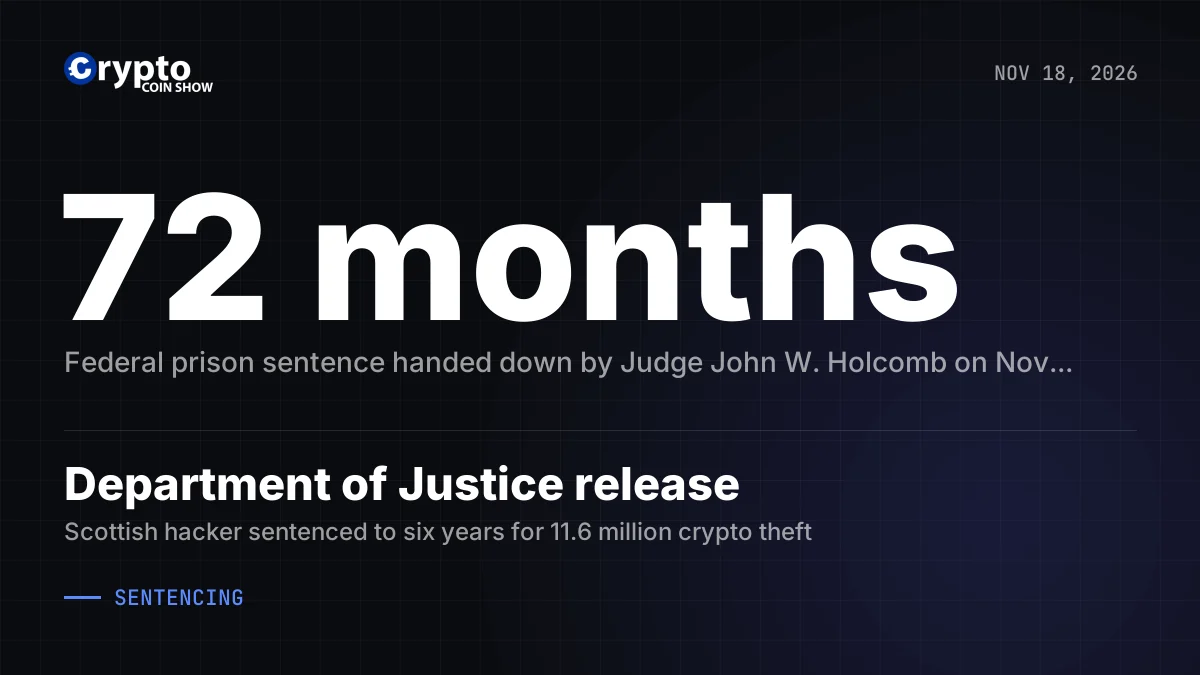
A Scottish national was sentenced to six years in federal prison today for orchestrating a hacking and cryptocurrency theft scheme that targeted employees at a dozen major companies and individual crypto holders across the United States. The conspiracy, which ran from September 2021 to April 2023, used text message phishing and SIM-swap attacks to steal at least $11.6 million in virtual currency.
- Perpetrator: Tyler Robert Buchanan, 24, of Dundee, Scotland, pleaded guilty to conspiracy to commit wire fraud and aggravated identity theft
- Theft amount: At least $11.6 million in virtual currency stolen from individual victims throughout the U.S.
- Method: SMS phishing attacks impersonating companies or their IT suppliers, followed by SIM swaps to bypass two-factor authentication
- 72 months Federal prison sentence handed down by Judge John W. Holcomb on November 17
- $11.6M Total virtual currency stolen from individual victims across multiple conspiracy incidents
- 5 of 5 Co-defendants sentenced; Buchanan is the final defendant in the case
The U.S. Attorney’s Office for the Central District of California announced the sentencing of Buchanan, who had been in federal custody since April 2025. The conspiracy targeted interactive entertainment companies, telecommunications firms, technology companies, cloud communications providers, virtual currency companies, and individual crypto holders across the United States.
SMS Phishing and SIM Swaps as Entry Points
Buchanan and his co-conspirators sent hundreds of SMS phishing messages to employee mobile phones, impersonating victim companies or their contracted IT and business process outsourcing suppliers. The messages contained links to fraudulent websites designed to harvest confidential information including usernames, passwords, and personally identifying information.
Once the conspirators obtained stolen credentials, they used them to access company computer systems and extract confidential work product and employee data. They then used that same information to target individual victims’ virtual currency wallets and accounts.
Defeating Two-Factor Authentication Through SIM Swaps
To gain access to crypto accounts protected by two-factor authentication, Buchanan and others conducted SIM-swap attacks. “SIM swapping” is a technique in which a criminal fraudulently induces a mobile carrier to reassign a cell phone number from the legitimate subscriber’s SIM card to a SIM card controlled by the attacker without authorization.
This allows the attacker to intercept SMS-based two-factor authentication codes and gain full account access.
At his Scotland residence in April 2023, Buchanan possessed files containing cryptocurrency seed phrases and login information for victim accounts, along with names and addresses of numerous individual victims.
Four Co-Conspirators Sentenced Earlier
Buchanan is the fifth and final defendant to face sentencing in this conspiracy. Ahmed Hossam Eldin Elbadawy, 25, of College Station, Texas, was sentenced on September 18 to 45 months in federal prison. Evans Onyeaka Osiebo, 22, of Dallas, Texas, received 45 months on August 14. Joel Martin Evans, 27, of Jacksonville, North Carolina, is serving two years. Noah Michael Urban, 22, of Palm Coast, Florida, is serving a 10-year sentence after pleading guilty to three fraud-related counts in April 2025.
What the Document Does Not Say
The sentencing memorandum does not specify which virtual currency companies or exchanges were targeted, or whether any of them experienced direct loss versus indirect facilitation of theft from their users’ personal wallets.
The document also leaves open whether Buchanan’s co-conspirators controlled or operated any of the phishing infrastructure themselves or whether they purchased it from other criminal groups.
Judge Holcomb scheduled a restitution hearing for December 11, which will determine how much Buchanan must repay victims. The document does not disclose the total restitution amount sought or any recovery efforts from cryptocurrency proceeds.
The CCS read. This case demonstrates how SMS phishing, a low-friction attack vector, combined with SIM swaps remains devastatingly effective against individual crypto holders even after years of warnings. The targeting of employees at crypto companies and BPO/IT suppliers suggests the conspirators understood that compromised work credentials lead directly to access of customer funds, a persistent vulnerability in custody infrastructure where human identity and account control remain linked to phone numbers.
Restitution hearing scheduled for December 11, 2026. The hearing will determine the amount Buchanan must repay victims; the document does not state whether proceeds already recovered from seized cryptocurrency assets will reduce the final restitution order.
Lead image: Crypto Coin Show. Source: Department of Justice release